We’re not where we used to be

You should be redirected to the new address. If that doesn't happen in a second, visit
http://short-sharp-shock.blogspot.com
Oh, and update your bookmarks. Thanks.

Wednesday, November 15, 2006

Meet the new math

The pursuit of revisionist mathematics by White House senior adviser, Deputy Chief of Staff and Prince of Darkness Karl Rove continues, even in the face of a clear and resounding election defeat.

Some of the latest evidence of that is the Nov. 12 interview Rove conducted with the Washington Post’s Peter Baker. In that interview, Rove bends over backwards to elaborate on the mistaken calculus he used before the election to explain why the Republicans would again prevail where it counts, at the polls.
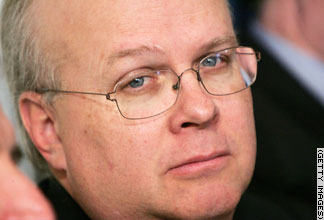
But despite all of his errant figuring, it is clear from the outcome of the election that Rove, like his party, truly underestimated the impact of the Iraq war on the hearts and minds of the voter. The Architect is a man clearly not above building a house whose foundation sits squarely in the middle of a swamp.

Bear in mind, the words “swamp” and “quagmire” are hardly antonyms.

Denial persists in the White House. To judge from the post-election expressions of the faces of Rove and White House Chief of Staff Josh Bolten, as they attended a press conference where their boss, President Bush, offered his own election postmortem, you’d think they had won. They wouldn’t have looked any different if they had.

Part of this is testosterone bravado. The glass-jawed palooka who gets his brains beaten out in the ring still musters up that little shred of ego after the fight. As he staggers to his feet to shake one of his opponent’s six hands, the expression flits across his face: “You didn’t hurt me that bad. I want a rematch. This was nothing!”

Bolten and Rove looked like that, in the Washington style. But despite their tough-it-out attitude, there’s been some piling on by a multitude of conservative friends presumably in their corner: Richard Perle, Richard Viguerie, Andrew Sullivan, David Gergen, and more besides.

Talking with The Post’s Baker, Rove reflected an inability to work that math he’s been so proud of. From Baker’s story:

“In an expansive interview last week, Rove said [his election] strategy was working until the House page sex scandal involving ex-representative [Mark] Foley (R-Fla.) put the Republican campaign "back on its heels," as he put it. ‘We were on a roll, and it stopped it,’ he said. ‘It revived all the stuff about Abramoff and added to it.’

“The various scandals surrounding convicted lobbyist Jack Abramoff and other ethics allegations, Rove said, had as much, if not more, to do with the defeat than the Iraq war. In Rove's analysis, 10 of the 28 House seats Republicans lost were sacrificed because of various scandals. Another six, he said, were lost because incumbents did not recognize and react quickly enough to the threat. That leaves 12 other seats lost, fewer than the 15 that Democrats needed to capture the House. So without corruption and complacency, he argued, Republicans could have kept control regardless of Bush's troubles and the war.”

With such reveleations, it’s clearer than ever that Rove just doesn’t get it, doesn’t appreciate the deeper reasons for the GOP defeat on Nov. 7 and 8. Last we heard, for example, corruption and complacency were good reasons for turning a Congress out.

Rove rationalizes away the election results with a conveniently tidy argument courtesy of Sen. Joseph Lieberman of Connecticut.

“ … if Iraq is the determining factor and it is a dominant opinion, then in a blue state like Connecticut you should not have 60 percent of the voters vote for one of the candidates who said, 'Stay, fight and win,' " Rove told Baker, referring to Lieberman’s victory over challenger Ned Lamont while running as an independent candidate. “I don't deny that it's a factor, but it is hard to declare" it was the leading factor, Rove told Baker.

It's a narrow view, and utterly reflexive in its partisanship. Rove forgets that Lieberman also had the long-term accumulated goodwill a favorite son acquires after almost 20 years in Congress, and more years in state government.

Rove needed to look a few states over, at Rhode Island, and the more emotionally typical case of Lincoln Chafee, a sitting liberal Republican senator beloved by his party and moderate Democrats alike – a man sent packing on Nov. 7 largely because the citizens of Rhode Island voted this time to send more of a message about the party than about the candidate.

Rove goes on to intimate that losing 28 House seats, six Senate seats and the congressional majority was no big deal, since it was, to quote Baker quoting Rove, “roughly comparable to losses suffered by the party in the White House in the sixth year of other presidencies.”

The very idea that Rove would try to compare this administration’s sixth year to that of “other presidencies,” utterly failing to understand the unique nature of this particular debacle in the making, indicates the depth of the disconnect between Rove and a large segment of American reality.

Much of the post-election Republican thinking seems to embrace the idea that the losses at the polls were the result of a momentary miscalculation. In the eyes of Rove and the Republican leadership, the GOP’s failure has been ascribed to either a mammoth (if single) misinterpretation of polling data and intelligence, or a single equally mammoth deus ex machina (like either of the Abramoff or Foley scandals) that arose to pervert the inevitable.

What’s largely missing from Republican retrospectives is glaringly obvious:

First, the Republican Party failed to hold its majorities in Congress because of a fundamental shift in the mindset of the American public, a change created and intensified by the needless slow undoing of the war in Iraq. Second, the Republicans lost because they didn't appreciate the gravity of that change in American thinking, relying instead on the habits of hubris to rescue them again, and totally failing to see the ways in which the voters made this election as much a referendum on the country's direction as the one we'll be having in less than two years' time.

Whether his miscalculation lasts will play itself out over the next two years, as the Democrats take the congressional reins. But however narrowly, Karl Rove misread the numbers, and this time it was the bigger numbers. This time, Bush's number-crunching brain couldn't handle the tidal arithmetic of the American mood.

Friday, November 10, 2006

Changing all the drapes

Tuesday was a day of rare events. The National Aeronautics and Space Administration reported that the planet Mercury passed between the earth and the sun in an infrequent celestial transit. The five-hour event, NASA says, was visible in parts of North and South America, Australia and Asia, and won't be repeated until sometime in 2016.

Equally rare, and no less momentous for some of us who inhabit the American corner of the third stone from the sun, is the outcome of the 2006 midterm election, a national canvass that saw a sea change in congressional leadership on Capitol Hill. With stunning swiftness, Americans turned out in near-record numbers for a midterm vote and transferred control of Congress to the Democrats for the first term since the Newt Gingrich-authored Contract on America in 1994.


It was more than a shot across the bow of the Bush administration; the outcome was a sound rebuke of administration policies, most notably the approach to prosecuting the war in Iraq.

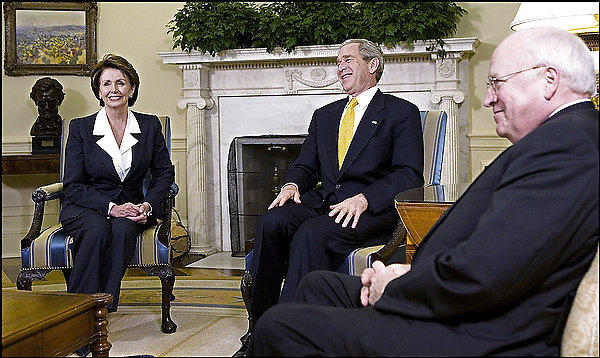
The good news for Democrats actually unfolded over Tuesday and Wednesday. When the election was over on Tuesday, it was clear the Democrats had exceeded their own expectations of victory. Pundits like Craig Crawford at Congressional Quarterly and Charlie Cook at the National Journal had long predicted gains for the Dems in the House of Representatives. True to form, when the votes were counted, the House had overwhelmingly changed hands, with no fewer than 33 seats moving from the Republican side of the aisle to the Democrats. In the process, the change also ushered in the pending escalation of Rep. Nancy Pelosi of California to be Speaker of the House, the first female speaker in American history.

So chastened, President Bush walked Wednesday morning down the long red-carpeted hallway of the White House leading to the East Room, where the press was waiting, the president's face betraying in glimpses the expression of a man about to ascend the steps to the gallows.

"Say, why all the glum faces?" Bush asked the scribes assembled there, mentioning nothing of the glum faces that must have haunted the West Wing in the hours before.

The president went on to formally concede the outcome. "The Democratic Party had a good night last night," he said. Then, alluding to a comment he made days earlier about the Democrats presuming victory to the point of ordering new drapes for the offices in the House, Bush acknowledged speaking with the Speaker-to-be. "And in my first act of bipartisan outreach since the election, I shared with her the names of some Republican interior decorators who can help her pick out the drapes for her new offices," he said.

That backhanded concession was only part of the story. What made the change in leadership so satisfying for the Democrats was the fact that, when the president conceded defeat, the second shoe -- the outcome on the vote count for seats in the Senate -- hadn't yet dropped.

That other Florsheim dropped soundly about 9 p.m. Wednesday night (probably after Bush had gone to bed), when word trickled onto the wires that the one race still outstanding -- the Senate race in the state of Virginia, bastion of the Confederacy, bulwark of the Southern strategy -- was over. Democratic challenger James Webb had by slightly more than seven thousand votes defeated incumbent Sen. George Allen, to become the senator-elect, thus completing an historic reordering of the national political calculus.


There was gravy on the icing on the cake for the Democrats. No sooner had the Democrats solidified their hold on the House than news came from the White House that Secretary of Defense & Hawk-in-Chief Donald Rumsfeld, the lightning rod for administration policies in Iraq, had tendered his resignation effectively pretty much immediately.

The Seattle Post-Intelligencer perfectly captured the moment in huge type on the front page: BLUE WAVE.

The weakness of the Republican strategy for this midterm was almost immediately obvious in retrospect. At his first Wednesday news conference, on the strength of some of his comments, it was clear that President Bush had been relying on the pocketbook issues -- the stellar status of the stock market, the steadily decreasing price of a gallon of gasoline -- to exonerate him and his party at the polls, and validate the trajectory, and the tragedy, of the war in Iraq.

But the voters saw no daylight between the issues. The war -- its cost in lives and limbs, money and materiel, global prestige and gravitas -- was as pressing a matter to John & Jane Q. Public as the price of unleaded at the neighborhood Texaco. And maybe more.

"You are entitled to your math, and I'm entitled to the math," White House senior adviser and Prince of Darkness Karl Rove told a National Public Radio interviewer before the election, after NPR dared suggest the Democrats might win.

Rove was last seen scuttling out of the White House with a box of Milton Bradley arithmetic flash cards.

# # #

Where things go from here is still to be seen. The Bushies made the obligatory overtures to bipartisanship, and not just talk about the drapes.

"It is our responsibility to put the elections behind us and work together on the great issues facing America," Bush said after huddling with his Cabinet, and with House and Senate Republican leaders. "Some of these issues need to be addressed before the current Congress finishes its legislative session, and that means the next few weeks are going to be busy ones."


But already the White House is said to be ready to dig in its heels on everything from execution of the Iraq war -- a matter you'd think was pretty well decided by the election! -- to the future of the National Security Agency's domestic wiretapping program, to the prospects for John Bolton, the U.S. ambassador to the United Nations who got the job as a recess appointment who bypassed the usual Senate hearings.

And then there's the little matter of judicial nominations. To judge from the early reactions from the Democrats, no doctrinaire strict constructionists need apply. "Send us more moderate people or don't waste your time," Sen. Dick Durbin of Illinois told The New York Times. And Durbin should know: as a member of the Senate Judiciary Committee, he'll be in a yea-or-nay position to approve those nominees. or not.

"This isn't my first rodeo," Bush said Wednesday morning with an insincere cockiness, before the bull had stormed all the way out of the gate, before the dimension of the Republican shellacking was fully known.

The stage is now set, poliltically, for what will clearly be his last.

Tuesday, September 5, 2006

See it then

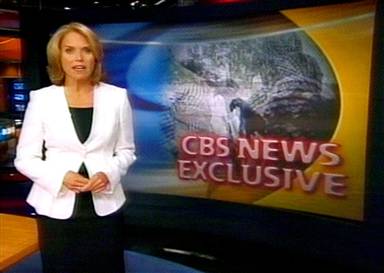
With a white jacket, a brisk but agreeable pace, a command of the telelanguage and a whole lotta leg, the unretouched Katie Couric inaugurated the new format, style and focus of the CBS Evening News – the same day (in American time zones at least) that Princess Kiko gave birth to a son to assume the Chrysanthemum Throne. A crisis of succession was averted in each of their respective empires.

It’s yet to be seen how the first male heir to Japanese empire in four decades will do; he as yet has issued no statements. But for Couric, the first official solo female anchor of an American network news broadcast, the stakes are high with her every statement, much like the speculation of what the Couric era ushers in.


The runup to this seems to have gone on forever, with the network dropping choice tidbits of information from time to time: the new theme was written by James Horner, the celebrated film composer (“Titanic”); a change in the customary interactive style between anchor and audience may be in the works.

Apparently the change at the top wasn’t enough for CBS News, whose photo retouching department – apparently not chastened by that little issue with the photographer upbraided for tweaking the smoke billowing from a war zone into something physically impossible – decided to digitally cut several pounds from the waistline of Couric, twice a mother.

Doing that may have won Couric some humanity points before she even went on the air; weight is everyone’s problem; the fact of her middle-aged spread – and the classy way she dealt with the issue (saying that despite the retouched photos, “there’s more of me to love”) could quietly endear her, in the short term at least, to millions of Americans fighting the same battles.

The touts at BetCRIS Sportsbook, a wagering company with twenty-one years experience, posted odds a few days earlier:

How many viewers CBS Evening News will have on Katie Couric’s first day:

LESS THAN 6.5 MILLION 12 to 1
BETWEEN 6.5 AND 7.0 MILLION 6 to 1
BETWEEN 7.0 AND 7.5 MILLION 3 to 1
BETWEEN 7.5 AND 8.0 MILLION 4 to 1
BETWEEN 8.0 AND 8.5 MILLION 4.75 to 1
MORE THAN 8.5 MILLION 3.75 to 1


But from the opening, it was clear that Couric has undertaken nothing less than the full transformation of her earlier persona, the period defined by the P-word better used as the name of Barbie’s poodle. “This is the CBS Evening News with Katie Couric,” said the voice-of-God doing the intro, the VOG being that of Walter Cronkite, fatally dealing a blade of pure gravitas to the throat of Perky.

But Uncle Walter notwithstanding, if the debut is any indication, Couric has a lighter, almost breezier touch than her predecessors. The stories whip by at a speed that seems even faster than usual in a twenty-two-minute broadcast. The first Couric broadcast is heavier on feature news than in the past, a legitimate nod to her experience and connections in the wider cultural arena of features and entertainment. The one coup of the evening was CBS' score of the cover of the new Vanity Fair magazine, with Tom Cruise and Katie Holmes, posing with the First Ever Photos of their daughter Suri, until that moment the most illustrious nonentity in modern times.

She went back to the feature well with "Free Speech," her stab at vox pop interactivity, "giving people a forum to express themselves, unfiltered and uninterrupted," in a segment that could yield both NPR-style "This I Believe" testimonials and expressions with the irascible tendencies of Andy Rooney. Morgan Spurlock, director of "Supersize Me," had the first crack, with an essay on the myth of America's red-state, blue-state dichotomies.

And Couric again dug deep into the features dept. well to come up with a retro segment called "Snapshots," a look back at some news event from the past (as recorded on the kinescopes and early videos of CBS News back in the day). “Snapshots” seems to borrow from the heyday of Life magazine’s “Miscellany” feature. Again, that word, feature. For the hardbitten journalists either part of or enamored of an era of harder evening news, feature is still an almost dirty word. They’re bound to weigh in tomorrow with a downbeat assessment of how Couric performed in her debut.

And to some extent they’ll have a point: When an anchor’s got about twenty-two minutes to get in the whole shot – to give people a meaningful, literate, visually appealing capsule of the day’s most pressing events – the choices that anchor makes, in an increasingly competitive telescape populated by increasingly impatient information surfers, say as much about the anchor as about the audience. And maybe more. With a debut newscast so locked into the world Couric supposedly vacated in May, there’s likely to be a concern that CBS’s reputation as the journalistic leader in the evening news – a reputation redolent of the gravity of Murrow and Sevareid and VOG Cronkite – will take a big hit under Couric.

But this is only day one, and Couric has already advised us to think of her newscast, at least in the early going, as a work in progress. She’s learning to make the right choices. It’s like shot selection for the ambitious but untried star of a basketball team; he sees himself draining it from the top of the key when he’s really better working the inside game. It takes time to find that out.

So tonight will definitely be the exception that proves the rule that is yet to be laid down. The Tiffany Network finally has someone at the helm of the news division who can actually wear Tiffany. Let’s see how she does.

And that means not just tonight. Hell, everybody tunes in the first night to get that first-blush, bragging-rights experience of seeing the carnival show when it first pulls into town. Let’s come back tomorrow and tomorrow and tomorrow, see what unfolds.

Anybody can see it now. But Katie Couric’s pledged to be something different in the world of television network news.

Let’s see it then.

Wednesday, August 30, 2006

Immoral confusion

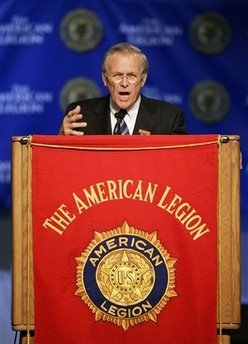
Secretary of Defense & Hawk in Chief Donald Rumsfeld defended the war effort in Salt Lake City yesterday at the annual American Legion convention, Rummy the early wave of the administration's assault on the national attention span in this, the runup to the fifth anniversary of the Sept. 11 terrorist attacks. In his address Rumsfeld invoked what's become the new hot-button word in the West Wing. Fascism, and its noun and adjectival variants, are all the rage. The secretary ran down a series of the most high-profile recent terrorist attacks, knitting a weave of connection between 9/11 and attacks in Bali, London and Madrid.

“I recount this history because once again we face similar challenges in efforts to confront the rising threat of a new type of fascism,” he said.

The American news media have tended to emphasize the negative rather than the positive, the secretary said. The AP reported that Rumsfeld said more media attention was given to U.S. soldiers’ abuse of Iraqi prisoners than to the fact that Sgt. 1st Class Paul Ray Smith received the Medal of Honor.

Rumsfeld was forthright enough to admit that, thanks to the abuse at Abu Ghraib and recent accusations of atrocities by Marines against unarmed civilians, the U.S. military has "bad actors — the ones who dominate the headlines today — who don't live up to the standards of the oath and of our country."

But mostly it was a rather punitive history lesson, hard on the press and its responsibility to ferret out the truth, intolerant of criticism, insistent on a dubious historical linkage. This was Rumsfeld's America.

It may well have been, as the Rev. Al Sharpton observed on “Hardball” on Aug. 29, “an insult to the intelligence of the American people.” But bad as that is, it's only part of the problem. Before the American Legion membership, Rumsfeld made the comparison of opponents of the Iraq war with those who appeased the Nazis before World War II, in virtually the same breath proposing to put the nation on alert against “the rising tide of a new type of fascism.”

The illogic isn’t hard to follow: the secretary of defense proposes to prepare America for fighting a new kind of war – waged against an enemy with no uniform, no borders, no formal military or governmental or geographic foundation – by invoking the symbolism and associations with a war that ended three generations ago.

Who best, then, to lead the nation’s military might but a resolute cold warrior insistent on fixing shapeless conflicts of the present and the future within the very frames of reference he says are obsolete? The very nature of fascism requires a fundamental government structure, something at odds with today's amorphous asymmetricality of war with a loose network of zealots, those practicing radical perversions of a venerable, honorable faith. Rumsfeld’s tortured reasoning is at war with itself. It's apples and oranges on a global scale.

Rumsfeld, Secretary of State Condoleezza Rice and others within the administration have to get their collective mind around the idea of abandoning the shopworn conceptual terminology of Winning and Losing. Just as the theater and context of warfare have changed, so, too, must change the traditional zero-sum game, winner-take-all notions of victory and defeat. In an information age rife with spin and nuance and 24/7 exposure, with audio-video and Internet technology the new universal enabler, "victory" and "defeat" are terms subject to manipulation, how well they’re shaped, how well they’re put across by any actor in a war at any given time.

In classic terms, the Hezbollah guerrillas were largely routed from strongholds in southern Lebanon: weapons confiscated, leadership impacted, if not severely damaged. But the Hezbollah have demonstrated an ability to rebound and to assist, in practical cash-on-the-barrelhead terms, the Lebanese people in the recovery from 34 days of bombardment and attacks by the Israeli Defense Forces. For better and possibly worse, Hezbollah has taken a page from the Israeli manual for survival – inventiveness, drive, solidarity, financial wherewithal – and taken unto itself the role of winner in the conflict, altering, at least in the short term, the traditional roles of Winning and Losing a war in the twenty-first century.

The primary theater for the war in Iraq is not territorial, it’s religious and philosophical, but that’s not to say that territory doesn’t have a role in the prosecution of this conflict. With control of the oil fields constantly shifting, with Shiite and Sunni sectarian violence increasing, and with the leader of Kurdistan, Iraq’s restive northern enclave, announcing a plan to stop flying the Iraqi national flag within his autonomous region, it’s clear that territory is the other prime mover of actors in this war. Iraqi Prime Minister Nouri al-Maliki, for all of his ostensible national authority, is in practical terms not much more right now than the Mayor of Baghdad. "Winning" and "losing" are for him words whose meanings shift, however slightly, every day.

"Victory" and "defeat" are terms that fail to embrace the complexity of what’s taking shape in Iraq. They reflect an almost-colonialist mentality, an attempt to impose an absolute Western-style solution on a region rife with tribal and social ambiguities we cannot now understand. New ways of thinking about this conflict are what’s needed – maybe, even probably requiring new people to do that new thinking.

It’s that necessary flexibility of planning and foresight, the capability to get beyond the institutional comfort zone that is its own Washington monument to stasis and inertia, the ability to think outside the box – to think outside the room the box is in -- that’s lacking in Foggy Bottom these days.

President Bush set the tone a few weeks earlier, with the use of the phrase "Islamic fascists," a frightening juxtaposition that few scholars and not near enough journalists have noted. The prevailing administration notion of conflating a government with a religion is monstrously problematic; it short-circuits the ability to discern, brief enough already in the Internet era; it makes it easy to see the enemy anywhere and everywhere, on the weakest pretext, with only the slightest provocation. We’re seeing that now. An Arab student living in the United States is briefly barred from boarding his JetBlue flight at Kenendy airport because he’s wearing a T-shirt with a pacifist slogan written in English … and in Arabic script.

This is Rumsfeld’s America. The loyal opposition are traitors and defeatists. Staying an incrementally disastrous course is the only option. But in Rumsfeld’s America are embodied bedrock principles that are, finally, un-American. The very idea that dissent against the war is immoral, criminal behavior strikes at the heart and bone of what makes us a democracy -- makes U.S., surely, The Democracy.

It’s the right to stand alone in the crowd and call the emperor on his imaginary wardrobe.

It’s the right to have a dissenting opinion, even if dissent is the only reason for having it.

It’s the right to exercise the contrary impulse, and the willingness to acknowledge that right in others the way you’d take it for yourself.

Keith Olbermann got it right. The host of MSNBC's "Countdown," making an unusually pointed and personal comment on the program, was pitch perfect in his assessment of Rumsfeld's comments, and what they mean to America in the wider sense of who and what we are as a nation:

Olbermann said Rumsfeld’s statement “did not merely serve to impugn the morality or intelligence -- indeed, the loyalty -- of the majority of Americans who oppose the transient occupants of the highest offices in the land. Worse, still, it credits those same transient occupants -- our employees -- with a total omniscience; a total omniscience which neither common sense, nor this administration’s track record at home or abroad, suggests they deserve.

"Dissent and disagreement with government is the life’s blood of human freedom; and not merely because it is the first roadblock against the kind of tyranny the men Mr. Rumsfeld likes to think of as “his” troops still fight, this very evening, in Iraq. It is also essential. Because just every once in awhile it is right and the power to which it speaks, is wrong. ...

"This is a Democracy. Still. Sometimes just barely. And, as such, all voices count -- not just his.

"Had he or his president perhaps proven any of their prior claims of omniscience — about Osama Bin Laden’s plans five years ago, about Saddam Hussein’s weapons four years ago, about Hurricane Katrina’s impact one year ago — we all might be able to swallow hard, and accept their “omniscience” as a bearable, even useful recipe, of fact, plus ego.

"But, to date, this government has proved little besides its own arrogance, and its own hubris. ...

"In what country was Mr. Rumsfeld raised? As a child, of whose heroism did he read? On what side of the battle for freedom did he dream one day to fight? With what country has he confused the United States of America?

"The confusion we -- as its citizens -- must now address, is stark and forbidding. But variations of it have faced our forefathers, when men like Nixon and McCarthy and Curtis LeMay have darkened our skies and obscured our flag. Note -- with hope in your heart — that those earlier Americans always found their way to the light, and we can, too."

Sunday, August 20, 2006

Lookin' for God in the unlikely places

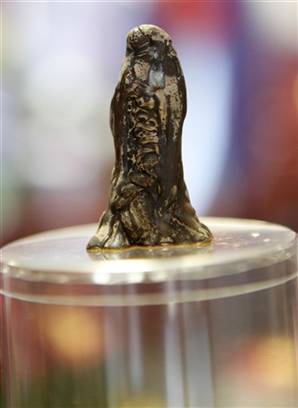
Could it be another sign of the End Days? In Fountain Valley, Calif., chocolate has assumed the status of divinity, and not pecan divinity, either. The Virgin Mary has been detected in a hunk of chocolate. Turns out that a gourmet chocolate shop has discovered a two-inch column of chocolate droppings that some store workers swear has a resemblance to the Virgin Mary.

The Associated Press reported that workers at Martucci Angiano's gourmet chocolate company, Bodega Chocolates, discovered the mini-ziggurat of chocolate. Since the discovery, AP reports, "Angiano's employees have spent much of their time hovering over the tiny figure, praying and placing rose petals and candles around it."

Cruz Jacinto, the kitchen worker who found the lump of melted chocolate when she began her shift, said she froze when she noticed the shape: Jacinot told AP it was a ringer for the Virgin Mary on the prayer card she carries in her right pocket.

"When I come in, the first thing I do is look at the clock, but this time I didn't look at the clock. My eyes went directly to the chocolate," said Jacinto. "I thought, 'Am I the only one who can see this? I picked it up and I felt emotion just come over me. For me, it was a sign."

For Cruz Jacinto, it was as real as real gets -- and who's to say she's out of line?

Now, we've been here before, folks. In the not so distant past, eBay has posted offers from people bearing a variety of ordinary artifacts with some purportedly divine connection ... or at least a visual resemblance to something symbolizing a divine connection between deity and man. Weeping madonnas, tears of what looks like blood on the face of Christ on the cross, the image of Jesus beatifically encrypted in the bread of a grilled cheese sandwich ...

It would be truly comical if it didn't say so much about who and what, and where, we are. Talk about contradictions: Right now the rise of spirituality in American life is perfectly logical. It just makes sense. Given the impact of fighting wars abroad and cultural wars at home, and a rapidly shifting sense of American identity, people are hungry for connection to something that stays in place, something reliable, or at least something representing something reliable. When the contours of the known world grow too sharp and confining, there's a retreat to the solidity of faith, a belief in the evidence of things not seen.

And faith is not a flimsy, threadbare phenomenon in America. Just ask Cruz Jacinto.

Oh you could say that she and thousands and thousands of other Americans are overdoing it, letting their faith color their judgments and movement in the secular world. Or you could just write it off as the steadfast belief of a devout animist, one of those who see the spiritual presence in just about everything.

But there's no getting around it, for the chocolatiers in Fountain Valley or anywhere else in the nation. LIke Bono, we still haven't found what we're looking for, and we're looking everywhere. Let's face it: When you're looking for God in a grilled cheese sandwich, you're hungry for something more than a grilled cheese sandwich.

Thursday, August 3, 2006

Ad nauseam

Kicking the lizard to the curb, maybe

How can this be? Is the GEICO Gekko – that witty, foreign-born reptilian symbol of the insurance arm of the Berkshire Hathaway empire – on his way down the drain?

We’ve seen him for a few years, at least, spreading the good word about how “15 minutes can save you 15 percent on car insurance.” He’s gone from being a nonentity in the GEICO operation to being hailed as employee of the month … all the way to making guest appearances on “talk shows,” preaching the company evangel to anyone who’ll listen. Only now, it appears he’s in the process of being replaced by a whole new cast of characters – some of them more animated that the lizard himself.

GEICO has rolled out its new ad campaign, one that plays on a straight man/wild man formula: Real GEICO customers are paired with exuberant public figures; their experience at getting claims settled quickly is contrasted with the celebrity’s “interpretation” of the customers’ experience with claims and customer service.

And so placid real-life GEICO customer Denise Bazik is paired with Little Richard, rock’s eternal freakazoid shouter. The customer’s real-life story is simple enough: On a Thanksgiving holiday she hit a deer. Little Richard: “Look out … somebody help me!” Bt thanks to GEICO’s quick claims service, the problem is resolved happily. On to Grandman’s house. Little Richard: “Mashed potatoes and gravy, and cranberry sauce! Wooooooo!”

Or there’s genial Stanley Smith, the gentleman who’s twinned with the forever bubbly and fully upholstered flamenco guitarist Charo, star of, well… star of Charo. The gentleman’s straightforward explanation of how GEICO services worked for him after wrecking a car he loved is translated in Charo’s effervescent Spanglish, virtually of it spoken too fast for transcribing here.

Then there’s Brenda Coates, who sits at a piano beside a somewhat ghoulish Burt Bacharach, the enduring songwriting legend, at the woman’s side like some lounge vulture from Vegas, audibilizing her automotive misfortune in supper-club style.

Her car, it seemed, was struck from behind by another GEICO customer. Bacharach croons: “I got hit in the rear …

Like with all the others, GEICO comes to Ms. Coates' rescue: Matter resolved. Bacharach again: “And I hope I never get hit … in the reeeear again.”

Not a lizard in sight anywhere – and that’s curious given one of his own pronouncements. “People trust advertising icons,” the Gekko says in one of the TV spots – which begs the question of why it seems at least possible he’s on his way out, why GEICO would throw over one of the best brand-associative symbols in the car insurance business.

Maybe the little bastard’s just planning a long vacation: kickin’ it with Winnie the Pooh and the Taco Bell Chihuahua on Ibiza for a month or so. Maybe they’ll bring him back in the fall with his own talk show. Who knows? But whether this is just a brief hiatus in the beast’s march toward world domination of car insurance or he’s gone for good, the Gekko lays claim, at least, to having made car insurance advertising more fun than it has any right to be.

Compensating for everything

It’s getting ugly in America, on the road and off. Competition is fierce and in a hot and angry nation, there’s not much room for second place. Bring it.

That’s the hyper-aggressive subtext for Hummer’s new ad campaign, a blatant nod to our more atavistic tendencies, and that American appeal for instant gratification.

The ads are an indication that the Hummer division of General Motors has finally, fully embraced its outsider status, a status maybe never more contrarian than in today’s $3-a-gallon-plus period, when we wince at the pump at least twice a month. Even with improved fuel economy, the Hummer’s as much a symbol as a vehicle. The two newest TV spots for its 2006 H3 model own up to it in bold, red-meat style.

In the first ad, two guys in a checkout line are contrasts in the moden male. The first guy’s groceries are health food gone overboard: tofu, leafy vegetables, superfood of every description. Btu he glances back at the guy behind him, clearly stocking up for a barbecue: charcoal, ribs, chips –guy food, food for a manly man.

After glancing at a Hummer ad in the magazine rack, Guy #1 leaves the grocery store in disgust. In ten seconds he’s parked his old car, driven to his neighborhood Hummer dealer, picked out the 2006 of his choice, transferred the groceries, grabbed the keys and driven away. To a carnivore-rock soundtrack, over the image of a satisfied customer biting into a carrot are superimposed the words “RESTORE THE BALANCE.”

(An interesting choice for a tag line – especially when you consider that, when the new campaign was first launched, the original words were “RESTORE YOUR MANHOOD.” Yeah, it made buying a Hummer too gender-specific, and left out half the possible population of buyers.

But you’re also inclined to think that somebody at GM thought that was going a shade too far; quiet as kept, men are sensitive to any idea of a relationship between the size of their vehicles and the size of, shall we say, their most personal machinery. Cooler heads at the rewrite desk prevailed.)

The second ad is equally direct. On a playground, kids are taking turns climbing a slide, under the watchful eyes of two mothers. One of the kids cuts in front of the other in a line that isn’t really a line in the first place.

“Oh, I’m sorry Jake was next,” slender Wimp-Mom says to hefty Bitch-Mom, standing beside her.

“Yeah? Well, we’re next now,” Bitch-Mom says to Wimp-Mom, who stands there for a few seconds, looking bereft, vacant, waifish, whipped.

A bus bearing a huge Hummer ad rolls by … and in the ten seconds of her transformation, Wimp-Mom gathers her son, drives away, heads to her neighborhood Hummer dealer, picks out the 2006 H3 of her choice, signs the contract with an emphatic flourish, straps the boy in the back, snatches the keys from the salesman’s hands and drives away. To Ruth Brown's "This Little Girl's Gone Rockin," and over the image of a woman determined to cut that heifer at the playground off in traffic if she sees her again, we see the superimposed words “GET YOUR GIRL ON.”

Hey, the ladies like a hit of testosterone too, now and again.

It’s all a little unnerving somehow, this appeal to our baser aspects despite the price of gas and the likelihood for more increases in that price because of continuing, and newly evolving, instability in the Middle East. The phrase “fiddling while Rome burns” doesn’t quite bring home the gravity of the situation. But on we roll, with bigger cars with more horsepower and more tailgating and angrier drivers – our own little Moebius strip of madness in passive-aggressive America, where everybody compensates for everything.