We’re not where we used to be

You should be redirected to the new address. If that doesn't happen in a second, visit
http://short-sharp-shock.blogspot.com
Oh, and update your bookmarks. Thanks.

Monday, January 23, 2006

The 'Brokeback' effect

To get a true fix on the battleground where the culture wars are being played out today, you don’t have to go any further than your friendly neighborhood multiplex. Ang Lee’s deceptively understated but emotionally resonant “Brokeback Mountain” has taken point in what James Dobson, the two Pats (Robertson and Buchanan) and the other presumptive generals of what they would surely call “the culture wars.”


But Lee’s film has caught them off guard if not flat-out by surprise; there’s a sense that as “Brokeback” gathers momemtum in the drive toward the Oscars, more than a few of them the usual rock-ribbed conservatives now frantically leafing through their strategy playbooks looking for a way out of a dilemma of identity. Since its release, conservatives have gone out of their way to keep the film, a story of two cowboys and the romantic relationship developing between them – on the margins of respectability and acceptabililty. The right wing is in full cry right now, for at least two reasons:

The first is because of the film’s unexpected penetration into American life. The conservatives had no doubt already conceded some of the cultural high ground to the film’s reception in some quarters. They’d forgone the usual suspect audiences for “Brokeback Mountain,” the coastal cultural centers like San Francisco, Seattle, Los Angeles, New York and other liberal enclaves the conservatives have already written off as the charnel houses of Satan.

What has to rankle the conservatives is the way in which “Brokeback Mountain” has broken through, trickled down and burrowed into the broader American consciousness, and done so with a deft touch and lightning speed. It’s broken out of the isolated audiences of the cognoscenti ¬– generally the film scholars and critics and fans on either coast – and burst into the American heartland, become something that people all over America are talking about, whether they’ve seen the film or not.

A host of critics from other publications across the country have come up with hosannahs of their own, independent of whatever the major papers thought. And “Brokeback” generated its popular attention by having the towering nerve to successfully assail the celebrated cowboy esthetic, the foundational Marlboro Man archetype that is one of the country’s most iconic and deeply-held self-images.

That’s buzz that no studio can buy, and no right-wing position paper or appearance on "Meet The Press" can counteract. “Brokeback Mountain” is the film this year with the kind of ineffable buzz that defies conventional marketing schemes (even as it thrives on them) and confounds the political strategy of division and accusation. “Brokeback Mountain” is the New – not just the new (as in that which is so-and-so’s new film or an old and recognizable gem just released on CD or paperback) but something that truly refracts the familiar light of our everyday assumptions, our national mythology, in a way that reveals us to ourselves – and the conservatives aren’t equipped right now to deal with the New.

This leads to the second way in which the conservatives have been effectively outflanked: Because of its relatively broad appeal at different levels, including the box office, “Brokeback’s” success undercuts any right-wing claim that such a film demonstrates fiscal irresponsibility on the part of the studios. The fact that such a successful film has been financed, marketed and distributed by a major studio whose parent is accountable to investors and shareholders is a plain indicator of the studios’ willingness to paint outside the usual comfortable creative lines – and to do it to great effect on the bottom line.

“Brokeback’s” success sends the clear signal that, contrary to many assumptions, the creative forces that made the film have a better sense of the public mood, a better more accurate track of the American psyche, than the conservatives who rail, profane and fight tooth & nail against both the expression of the life experiences in “Brokeback” and the real-life experiences themselves.

In this little pitched battle for public opinion, at least, the conservatives are thus denied the high grounds of American iconography, populist sentiment, and any hope of winning arguments about a company’s fiduciary responsibility by adhering to “American values.”

Truth is, “Brokeback Mountain” has blindsided the conservative politicians like it hit the rest of us. The way in which the film has witnessed its steadily increasing audience is problematic to those who would frustrate creation of a national community as indifferent to sexual orientation as it tries to be to race and gender.

Sometimes in the culture, a profound shift happens. And sometimes when that seismic shift happens, it’s not because of a Titanic Moment. Sometimes, it’s smaller. It’s often quieter, less big-sky bombastic than the advertisement campaign mounted to promote it.

It can be the kind of motion picture in which the actors are the best special effects, as great actors usually are. It can be a story of two lonely wounded people striving to survive and thrive in a brittle and indifferent world, people very like us in a world very like our own. And in its understatement, that story can shake the rafters of the national complacency, and rattle the walls of our understanding of what it means to be a human being.
-----
Image credit: Focus Features

Thursday, January 19, 2006

History repeating

Walter Leland Cronkite Jr., 89 years young, has graciously offered to pinch-hit as anchor on the “CBS Evening News,” should they come calling in their endless hunt for a permanent anchor. Bob Schieffer’s been doing admirably well in the position pro tem, and the Tiffany folks have been drooling after Katie Couric for months; we’ll see where that goes.

But if dear Uncle Walter never plays another down of anchor-chair football, his greatest service in the era After Cronkite may be what he said recently, in a case of (possibly) history repeating itself.

Speaking at the Television Critics Association Winter Press Tour in Pasadena Calif., and responding to a question about American involvement in Iraq, Cronkite said, boldly, plainly, “it’s my belief that we should get out now.”

It was a reiteration of something he said in 2004, when he criticized the invasion of Iraq the year before, saying that the American people were no safer from terrorism because of the invasion. Now, in post-Katrina America, Cronkite brilliantly established a linkage between the first disaster and the second one, still playing itself out in New Orleans.

“We had an opportunity to say to the world and Iraqis after the hurricane disaster that Mother Nature has not treated us well and we find ourselves missing the amount of money it takes to help these poor people out of their homeless situation and rebuild some of our most important cities in the United States. Therefore, we are going to have to bring our troops home.”

You can quibble with his rationale for using a natural catastrophe at home as a way of extricating the nation from the manmade debacle of elective war. But there’s no escaping the connection of the nation’s sad response to Katrina and the money and manpower in Iraq lost to recovery efforts in Louisiana. And there’s no way around the historical parallels of this recent statement with one he made on Feb. 27, 1968, in the heat and height of the Vietnam War.

That night, at the end of a documentary made after a visit to Vietnam during the January Tet offensive, Cronkite said on the air that the war was unwinnable and that U.S. forces should get out. From the bully pulpit of a network anchor’s chair, Cronkite said the emperor was naked and accelerated the tide of public opinion against the war. That great unraveling took another five years, but Cronkite’s statement – a departure from journalism’s storied objectivity – made it plain that the end of public support, if not the conflict itself, was very much in sight.

In today’s multichannel crazyquilt of television news, it’s hard to imagine someone with that kind of avuncular gravitas, that kind of moral authority stepping forward and saying the same thing. Cronkite is one of the last living holdovers from the era when three broadcast networks dominated the airwaves, from a time when the national attention span was more focused.

But there’s no spin the administration can put on this case of history repeating. Cronkite’s statement in 1968 was a journalistic seismograph warning of the social earthquake to come. We may not be so subject to persuasion today, in 2006, but Cronkite’s more recent assessment weds us to the wisdom of his earlier one -- "We have been too often disappointed by the optimism of the American leaders, both in Vietnam and Washington, to have faith any longer in the silver linings they find in the darkest clouds” -- and to another warning, that sobriquet by George Santayana …

You know the one ... about being doomed to repeat the lessons you didn’t learn the first time.

Thursday, January 12, 2006

While you were shopping

Happy new year. We made it. While you were shopping the after-Christmas sales and snoring off the last of the champagne, a Nobel-winning economist came up with the bill the United States can expect to pay for the war in Iraq. You think you've got a big post-holiday bill? Try $2 trillion.

Two trillion dollars. More money than God and Oprah combined can lay claim to. But that's the projection of the long-term costs, direct and indirect, for the Iraq conflict, according to a study released Jan. 9 by Columbia and Harvard universities. The study, written by Columbia economist Joseph E. Stiglitz -- a Nobel economics laureate in 2001 -- and Harvard lecturer Linda Bilmes included disability payments for the 16,000 U.S. soldiers wounded in the war, Reuters reported.

The study assessed a variety of ways such costs would trickle down to the average American, including higher health-care costs, the loss to the national economy from wounded veterans who can't contribute as productively, and a rise in the price of oil prices. The study concluded about 20 percent of the $25-a-barrel gain in oil prices since the war started in March 2003 was directly attributable to the war itself.

This begins to explain some of the White House talk of late about accelerating troop rotation out of Iraq; there are periodic briefings meant to establish an informal expectation of troops coming home sooner rather than later, a significant number almost certainly heading back before the November elections. Much depends, we're told, on the ability of Iraqi police and troops to fill the vacuum left by the American part of the coalition, which functionally means the coalition itself.

With the U.S. economy more than sputtering back to life -- consider the market closing above 11,000 two days running to start the year -- the exit strategy for U.S. troops from Iraq will be motivated as much by economic forces in play as by the prevailing military exigencies on the ground.

While you were shopping, the United States government got handed a bill it can't comfortably begin to pay. It's likely to be a boon for at least part of the economy; as the cost seeps down into your wallet and mine, the Credit Counselors' Full Employment Act is a shoo-in to sail through Congress, with no questions asked.

Tuesday, December 27, 2005

The [Brand Name Here] News

If there was ever any doubt that it's advertising's world and we just live in it, that doubt should have been erased with the announcement, earlier this month, that a radio station in Madison, Wisc., had sold the naming rights to its newsroom to advertisers. Starting jan. 1, the newsroom for WIBA radio will morph into the Amcore Bank News Center. For journalism, that apocalypse we always talk about being upon us may really, finally be here.

Or has already been here: The Associated Press reports that a Milwaukee station sold its naming rights to another bank, Pyramax, in 2004. Monica Baker, Pyramax's senior vice president of marketing, told The AP that it was just a matter of the bottom line. "This is a way for us to maintain our revenue levels and make the station successful," she said. "The concern about any possible conflict of interest is just ridiculous."

But there's much room for concern among journalists, and there should be with the public as well. The Pyramax and Amcore deals don't just smudge the line between news and advertising, they cross the line with blithe ruthlessness and a reflexive justification on grounds of fiscal responsibility. Such alliances are a problem for anyone hoping for news outlets separate from the corporations that those outlets must sometimes cover.

Company brands on news broadcasts aren't really new. David Klatell, vice dean at Columbia University's Graduate School of Journalism, told teh AP that the practice was discontinued in the 1950's, after such broadcasts as the NBC evening news broadcast featured the orange and white Gulf Oil logo on the set.

The problem NBC brass must have figured out then, Klatell noted, is the same issue they'll be forced to wrestle with this time if the trend continues. "They couldn't fairly cover not only Gulf, they couldn't cover anything that was relevant to the oil industry or its competitors."

As more and more American companies engage in the reverse mitosis of mergers and acquisitions, bulking up by conusming their smaller rivals (witness the new AT&T, happily digesting what was once SBC), the inevitability of conflict of interest is obvious. Consider the range of divisions of just some of the country's leading communications companies: from theme parks to magazines, from aircraft engines to the 50-gallon water heater I plan to buy for my home.

With a range of interests like that, it's obviously hard enough to maintain some degree of editorial independence when stories even peripherally related to a parent company's bottom line cross the editor's desk. You could imagine, for example, the dilemma of reporting a story on faulty aircraft engines implicated in a series of deadly airline crashes when your network's parent company makes the engines in question.

That dilemma is that much more transparent when you've branded your news product with the name of your biggest advertiser. Those newsrooms in Madison and Milwaukee can only hope they don't have to deal with any banking scandals tied to anyone working for Amcore or Pyramax banks. But that's the easy call; how will they handle stories on the banking sector in general? Can they be counted on to report news about other banks as aggressively as they'll cover news related to Amcore or Pyramax?

And how do these news departments handle the issue of professional integrity, namely, the matter of not just avoiding conflict of interest but also avoiding the appearance of conflict of interest?

That's a matter that two newsrooms, for now, are grappling with. The deeper, bigger question is, what happens in the future. But with advertisers increasingly challenged to find a way to get into the public mind and stay there, with corporations increasingly challenged to hit their numbers, with news outlets increasingly challenged to inform the public and bludgeon their competition in the process, the Brought To You By News of the past may well be a worrisome development to come.

Monday, December 26, 2005

No, no, nano

So there I was at at the Apple Store at University Village on Christmas Eve, internally debating which vision of the digital future of entertainment I should endorse with my dollars. Which way to go: Video iPod or Nano?

Lately there’s been a lot of press about both of them. The Video iPod got attention because of its video capabilities; the nano was rightly heralded as an advance in miniaturization that other music-player manufacturers would come around to, sooner or later.

I checked them both out thoroughly, mostly with that touchy-feely, tactile sense of validation we use before making any big purchase (one reason I wasn’t overjoyed at the prospect of waiting to get one in the mail).

The nano’s reputation for sleekness is well-deserved; you could easily forget you had the thing and lose track of its location. There's a charm aspect to the nano that tries hard to make it seem irresistible, especially to younger buyers of leisure technology.

Likewise, the video iPod has garnered a lot of attention for the video feature, which, depending on the degree of your addiction to television, may or may not be the coolest thing.

Both devices have their champions and their audiences. But there in the Apple Store, it was my turn to decide. Which paradigm would get my dime?

Then, in an instant -- in one of those flashes of thought that could be insight but is probably more just a spendthrift shopping as shrewdly as possible -- the decision became crystal clear, as clear to me as I suspect such decisions will be for others in the future.

Like others, I too had fallen in love with nano: its sleek shape, its almost invisible size. But when the rubber met the road, I began to suspect something was amiss. First, it was a matter of cost efficiency. The nano I intended to buy would let me carry about 1,000 songs on a 4-gigabyte hard drive. Cost: $199. The video iPod, on the other hand, allowed for downloading 7,500 songs on a 30-gigabyte drive. The larger size of the video iPod wasn't important. But the cost? $299. Clearly you dont have to be a math major at MIT to see which device, on a dollar-per-gigabyte comparison, is the better value.

And then there was the other matter to be considered. Let's call it the vision thing. The nano, despite its cuteness factor and the buzz that preceded its arrival into the culture, is effectively no more than taking us where we've already been -- where Apple's already been. The nano is a clever sonic tweak of the original iPod technology, a smart rehash of the model launched in 2001 -- but still a rehash, one that doesn't advance that original technology with anything more than size. Setting aside the early hosannahs for nano, I've got the suspicion that other late adopters are likely to come to the same conclusion. Not to rain on Steve Jobs' parade, but the nano of 2005 may well go the way of the iPod mini in two years' time: slowly but reliably phased out, ushered to the back of the universal serial bus.

The video iPod, with its capacity for downloading videos with the same ease as downloading music, is the trailblazing device, the one that networks and music websites will be retooling for in the future. NBC and ABC have already started that process: NBC makes downloads of the "Nightly News" available free, while ABC offers up downloads of "Desperate Housewives" and "Lost" for about $2 each. As the driver of an online business model, the video iPod had it nailed. At least that's what I thought as I walked to the counter, debit card in hand, eagerly anticipating my ticket to the cutting edge.

At least until Apple comes up with something new.

Think they won't? You watch; they will.

iGuarantee it.

Thursday, December 8, 2005

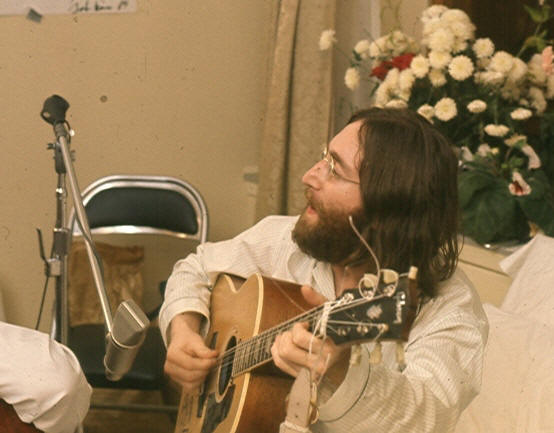
Lennon

It was Dec. 8, 1980, early in the evening in Boulder, Colorado, and I'm sitting in my bedroom at the foot of my bed with Marjorie, my next-door neighbor and infatuation of the moment. With my roomies sitting in the next room noisily watching ABC's "Monday Night Football," I kissed Marjorie for the first time; we necked and snuggled and considered the possibilities of spending some big percentage of our lives together; and then we heard, with the door not quite closed enough, the unmistakable voice of Howard Cosell telling us, telling the world, that John Lennon was dead.

Things started to turn sour for me and Marjorie from almost that moment on. It took a while to fully play out, but our romantic fortunes went downhill -- which shouldn't have been surprising. One way or another, things went south for all of us from that day on.

Some mile markers in life are unavoidable, like road obstacles that are too big to drive around. There's no escaping them when they happen or even years later. There's behavior that's common to our species -- or maybe just particular to our era: we tend to measure the gravity of events in the context of the terminal. We all have our stories of where we were when John F. Kennedy was assassinated, or Malcolm X, or Martin Luther King or Robert Kennedy or Yitzhak Rabin. John Lennon joined that pantheon of eternals, but in a slightly different way.


Lennon always had an edge about him. In his life as a Beatle and afterward, there was a sense of the precipitate, the volatile about John Lennon. More than any of the other Beatles -- the often-sullen George, the relentlessly chipper Paul, the phlegmatically loyal Ringo -- John embodied rock and roll's potential for unalloyed danger, that feeling you get in the best rock music of careening headlong into a new and strange place -- and not being frightened by the prospect in the least.

Long before that nightcrawler trapped him in the vestibule of the Dakota, John Lennon wore a target; it's been said that years before the Beatles exploded, when he was still playing with the Quarrymen, blokes in his Liverpool neighborhood wanted him hurt, or worse, for reasons we can only guess at now.

His was rock and roll's first outright assassination. With his killing, legions of fans got the wake-up call they'd been dreading, or avoiding, at least since the Beatles broke up a decade earlier.

And it was hard to let go. It was, and still is, hard to give up that giddy frisson of the Beatles' first performance on the Ed Sullivan Show, when four shaggy knuckleheads in suits landed in a country numb from the loss of Camelot about nine weeks before they arrived. The audience that night, its screams like a flock of crazed birds, was a taste of the future. The screams followed them around the world for six years -- the reaction of fans who lost themselves in a music and a style and a world-view that began the transformation of popular culture.

Not long after the bottom fell out of the Beatles, in 1970, Lennon was warning us. Telling us in his fashion to get ready. Be prepared for anything. Grow up. "I don't believe in Beatles," he told us in the song "God." "The dream is over." Lennon was teaching us to grow up even while, paradoxically, he was growing up himself. There were dalliances for a time when things with Yoko went badly.

He hangs out with Harry Nilsson in L.A. He and Harry get tossed out of the Troubadour for heckling the Smothers Brothers. He goes to another nightclub and gets upbraided by a waitress for wearing a tampon on his head. He learns the process of starting over.

We're lucky that the fruition of that process was something positive. Rather than an obituary of a rock star who passed from the scene with a spike in his arm or a shotgun to his head, we got from John Lennon the evidence of his mellowing, his maturity. You can't listen to "Double Fantasy" without hearing that growth process in the works; like a butterfly fighting its way out of a cocoon, John and Yoko were fighting to regain their own identities -- regain, hell! maybe fighting to just have identities separate from those foisted on them by the media, the music biz, and always, always, the fans.

We got a taste of that great possible. But only a taste. Now, a quarter century after Lennon died -- sounds tree-ring strange saying "quarter century" -- we're in some ways more in need of his candor, his wit, his passion, than we ever were before.

John Winston Ono Lennon remains an indelible spirit of our times, a man whose wrestling with demons within and without has made our own caged match with reality a little more bearable. It's a real tribute to someone's life when you find that you miss that person, need that person, feel that person's presence more and more as time goes by, not less.

John Lennon was a rock dropped into the water of our time and our lives, and the ripples from that rock get stronger and stronger all the time, the further and further we get from their source.

Imagine that. Just imagine.
-----
Image credits: Top photo: Roy Kerwood, 1969; Dakota: David Shankbone