We’re not where we used to be

You should be redirected to the new address. If that doesn't happen in a second, visit
http://short-sharp-shock.blogspot.com
Oh, and update your bookmarks. Thanks.

Sunday, July 20, 2008

Obama on tour, McCain on defense

The campaign of Sen. John McCain has worked hard to build a narrative of negative about the daring and wisdom of Sen. Barack Obama’s pledge to return U.S. combat forces in Iraq within 16 months of taking office.

That persistent attempt to cast Obama in the light of a rookie player not ready for the pros — a foreign-policy lightweight ill-equipped to handle affairs of state on a global stage — has taken meaningful hits recently, maybe none as bad as that delivered over the weekend.

While Obama continues his limited world tour of Iraq, Afghanistan and Europe, Reuters reported that Iraqi Prime Minister Nuri al-Maliki told the German magazine Der Spiegel that he supported Obama's proposal that U.S. troops exit Iraq within that 16-month timeframe.

“U.S. presidential candidate Barack Obama talks about 16 months,” Maliki said in an interview with Der Spiegel released on Saturday. “That, we think, would be the right timeframe for a withdrawal, with the possibility of slight changes.”

While cagey enough not to explicitly support Obama over McCain, Maliki said that "[w]hoever is thinking about the shorter term is closer to reality. Artificially extending the stay of U.S. troops would cause problems."

◊ ◊ ◊

“This could be one of those unexpected events that forever changes the way the world perceives an issue,” blogs The Atlantic’s Marc Ambinder. “Iraq's Prime Minister agrees with Obama, and there's no wiggle room or fudge factor. This puts John McCain in an extremely precarious spot: what's left to argue? To argue against Maliki would be to predicate that Iraqi sovereignty at this point means nothing.”

“In the U.S., this is all bad news for the McCain campaign,” writes Joe Klein, of Time magaine. “Yes, McCain was right about the Surge, but that is a small, tactical truth too complicated to be understood by most Americans. Maliki Endorses Obama Withdrawal Plan is a headline everyone can understand. ...

“With this happening in the same week that the Bush Administration not only has agreed to sit down with the Iranians but also (and even more significant) is exploring the possibility of establishing a U.S. diplomatic Interests Section in Tehran, another of McCain's foreign policy pillars — the nonrecognition of Iran — seems to be cratering as well.”

This latest hardly-improvised explosive device on the road to the Republican National Convention follows a number of missteps by and surprises for the McCain campaign: McCain’s late-to-the-game pivot on the importance of Afghanistan in the war against terrorism; former economic adviser Phil Gramm’s “nation of whiners” comment; the intraparty bombshell of California Gov. Arnold Schwarzenegger, a supporter, expressing willingness to sign on to an Obama administration as energy czar; McCain’s clueless denunciation of the foundational premise of Social Security; gaffes and goofs by Carly Fiorina, the new face of McCain economic probity.

Today, the McCain campaign finally responded, with what amounts to weak tea and double-talk. Senior Foreign Policy Advisor Randy Scheunemann released a statement:

“The difference between John McCain and Barack Obama is that Barack Obama advocates an unconditional withdrawal that ignores the facts on the ground and the advice of our top military commanders. John McCain believes withdrawal must be based on conditions on the ground. Prime Minister Maliki has repeatedly affirmed the same view, and did so again today. Timing is not as important as whether we leave with victory and honor, which is of no apparent concern to Barack Obama. The fundamental truth remains that Senator McCain was right about the surge and Senator Obama was wrong. We would not be in the position to discuss a responsible withdrawal today if Senator Obama's views had prevailed."

◊ ◊ ◊

The towering sophistry built in to this statement becomes obvious when you break down the wall of its magisterial construction:

Scheunemann says Obama favors “unconditional withdrawal that ignores the facts on the ground,” ignoring the fact that many of those “facts on the ground” must be derived from the Iraqi government, not the leaders of a temporary military occupation.

(Never mind the fact that Obama has said repeatedly that his 16-month forecast wasn’t etched in stone or sealed in political amber, but was both a forecast necessarily subject to change based on emerging realities, and a figure he arrived at after consultation with former U.S. military leaders — long before he uttered that estimate in the first place.)

If Maliki repeated “the same view” again today, and his view is consistent with Obama’s own, where’s the short-sightedness and lack of judgment Team McCain alleges Obama is guilty of?

The real truth of the McCain campaign’s remaining options may well have come from outside the campaign, in an e-moment of remarkable candor. The Atlantic’s Ambinder reports having received the following:

“Via e-mail, a prominent Republican strategist who occasionally provides advice to the McCain campaign said, simply, ‘We’re fucked.’”

◊ ◊ ◊

Meanwhile, the Obama Tour continues, likely to rival the reception for a major rock band like U2 or the Rolling Stones. The New York Times today reported the location for his appearance in German on Thursday: at Tiergarten Park in Berlin, at the feet of the Victory Column, aka Der Siegessäule. (Pop-culture ref: it’s the same location where angels gathered in Wim Wenders’ “Wings of Desire,” starring the indelible Solveig Dommartin.)
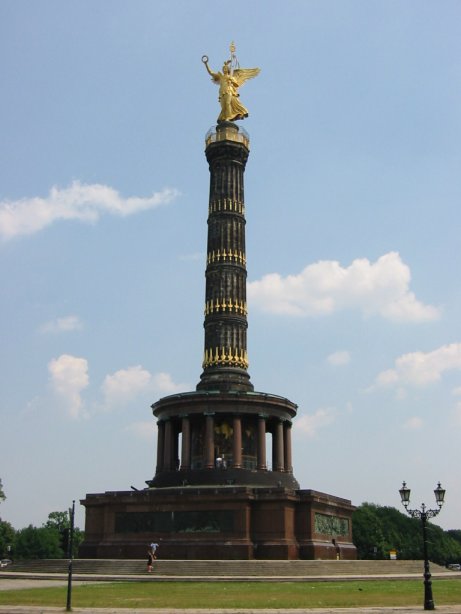
According to Team Obama, the presumptive Democratic nominee will “give a major speech on the historic U.S.-German partnership, and the need to strengthen Transatlantic relations to meet 21st century challenges.”

The Times reported that Berlin officials were having a hard time trying to gauge the size of the expected crowd. One local newspaper, Tagesspiegel quoted one as predicting “between 10,000 and a million.”

There’d been talk that Obama would speak at the Brandenburg Gate, arousing unwarranted comparisons to Kennedy and Reagan, who made addresses at the historic Gate.

But Phil, posting Sunday to the NYTimes Web site, grasped the deeper reality, the deeper contrasts between Obama and McCain:

“In the end it won’t matter where Obama gives his speech in Germany, because whether or not he’s standing in front of the Brandenburg Gate, the Siegessäule, or suspended from the top of the Reichstag, the most startling thing about his speech and trip isn’t going to be the backdrop but rather the huge, international support he already has.

“Remember when the US had foreign policies that didn’t make you embarrassed to be an American while traveling? Clearly the rest of the world is ready for a sharp change from the past 8 years as well.”
--
Image credits: Obama: Ari Levinson (Autumnfire). Victory Column: djmutex. Both republished under GNU Free Documentation License.

Thursday, July 17, 2008

John McCain's inheritance tax

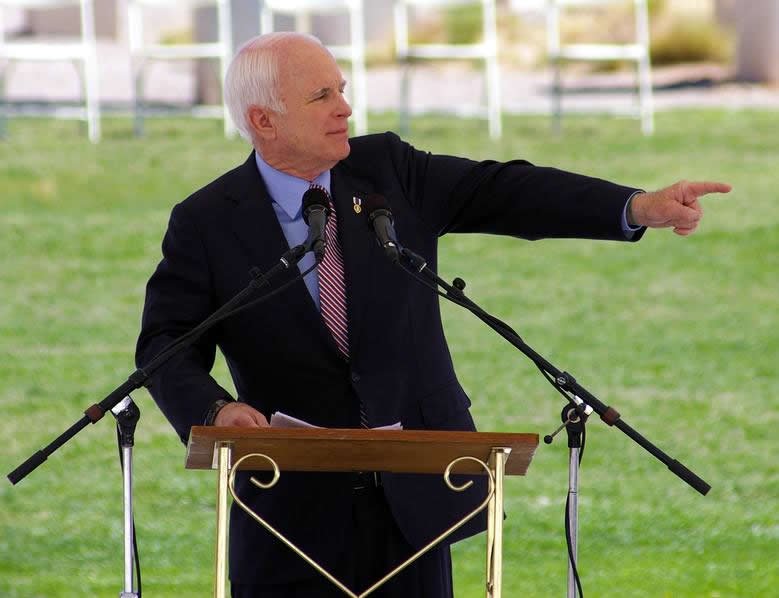
Sen. John McCain went into the lion’s den on Wednesday, addressing the 99th annual NAACP Convention in Cincinnati, Ohio. Hold up — there was no blood on the floor of the Duke Energy Center. From all indications, the presumptive Republican nominee for the presidency was warmly received in as close to a love feast as any Republican has a right to expect.

Give McCain props for at least showing up this year (last year he begged off due to scheduling conflicts. “As you might recall, I was a bit distracted at the time dealing with what reporters uncharitably described as an implosion in my campaign,” he said). The Arizona senator was sharp enough to begin with a big wet olive branch, with praise for challenger, Sen. Barack Obama.


“Let me begin with a few words about my opponent,” he said. “Don't tell him I said this, but he’s an impressive fellow in many ways. He has inspired a great many Americans, some of whom had wrongly believed that a political campaign could hold no purpose or meaning for them. His success should make Americans, all Americans, proud. Of course, I would prefer his success not continue quite as long as he hopes . . . Senator Obama talks about making history, and he's made quite a bit of it already.”

Many of McCain remarks concerned education; McCain pledged to back more aggressive recruitment of quality teachers, and bonuses paid to teachers “who take on the challenge of working in our most troubled schools -- because we need their fine minds and good hearts to help turn those schools around.”

“After decades of hearing the same big promises from the public education establishment, and seeing the same poor results, it is surely time to shake off old ways and to demand new reforms,” McCain said.


“Democrats in Congress, including my opponent, oppose the D.C. Opportunity Scholarship program," McCain said. "In remarks to the American Federation of Teachers last weekend, Senator Obama dismissed public support for private school vouchers for low-income Americans as, ‘tired rhetoric about vouchers and school choice.’ All of that went over well with the teachers union, but where does it leave families and their children who are stuck in failing schools?”

◊ ◊ ◊

On this and other topics — the growth of the federal government, economic empowerment, the value of the NAACP itself — McCain delivered a fairly detailed, articulate address punctuated with charm, at times gently didactic, other times winningly self-deprecating. There was no winging it town-hall style; McCain appeared to grasp the moment of the occasion.

He left openings for contrarians. McCain generally condemned the prospect of “trillion-dollar debts,” with not a word about those debts’ relationship with the ruinous war in Iraq he’s supported since before it began. And even though he tried to make peace for initially opposing the federal King holiday (scattered boos were heard in the audience) many black Americans still hold it against McCain for coming way late to the party — the broad national consensus that King was more than worthy of national recognition on a par with its greatest leaders.

◊ ◊ ◊

McCain’s biggest problem with black America may be not who he is, but what he represents. The relative absence of black support for the GOP in general, and the Arizona senator in particular, has antecedents. It’s bigger than McCain, and it has been for years.

“There’s an issue of trust; it has nothing to do with issues or policy — though I won't say policy is nothing,” said David A. Bositis, a senior research associate at the Joint Center for Political and Economic Studies, a Washington-based think tank concentrating on African American and minority issues, in an MSNBC.com interview. “The problem is that African Americans don't trust the Republican Party because it's a white Southern party. They don't trust the Republican Party to do things in their interest.”

“It seems like the Republican Party is in a continuous search for those elusive black voters,” Bositis said. “The party of Lincoln? I don't think so,” Bositis said. “The Republican party is now the party of Jefferson Davis.”

Bositis said that in 2004, the same year that President Bush installed by recess appointment (bypassing Senate confirmation) Judge Charles Pickering to the Court of Appeals for the Fifth Circuit, despite Pickering's poor record on civil rights decisions. Pickering condemned the “one-person, one-vote” principle recognized by the Supreme Court and tried to curb remedies provided by the 1965 Voting Rights Act.

2004 was the same year that Bush rebuffed the NAACP’s invitation to address the national convention, becoming the first sitting president since Harding to refuse to do so.

2004 was the year after Bush, on what would have been Rev. Martin Luther King's 74th birthday, condemned the admissions system at the University of Michigan, which used race as one of several factors to assess qualification for admission, as “divisive, unfair and impossible to square with the Constitution.”

◊ ◊ ◊

The matter goes back generations. Black Americans benefited greatly from a number of policies, including President Roosevelt’s New Deal programs and, later, President Truman's 1948 signing of Executive Order 9981, committing the U.S. government to integrating a long-segregated military.


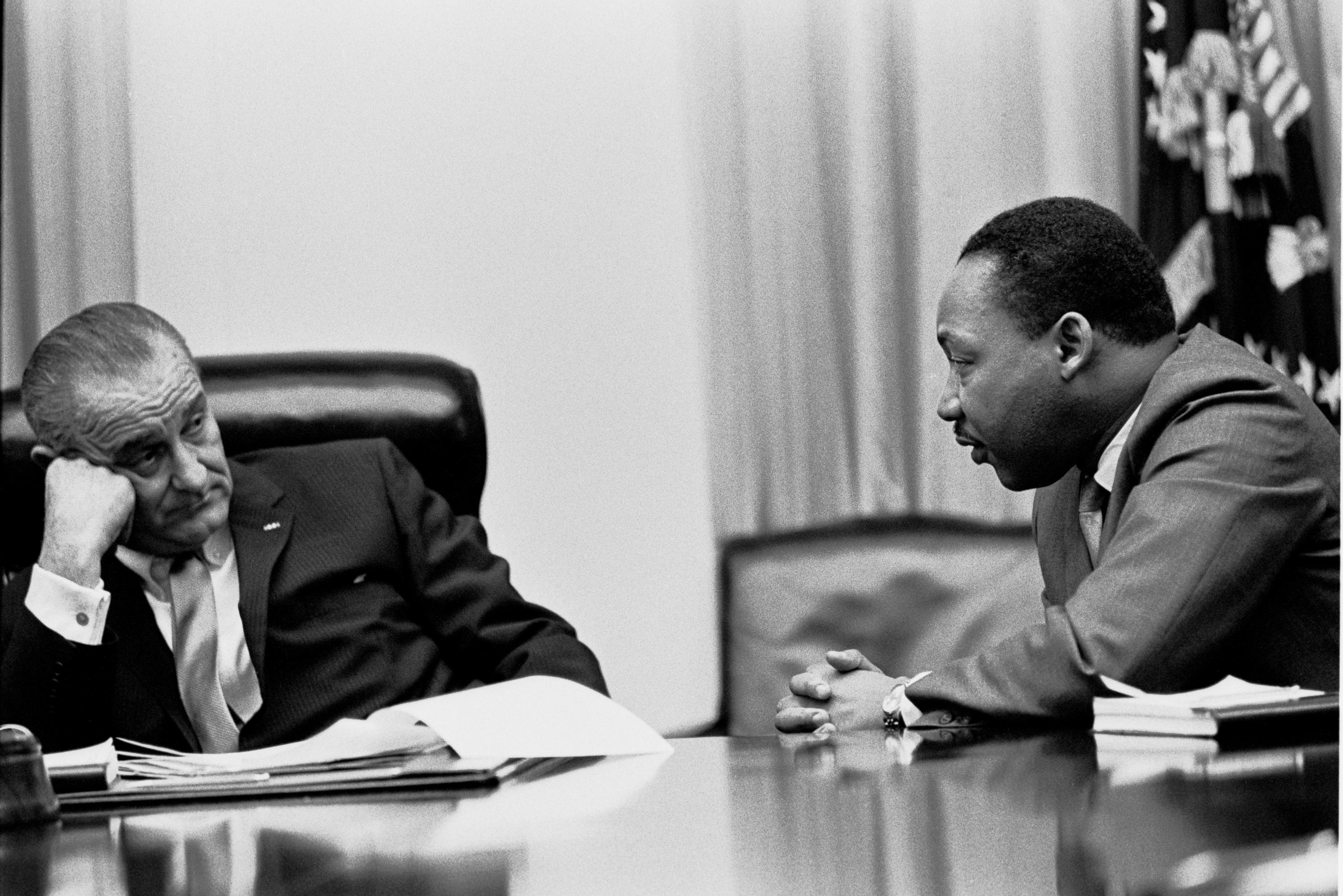
Civil rights programs launched under the Kennedy and Johnson administrations (especially LBJ’s Great Society program and passage of the 1965 Voting Rights Act) locked down the relationship between blacks and Democrats, basically the one that exists now.

But by then, there were serious divisions between Democrats and many of their white southern counterparts angered by Truman's 1948 desegregation order and the party’s evolving support of the civil rights movement. The so-called Dixiecrats — disgruntled Democrats who joined the Republican party in 1964 — were central to the success of Nixon's “southern strategy” in 1968, and in laying the foundation of what would ultimately become the modern GOP.

Those Dixiecrats found a champion in Ronald Reagan who, in August 1980, offered a full-throated support of “states’ rights,” one of the legendarily divisive code words and phrases created in a blatant appeal to white rural voters, and no one else.

◊ ◊ ◊

And that’s more or less what John McCain inherits today: what Marc Racicot, former Montana governor and RNC chairman, once described as “a long period of history where we were not as careful and sensitive as we could have been as a party.”

“The Republican Party has to realize that it cannot be lily-white any longer,” Armstrong Williams, the black conservative commentator, said in January 2003. “Change must come about, and it must start within our house.”

McCain’s appearance at the NAACP convention, not as much courageous as it was compulsory, showed that this self-described political maverick knows when it’s smart not to be a maverick, when it’s politically necessary to tack to the left, or at least the center, to court a skeptical constituency.

But McCain reaps the windbags and demagogues that have populated the most ardent wing of his party — people from the late Lee Atwater, who helped Reagan craft his own take on the corrosive Southern strategy, to the present-day arch-conservative pit bull, lobbyist and tax-reform advocate Grover Norquist, who late last month referred to Barack Obama as “John Kerry with a tan,” to McCain economic adviser Phil Gramm, who presumes to help his candidate lead "a nation of whiners."

John McCain must know — all the self-deprecation in the world can’t change that.
-----
Image credits: Johnson and King: Public domain. Pickering: presidentmoron.com. Reagan: Public domain.

Monday, July 14, 2008

Condé’s nasties

Nothing in the world of publishing has perfected the art of editorial distillation — saying a lot in a little space (or saying little in a space better used for something else altogether) — quite like magazines. They scream and cajole us from the subway platforms to the checkout stands; the hysteria of type and images is so much a part of the lingua franca of our daily informational consumption, it’s become a wash of noise, a blanket of titillation we tend to suspect distorts reality, rather than illuminating it.

Few ply the trade like Condé Nast, one of the largest and most successful magazine publishers in the world, a conglomerate whose brand-name ventures run the spectrum of modern life, from fine dining (Gourmet) to technology (Wired) to shopping (Lucky). Two of Condé Nast’s publications have lately gone down a troublesome road, with covers that have awakened issues of racial and ethnic sensitivities, in an industry known historically for having little of either one.

◊ ◊ ◊

The cover of the latest issue of The New Yorker, venerable iconoclast of the publishing world, the dazzlingly literate party guest who’s liable to say anything, is understandably topical: Barack and Michele Obama are featured in one of the New Yorker’s classic cover illustrations. But today, the magazine came heavily under fire for that depiction:

In the Oval Office, Barack Obama stands in a turban and Muslim attire doing the fist pound with Michele Obama, herself decked out in combat gear and an Afro Angela Davis would have envied, an assault rifle slung over her shoulder. On the wall to Obama’s right hangs a portrait of Osama bin Laden artfully cropped halfway by the page’s edge (perhaps The New Yorker’s way of knowingly pulling back before they went too far over the top). In the fireplace, a burning American flag.

The illustration by Barry Blitt, a frequent New Yorker contributor, synthesized in one image all of the prevailing distortions and misconceptions about Obama, his past, his loyalties and his political mission. Obama has made clear repeatedly that he is not nor ever has been a Muslim; wife Michele has been just as forthright debunking images of her as a 60’s-style radical in Ivy League clothing.

The jury of the punditburo has been out all day, debating the image:


Editor & Publisher editor did a comprehensive roundup of other media reactions.

New Yorker editor David Remnick defended his magazine. “It is an attack on those who would manipulate and lie about him, and we are holding up a mirror to that,” he told NBC. There are other examples of this kind of artistic exaggeration to the nth degree; of course it’s the foundation of satire.

But The New Yorker has taken a step beyond pure satire, one that invites concerns about whether the greater good is served by an illustration that so cleverly distills the artifacts of a national lie. Is this satire in the service of moving beyond our deepest irrational fears vis-à-vis race and ethnicity, or merely satire in the service of deepening those fears, giving them the imagistic credence that equals validity in our visual culture? In that sense, is it satire at all?

Team Obama condemned it, of course, calling it “tasteless and offensive,” but otherwise has pretty much taken the high road, brushed this off the shoulder. Maybe they realize that in that same visual culture, for all their immediate impact, magazines are perishable things, with a shelf life as brief as vegetables in the refrigerator. The New Yorker will feature a new cover one week from now.

◊ ◊ ◊

The cover of the April issue of Condé Nast’s Vogue imprint has been, uh, more of a problem. You know the issue. On the cover, Cleveland Cavaliers star LeBron James is clutching the waist of ubermodel Gisele Bundchen, his teeth bared in a cartoon defiance. This apparent outtake from “King Kong,” directed not by Merian C. Cooper but by celebrity photographer Annie Leibovitz, instantly generated exactly what you’d expect.

Magazine analyst Samir Husni told The Huffington Post he thought the photo “screams King Kong.” Husni said that, given the time and preparation required for a Vogue cover, facile explanations just don’t hold water. "So when you have a cover that reminds people of King Kong and brings those stereotypes to the front, black man wanting white woman, it's not innocent," he said.

Damion Thomas, assistant professor in the Department of Kinesiology at University of Maryland, told the HuffPost that such images of black male athletes "reinforce the criminalization of black men."

Condé makes another perverse statement about the value of black faces on its magazine covers. The LeBron James cover was the first in Vogue's 116-year history to feature a black man, and Vogue couldn't play it straight, couldn't put its first black male subject in the apparel whose style and elegance defines the magazine. Vogue went in for clowning instead.

You’re tempted to think this is something specific to Condé Nast; maybe some bad water got loose in the pipes that run the course of the company’s headquarters in Manhattan. But such evidence of insensitivity to both the country’s racial history and prospects for its multiracial future is an industrywide thing.

In a July 2007 story in Folio:, writer Linda Zebian posits the idea of magazine publishing as “the country club of the media industry.”
Zebian quoted former publisher turned professor of media studies Michael Weiskopf: "With few exceptions the demographic composition of management in the magazine world continues to resemble that of a restricted country club. From the photographs one could just as easily conclude it was the Jesse Helms Awards."


◊ ◊ ◊

Shaunice Hawkins, vice president of diversity & multicultural initiatives for the Magazine Publishers of America, told Folio: that her own organization has had difficulties with researching the presence of diversity in the publishing industry.

"Our industry is a combination of private and public entities so a lot of that information is not readily available. That's one of my biggest challenges. We don't have jurisdiction over our members to say, 'Give us your numbers or else.'"

Thus Condé Nast — and its parent company, the privately held (no public shareholders) Advance Publications — are able to call its own shots over who gets on the cover, and how they’re depicted, with no oversight or accountability to the public.

Reacting to the LeBron cover, Tamara Walker, a Philadelphian interviewed by HuffPost, grasped the wider importance both of that cover and the New Yorker cover that followed— seemed to understand not just what such covers say about Vogue and The New Yorker, or even what they say about Condé Nast, but the message they send about the magazine publishing industry in general.

“If more people of color worked for Vogue in positions of editorial authority, perhaps someone in the room might have been able to read the image the way so many of us are reading it now, and had the power to do something about it.”
-----
Image credits: Covers: ©2008 Condé Nast Publications/Advance Publications.

Saturday, July 12, 2008

War and popcorn

It’s 114 days and counting until the 2008 presidential election, but three film projects — one in theaters now, one set for the small screen starting Sunday, and one eagerly (or anxiously) awaited for release in October — are setting the stage for the farewell to the Bush administration (77 days after that election).

The one with the buzz — Oliver Stone’s “W,” has been on a fast track toward completion since it started. Shooting started in May, and the Lionsgate film is set for release on Oct. 17, less than three weeks before the fall classic. (The teaser poster, above, is priceless).

Josh Brolin, on a roll since his star turns in “American Gangster” and “No Country for Old Men,” will star as George W. Bush, with Elizabeth Banks as Laura Bush, James Cromwell as George Bush (#41) and Ellen Burstyn as Barbara Bush.

Much of the rest of the cast has been fleshed out since the principal shooting began: Jeffrey Wright (“Basquiat,” “Casino Royale,” “Quantum of Solace”) stars as Colin Powell, Scott Glenn as Donald Rumsfeld, Richard Dreyfuss stars as Dick Cheney, Thandie Newton (“Mission: Impossible 2”) as Condoleezza Rice and Stacy Keach as Billy Graham.

Benjamin Svetkey of Entertainment Weekly reported that Brolin spent months nailing down Bush’s singular vocal style by calling hotels in Texas and talking to the people at the front desk, listening to their accents.

Brolin has also been watching videos of Bush walking. The actor told Svetkey that Bush’s gait "changes over the years, how he walks in his 30s, how he walks in foreign lands, before 9/11 and afterwards. People hold their emotions in their bodies. They can't fake it. Especially him.”


“’W.’ isn't an overly serious movie, but it is a serious subject,” Stone told the Los Angeles Times on June 29. “It's a Shakespearean story. . . . I see it as the strange unfolding of American democracy as I have lived it."

Mike Goodridge of Screen Daily reported that Stone described the tone of “W” as in the over-the-top style vein of Sidney Lumet’s "Network" or Stanley Kubrick’s seminal antiwar rapier, "Dr. Strangelove or: How I Learned to Stop Worrying and Love the Bomb."

Few American filmmakers ever generate the kind of anticipation Stone does, largely because of his visual and thematic daring. “Nixon,” his 1995 take on the presidency of Richard Nixon, starred Anthony Hopkins in the title role, a role in which Hopkins bore no real physical similarity to Nixon. Stone said that his intent was to get to the essence of Richard Nixon, despite a lack of physical verisimilitude. If Brolin’s makeup job as Bush #43 is any indication (see image above), Stone’s playing it visually straight this time.

◊ ◊ ◊

While Stone plots his overview of the life of George Bush, the seven-part HBO miniseries “Generation Kill,” which begins Sunday night, offers a grunt’s-eye view of the war that will be forever connected with the Bush administration.

The miniseries, based on a book of stories by embedded Rolling Stone reporter Evan Wright, follows the exploits of the U.S. Marine First Reconnaisance Battalion — the tip of the American spearhead — during the first 40 days of the Iraq War, in 2003.

Challenged by equipment shortages, imprecise rules of engagement and inept commanders, the Marines of the First Recon seem to be a microcosm of the American military as a whole in the halcyon days of “Mission Accomplished,” before the worst of the war began to happen.

The cast of “Generation Kill,” which was overseen by a variety of directors, both includes actors and real former Marines, one of whom acted as a technical adviser to insure authenticity. HBO’s excellent track record on edgy, provocative entertainment (“The Wire” and “The Sopranos” are two fine examples of what they’re capable of) suggests this will be destination viewing for the seven weeks of its run.


◊ ◊ ◊

The Iraq war gets the fictional treatment in “War, Inc.” a wild sendup of war as a financial enterprise. In the film directed by Joshua Seftel and co-written by John Cusack, the country of Turaqistan is effectively bought by the Tamerlane Corporation, run buy a former U.S. vice president. The company dispatches a hitman to eliminate an oil minister, one of Tamerlane’s competitors and the last obstacle to Turaqistan’s domination.

Cusack stars as the hitman (yeah, he did it before in “Grosse Pointe Blank”) with support from sister Joan Cusack, Hilary Duff, Dan Aykroyd, Marisa Tomei and Ben Kingsley.

It’s been in release since May and, until recently, only in a handful of theaters. A slow rollout to more theaters started in June, based on popular reception at theaters in New York and Los Angeles.

To date it’s earned about $405,000 at the box office. Many reviews have not been kind; the film scored 32% on Rotten Tomatoes.

But some approved: “A sprawling folly, this uniquely hellish war film has almost breathtakingly impressive (and busy) production values and is anchored by a memorably complicated performance from John Cusack,” said Tom Keogh of the Seattle Times.

Michael Phillips of the Chicago Tribune said “'War, Inc.' has that provocateur's edge, and it's at least awake to the world around us.”


◊ ◊ ◊

There’s been a building critical mass of antiwar films linked to Iraq; MTV Films released “Stop-Loss” in March, and Errol Morris’ documentary, “Standard Operating Procedure,” laid bare the atrocities of Abu Ghraib. “Redacted” and “In the Valley of Elah” examined the war from the front lines to the home front.

Like the current opinion polls reflecting a groundswell of opposition to the Iraq war, these films are both leading indicators of where we’re going and dark testament to where we’ve been. It’s not a chicken-or-egg issue; which came first doesn’t matter. What’s important is that they’re all here now, in the runup to what may be a moment of broad national change.
-----
Image credits: W teaser poster, Josh Brolin as George Bush: ©2008 Lionsgate Films. Generation Kill cover: Putnam Adult. War Inc. poster: ©2008 Millennium Films.

The McCain scrutiny X

For some time now, the operation of the John McCain campaign bus has been a startlingly democratic (with a small d) enterprise. Early in the year, the lobbyist-friends of the candidate had a hand (or seemed to) in charting the campaign trajectory, to the candidate’s disadvantage. Last month, McCain chief strategist Charlie Black took his turn behind the wheel of misfortune when he said another terrorist event the scale of 9/11 would play to McCain’s advantage.

Add to that list the name of Phil Gramm, the former Texas senator and economics professor, current vice chairman for the Swiss UBS Investment Bank, incidental architect of the housing crisis that plagues the United States, and McCain economic adviser and campaign co-chairman. With one interview, Gramm has taken the McCain campaign vehicle into provocative, even dangerous territory, and made plain the irony of McCain, the presumptive Republican presidential nominee, seemingly at the mercy of his lieutenants.

It seems that whoever’s driving the McCain campaign bus may, or may not, be the man with his name on it.

◊ ◊ ◊

Gramm, a supporter of tax cuts and supply-side economics, has long been a champion of a decrease in government regulation, something that the investment banking and mortgage industries have howled for in recent years —something that Gramm, as a UBS Business Group vice chairman, has been, uh, in a position to help out with on Capitol Hill.

Gramm, whom McCain has retained to offer much-needed advice on the national economy, sat down Wednesday for an interview with The Washington Times.

In an overview of modern America, the national economy and the rise of global competition, Gramm, a man with a Ph. D in economics, volunteered that the nation’s problems are more illusory than not.

“You've heard of mental depression; this is a mental recession,” Gramm told The Times. “We may have a recession; we haven't had one yet. We have sort of become a nation of whiners. You just hear this constant whining, complaining about a loss of competitiveness, America in decline. We've never been more dominant. We've never had more natural advantages than we have today,”

“We have benefited greatly” from globalization in the last 30 years, Gramm said.

“Misery sells newspapers,” Gramm said. (For the growing number of newspaper editors who’ve been laid off this year, some who’ve seen their work actually outsourced to India, it must come as a relief to know that something sells newspapers these days.)

“Thank God the economy is not as bad as you read in the newspaper every day,” said Gramm, who’s being paid handsomely by UBS to lobby Congress to reverse state regulations meant to curb use of predatory lending practices that led to homeowners seduced by lenders and brokers into high-cost, high-interest mortgages they couldn’t afford.

It’s this glaring disconnect, this separation from the realities of millions of Americans, that McCain reinforces with a staff thick with lobbyists pursuing the same special interests McCain has condemned; with inconsistencies on a host of positions, from setting a withdrawal date from Iraq to his own willingness to vote for his party’s leader, President Bush.

◊ ◊ ◊

Gramm damage control kicked in almost immediately. “Phil Gramm’s comments are not representative of John McCain’s views,” a McCain official said. “John McCain travels the country every day talking to Americans who are hurting, feeling pain at the pump and worrying about how they’ll pay their mortgage. That’s why he has a realistic plan to deliver immediate relief at the gas pump, grow our economy and put Americans back to work.”

The presumed nominee put daylight between himself and Gramm with the obligatory town-hall dissent. “I strongly disagree” with Gramm's remarks, McCain told reporters and businesspeople at a stamped products plant in Belleville, Mich. “Phil Gramm does not speak for me. I speak for me,” McCain said, wresting the wheel of the vehicle from Dr. Gramm.

McCain said anyone who’d just lost a job "isn't suffering from a mental recession."


“America is in great difficulty. And we are experiencing enormous economic challenges as well as others,” he said.

And when he was asked by Time magazine whether Gramm might be the treasury secretary in a wildly hypothetical McCain administration, McCain tried to crack wise, responding with some of his characteristic humor.

“I think Senator Gramm would be in serious consideration … for ambassador to Belarus,” he said, “although I’m not sure the citizens of Minsk would welcome that.”

The sound of crickets on a summer’s day was deafening. Less obvious were the screams of the good doctor, clinging to the rear axle of the Straight Talk Express.

◊ ◊ ◊

Obama, as you might expect, parked it in deep right field. “A nation of whiners,” he said at a campaign stop in Fairfax, Va., warming to the issue like a standup comic about to deliver a guaranteed kill. “I want you all to know America already has one Dr. Phil. We don’t need another one when it comes to the economy.

“It’s not just a figment of your imagination. It’s not just all in your head.”


“What John McCain, George Bush, Phil Gramm just don't understand is that the American people aren't whining about the state of the economy; they are suffering under the weight of it — the weight of eight years of Bushenomics that John McCain and Phil Gramm have vowed to continue,” Karen Finney, Democratic National Committee communications director, told The Politico’s Mike Allen. 


McCain has made much of having some 300 economists who have signed on to his Jobs for America plan. Responding to an e-mail from The Huffington Post, seeking reaction to the McCain economic strategy, Michael Connolly, economics professor at the University of Miami (and one of the 300), grasped the connection between the national economy and McCain’s signature issue: the war in Iraq.

“Yes, I support the Jobs for America policy proposal, especially a simplified tax code, lower restrictions on trade, and energy development," Connolly said. "[But] I am worried that continuing the wars in Iraq and Afghanistan will tear apart our social fabric and defeat any economic proposal to reduce the deficit and stimulate growth. Guns are crowding out butter.”

◊ ◊ ◊

“I'm going to be honest,” McCain told The Wall Street Journal in 2005. “I know a lot less about economics than I do about military and foreign policy issues. I still need to be educated.”

The education of John McCain continues. Since Phil Gramm doesn’t speak for John McCain but John McCain does, we’ll see how well Phil Gramm instructs John McCain on economic matters from the bottom of the back of the campaign bus.
-----
Image credits: Gramm: Public domain. McCain: T Toes, Creative Commons Attribution ShareAlike license 2.0.

Friday, July 11, 2008

Malefaction Jackson


There’s no denying that Jesse Louis Jackson has been a soldier on the ramparts of the civil rights movement. His role in black American life since the assassination of Rev. Martin Luther King Jr. in 1968, his in-your-face method of speaking truth to power, helped to fill a vacuum of inspiration and leadership at a critical time. But in more recent years, Jackson’s been a self-fulfilling parody, a loose cannon of half-baked strategies, slurs and personal missteps that have badly compromised his standing as a national leader.

That decline on the national stage got worse this week. By now you probably know the dirt: Jackson was preparing for an interview on “Fox & Friends” on Sunday, and sitting before a microphone he didn’t know was live. Responding to a fellow guest’s inquiry about speeches on personal responsibility that Obama has given recently at black churches, Jackson whispered what may be his real feelings about Sen. Barack Obama, the presumptive Democratic nominee — the man who realized what Jackson had failed to achieve in his two abortive runs for the presidency.

◊ ◊ ◊

The whispering Jackson appeared to barely suppress anger at Obama, in the wake of the senator’s Father’s Day speech in which Obama called for black fathers to more fully assume the responsibilities of fatherhood and reject the pernicious legacy of out-of-wedlock births, part of the panorama of nihilistic behavior that vexes black America today.

“We need fathers to realize that responsibility does not end at conception. We need them to realize that what makes you a man is not the ability to have a child - it's the courage to raise one.” Obama said as a part of a wide-ranging speech that addressed many issues of black social pathology — a speech that really didn’t say anything that hasn’t been said before by others in the black community, from Bill Cosby to Louis Farrakhan — to Jackson himself (remember his condemnation of "babies making babies"?).

Jackson, apparently, lost sight of that historical perspective that he’s a part of when he made his comments Sunday on the Fox News set. When he said … what he said. Some embarrassments don’t deserve to be excerpted; you need to see the whole thing. Here it is:


“I wanna cut his nuts off.”

There hasn’t been more attention paid to the word “nuts” since 101st Airborne Division commander Gen. Anthony McAuliffe, besieged by the Nazis during the Battle of the Bulge and offered the chance to surrender, sent that one-word reply to the Germans, in a much-celebrated show of American determination.

Jackson’s use of the word was hardly so heroic. There may be no more psychically corrosive symbol of the subjugation of black Americans than the prospect of castration — a fate suffered by countless black men through American history. Castration was part of the ritual degradation of lynching stretching back to Reconstruction, after the Civil War. Jackson’s sotto voce call for symbolic emasculation of the most successful black presidential candidate in American history spoke volumes about a lingering history we can’t put behind us fast enough.

◊ ◊ ◊

Apologizing later, after his comments were broadcast Wednesday on Fox's "O'Reilly Report," and after the gravity of what he’d said began to resonate, Jackson called Obama’s campaign “a redemptive moment for America.”

"For any harm or hurt that this hot-mike private conversation may have caused, I apologize," Jackson said in a written apology released Wednesday. "My support for Sen. Obama's campaign is wide, deep and unequivocal."

It was part of an All Apologies Tour for Jackson, who furthered the written mea culpa with a series of televised appearances essentially repeating the same thing.


It’s a long comedown for Jackson, perhaps the last beneficiary of the perception of unified black thinking in America, in the wake of King’s assassination. It was he who, according to an Associated Press-AOL Black Voices poll in February 2006, was voted “the most important black leader” trailed by none other than Secretary of State Condoleezza Rice.

The whisper incident was maybe the best evidence of something black America has known for years: Long ago, the mantle of black national leadership moved, not to one individual in the mold of King or Malcolm X or Farrakhan or any other singular personality, but to no one in particular. With King’s passing 40 years ago, the notion of one person speaking for a monolithic black America largely vanished — right along with the idea of there ever having been a monolithic black America in the first place.

“We have formally entered the post-Jackson reality,” said Rev. Eugene Rivers of the Azusa Christian Community Church, on MSNBC’s “Hardball” on Thursday. The question going forward, he said, “is how do we frame a post-civil rights agenda that … dovetails with the pragmatic politics that Senator Obama brilliantly personifies?”

◊ ◊ ◊

But other questions remain: Were Jackson’s sentiments merely the proof of a once-powerful spiritual and political leader realizing the degree of his own eclipse? Or were they evidence of a generational divide within black America — the same kind of split apparent in the controversy over comments by Rev. Jeremiah Wright, earlier this year?

Despite the fulsome apologies, how valuable can Jackson possibly be now in solidifying black support for Obama in his quest for the presidency?

And finally … after two generations in the public eye, how could he be so tone-deaf to the history of his own people? How could he just get it so wrong, after so long?

Rev. Martin Luther King, Jackson's spiritual mentor, referred to himself more than once in his too-brief lifetime as a "drum major for justice." With this latest accidental revelation, Jesse Jackson's shown that he's a drum major marching in his own parade.
-----
Image credits: Jackson: Still image from Fox News. McAuliffe: Public domain.