You should be redirected to the new address. If that doesn't happen in a second, visit http://short-sharp-shock.blogspot.com Oh, and update your bookmarks. Thanks.
It’s not supposed to be this easy. The act of demonizing “the other” political party can be a bit of a tic, a reflex, an automatic piling-on often prone to anything but civility. But it all makes sense, the demonizing is justified when “the other party” seems to go out of its way to alienate, obfuscate, distort and flat-out lie — when that party does everything it can to remain “the other.”
Rep. Todd Tiahrt of Kansas takes point in the latest effort of the Republicans to isolate themselves from the mainstream of this nation. With a character assassination that was breathtaking in its scope, Tiahrt spoke July 16 from the floor of the House of Representatives, and showed just how desperate the Republicans have become.
Tiahrt had previously filed an amendment with the House Committee on Rules to bar use of taxpayer dollars to pay for publicly-funded abortions in the District of Columbia. The Rules Committee rejected the amendment out of hand.
The amendment, co-sponsored by Tiahrt and Rep. Lincoln Davis, a Tennessee Democrat, would reinstate a 14-year-old prohibition on such abortions, a ban that Democrats had removed from an appropriations bill at President Obama’s request. On Thursday he expressed his opinion in the House.
Opposition to the President’s plan is one thing. What Tiahrt said was something else again:
“If you think of it in human terms, there is a financial incentive that would be put in place, paid for by tax dollars, that would encourage…single parents, living below the poverty level, to have the opportunity for a free abortion. If you take that scenario and apply it to many of the great minds we have today, who would we have been deprived of?
“Our President grew up in those similar circumstances. If that financial incentive was in place, is it possible that his mother might have taken advantage of it? Clarence Thomas, Supreme Court Justice, if those circumstances were in place, is it possible that we’d have been denied his great mind?”
◊ ◊ ◊
It's never easier to defeat an adversary than when the adversary defeats himself. Tiahrt's impugning of the morals of mothers, his cynical cheapening of the value of African American life may be the most brazen act of political self-immolation since ... since Mark Sanford got back from Argentina. Political suicide was never so willfully transparent. Or apparently so occasioned with inaccuracies; ThinkProgress.org weighs in on its Web site:
“Setting aside Tiahrt’s questionable decision to list only African-Americans as candidates for retroactive abortion, Tiahrt also makes the misleading claim that “70 percent of Americans oppose using public funds for abortions.” In reality, current law allows Americans to pay for abortion through their health plans, and a recent poll shows that 71 percent of the country supports maintaining the status quo by permitting a public plan to cover reproductive services.”
Tiahrt is running for the Senate, cranking up to make a run at the seat being vacated next year by Sam Brownback. You can only hope the good people of Kansas will take a hard look at the candidate between now and November 2010, to see what he's clearly capable of. And then think. Kansans, you deserve better than this. ----- Image credit: Tiahrt: Official House photo.
He had a career as a globe-trotting journalist acquired years before he hunkered down in the medium that secured his reputation, but Walter Leland Cronkite really established his bona fides for us on the blue-glow box in the living room, the same device whose importance to everyday people has been transformed by the velocity of modern times, and by that other blue-glow box: the one on your desktop.
Cronkite, who died on Friday at the age of 92, died three days before the 40th anniversary of the Apollo 11 moon landing (which delighted him), and more than 45 years after the assassination of John F. Kennedy (which brought him to the verge of tears on the air).
In 19 years at the CBS Evening News, Cronkite ushered us into those events and more: the administrations of five U.S. presidents, the folly of one war, the assassinations of two of the nation’s best and brightest; and the rich pageant of 20th-century life.
His passing brings us to the inescapable: there was television news B.C. and A.C., and the difference is more than mere chronological wordplay.
Before Cronkite began his incarnation of the CBS Evening News, in April 1962, the CBS evening news was all of 15 minutes long, not so much a digest of the day’s pivotal events as a snapshot whose content might not be more substantial than the stuff of a chat with your neighbor over the hedge.
◊ ◊ ◊
Cronkite helped codify the experience of the evening news, for his network and the others; he helped give the concept a shape and meaning, and a definable personality, affable and avuncular, that the nation could gather around.
One of Cronkite’s great gifts to his viewers was the ability to boil down not what was important generally, but what was important to him — and by extension, what he knew would be important to the rest of the country.
He distilled the mess of the Watergate scandal down to graphics and plain language that people could understand. He helped make sense of the Iran hostage crisis in a daily chronology that puts things in perspective.
And earlier, Cronkite went up against the military-industrial establishment and tapped the collective unconscious. In a documentary that properly separated Cronkite’s role there from his role as the CBS News anchor, he went on the air in February 1968 and said flat-out what Americans had been saying and thinking privately: that the Vietnam War was unwinnable:
“To say that we are closer to victory today is to believe, in the face of the evidence, the optimists who have been wrong in the past. To suggest we are on the edge of defeat is to yield to unreasonable pessimism. To say that we are mired in stalemate seems the only realistic, yet unsatisfactory conclusion.”
It was a statement that broke the back of the nation’s gung-ho military psyche. President Johnson said as much after the broadcast: “If I’ve lost Cronkite, I’ve lost middle America.” It was also a statement that probably saved hundreds, if not thousands of American lives, and thousands, if not tens of thousands, of Vietnamese lives.
◊ ◊ ◊
Even a casual look at the mediascape since he left the air, on March 6, 1981, confirms: For the most part, after Walter came the deluge.
Before he left the anchor’s chair, Cronkite was witness to the future — a little bit like the vintage car mechanic observing his first fuel-injection engine. CNN, of course, had launched in June 1980, the first all-news, all-the-time venture in the history of the medium, and one that was steadily growing its reach and influence.
MTV, which ushered in a new source for music entertainment, another kind of news (that largely bypassed the TV networks that largely bypassed them), was launched on Aug. 1, 1981.
In January 1982, after he’d left the scene, CNN launched Headline News, airing a continuous cycle of half-hour newscasts, a style of delivery that continues on the channel today.
The Internet we know and love first acquired its recognizable contours when British scientist Tim Berners-Lee invented the World Wide Web in 1989.
And after Cronkite’s news went off the air, eventually we got the sleek, relentlessly manicured television news to which we’ve become accustomed … followed by the political caged matches so common on the cable networks today.
◊ ◊ ◊
Walter Cronkite symbolized civility in journalism. On Friday, Dan Rather, who succeeded Cronkite in the big chair at CBS, said as much to MSNBC’s Rachel Maddow. “Being on television,” he said, “… it’s an egocentric, narcissistic business, but you rarely if ever saw that in Walter Cronkite … he had the ability to get through the glass, which is to say, to connect with people.”
Cronkite did that in front of about 22 million Americans five nights a week for 19 years. He may well have been the last television news personality who really deserved to be a television news personality. He seemed to wear his authority lightly. He wasn’t just a man comfortable in his own skin; he went out of his way to make us comfortable in ours.
He tried to be that neighbor you talked to over the hedge.
Ironically, he was also one of the last emotionally accessible symbols of fortress journalism, represented by those mammoth news operations (like CBS) that reveled in maintaining an insulating distance between the press and the public — and a one-way directionality that effectively told people what news was.
Those days are over. You won’t get that kind of attention on the Internet or the cable nets; the emotional responses that haven’t been boiled down completely by e-mail emoticons are always about to boil over on the pit-bull shows on cable. And news? Whose news? Yours ain’t like mine ain’t like hers, and that’s a democracy-wall prospect that’s both thrilling and terrifying.
Cronkite’s nightly signoff was legendary: And that’s the way it is. And maybe that was Uncle Walter’s big inside joke, for those who watched him long enough. Truth was, that’s the way it was according to Cronkite. And today, the news is the way it is according to you and me.
◊ ◊ ◊
“Barely a generation has passed since Walter Cronkite disappeared from our evenings,” wrote Ted Anthony of The Associated Press, in a valedictory essay. “But the notion of one man — a single, authoritative, empathetic man, morally reassuring and mild of temper — wrapping up the world after dinner for America seems incalculably quaint in the technological coliseum that is 21st-century communications.”
“We are now confronted with a rushing, 24-hour river of information, much of it chaotic and raw, with no one to shepherd us through it,” writes Anthony.
But we’ve always been confronted with that river, certainly in the life of our 20th-century time. That river’s always been there for the last forty or fifty years, moving more swiftly every decade, obeying some Moore’s Law of information flow. Maybe we just didn’t know it. Uncle Walter knew it, and he knew it way before the Internet said as much: the world was a nonstop event machine, a tragicomic parade.
On Thursday at 8:52 p.m. ET, the Senate Judiciary Committee formally ended the confirmation hearings of Judge Sonia Sotomayor, in the committee’s consideration of her qualifications for a seat on the U.S. Supreme Court.
The consensus opinion is that, despite the Republicans’ obligatory harrumphing and a needlessly protracted fixation on Sotomayor’s “wise Latina” phrase, the judge will be approved by the committee, moving the issue to the full Senate, which now enjoys a Democratic supermajority. Barring an extinction-level event, Sotomayor will be confirmed in the next few weeks as the first Latina associate justice of the U.S, Supreme Court (and a presumably wise one at that).
The relative ease with which this is happening — even South Carolina Republican pepper pot and Sen. Lindsey Graham said this week that barring a complete meltdown by the nominee, his party didn’t have the ammunition to stop Sotomayor’s confirmation — makes you wonder what conservatives in Congress thought would be truly achieved by working to derail President Obama’s choice to replace the retired Justice David Souter.
Why all this reflexive opposition; was it all just a show for the bedrock of the party, or a way of making sure they didn’t look like a pushover? Is the GOP that insecure? Or do conservatives feel a need or an obligation to carve out a distinction between themselves and the president’s choice for the high court, even when they can’t really find a distinction sharp enough to slow the confirmation process?
◊ ◊ ◊
This tic of antagonism has animated American politics from the beginning of American politics; in the hearings just ended, the nation was witness to varying degrees of bad behavior from Graham, Sen. Jeff Sessions of Alabama and Sen. John Cornyn of Texas, actions that reinforce the us-versus-them aspects of our politics, rather than act to overcome them.
Many questions hinged on Sotomayor’s judicial temperament, her embrace of “empathy” as a factor in some of her decisions, and of course the words “wise Latina” (a bit of judicial hyperbole Sotomayor used years ago and no doubt mightily regrets right now).
But when Graham flatly says that Sotomayor would be confirmed absent a complete catastrophe, the question becomes why Republicans went so aggressively through the motions of partisanship in the first place. If they had substantive objections to Sotomayor’s appointment, that would be one thing. But the attention committee Republicans paid to the cosmetic, the peripheral and the subjective revealed more shortcomings about the Republicans than about Judge Sotomayor and her qualifications.
Among those shortcomings facing the Republican Party next year, election year 2010, will be a persistent lack of appeal for Republican candidates by Latino voters. The drubbing the GOP took at the polls in November had much to do with aggressive Hispanic voter turnout, something that’s not expected to disappear next year. Latino Americans are testing their newfound electoral clout in different ways; some Latino evangelical leaders are already contemplating a boycott of next year’s decennial census.
◊ ◊ ◊
It’s a safe bet that the style of the GOP inquiry and commentary directed at Judge Sotomayor will come back to haunt Republicans next year.
Rightly or wrongly, Obama’s choice of Sotomayor has been seen as a matter of payback for overwhelming Hispanic turnout for the Democrats last year. Likewise, Latino voters won’t forget the innuendo and patronizing that accompanied some of the senators’ inquiries — or the character assassinations Sotomayor had to endure from conservative media in the runup to the hearings.
Two of the most recent examples are two of the most outrageous: MSNBC analyst and GOP museum piece Pat Buchanan howled loudly this week for closer vetting of Sotomayor's LSAT scores (despite the fact that Sotomayor has been on the federal bench for years); last week talk-radio Doberman Rush Limbaugh likened her to a cleaning lady he pledged to buy vacuum cleaners for.
“An elephant never forgets,” the saying goes. Neither will the 45.5 million people comprising the nation’s fastest growing demographic bloc. Latinos looking ahead to 2010 will make judgments about how Sotomayor was treated this week. The GOP elephant would do well to remember that. ----- Image credits: Sotomayor: Still from C-SPAN.
One hundred years after the National Association for the Advancement of Colored People established and identified itself as a voice and champion of black Americans, President Barack Obama — perhaps the most visible and potent beneficiary of the success of the NAACP’s mission — addressed its annual meeting on Thursday in New York City.
The newly-minted president of the United States, fighting two foreign wars and facing serious challenges from Congress on his health-care plan, put on his rhetorical latex rubber gloves and played the role of Dr. Toughlove.
In an address that offered a deep, churchy appreciation of what the NAACP has achieved in 100 years, Obama also spoke truth to power when it comes to African Americans owning up to the problems in their own house — our own house — and what must be done to correct them.
On Thursday, Obama weaved his usual oratorical spell, noting the NAACP’s formidable history and its origins in a knife-edge time for African Americans.
“It was a time when Jim Crow was a way of life; when lynchings were all too common; when race riots were shaking cities across a segregated land. It was in this America where an Atlanta scholar named W.E.B. Du Bois — a man of towering intellect and a fierce passion for justice — sparked what became known as the Niagara movement; where reformers united, not by color, but by cause; where an association was born that would, as its charter says, promote equality and eradicate prejudice among citizens of the United States.”
In that statement and elsewhere, the president duly noted the NAACP’s work throughout the century whose legacy DuBois accurately prophesized as “the color-line.”
But, the president seemed to say, that line has its dsecendants.
◊ ◊ ◊
“[M]ake no mistake: The pain of discrimination is still felt in America. By African American women paid less for doing the same work as colleagues of a different color and a different gender. By Latinos made to feel unwelcome in their own country. By Muslim Americans viewed with suspicion simply because they kneel down to pray to their God. By our gay brothers and sisters, still taunted, still attacked, still denied their rights.”
“On the 45th anniversary of the Civil Rights Act, discrimination cannot stand — not on account of color or gender; how you worship or who you love. Prejudice has no place in the United States of America. That's what the NAACP stands for.”
Thus were African Americans — and particularly those in the NAACP’s demographic sweet spot, skewing significantly older and more culturally conservative — put on notice that there were no excuses for black Americans stoking ill will against Latino Americans, in the wrong-headed perception that Latinos were taking jobs from blacks. And there were no excuses for blacks continuing to look askance at gay, lesbian, bisexual and transgendered persons within the race and outside it.
And no more excuses for young black men and women finding some perverse success in failure.
◊ ◊ ◊
“We've got to say to our children, yes, if you're African American, the odds of growing up amid crime and gangs are higher. Yes, if you live in a poor neighborhood, you will face challenges that somebody in a wealthy suburb does not have to face. But that's not a reason to get bad grades, that's not a reason to cut class, that's not a reason to give up on your education and drop out of school.
“No one has written your destiny for you. Your destiny is in your hands — you cannot forget that. That's what we have to teach all of our children. No excuses. No excuses. You get that education, all those hardships will just make you stronger, better able to compete. Yes we can. To parents — to parents, we can't tell our kids to do well in school and then fail to support them when they get home.
“You can't just contract out parenting. For our kids to excel, we have to accept our responsibility to help them learn. That means putting away the Xbox -- putting our kids to bed at a reasonable hour.
“It means attending those parent-teacher conferences and reading to our children and helping them with their homework. And by the way, it means we need to be there for our neighbor's sons and daughters.
“That's the meaning of community. That's how we can reclaim the strength and the determination and the hopefulness that helped us come so far; helped us make a way out of no way. It also means pushing our children to set their sights a little bit higher. They might think they've got a pretty good jump shot or a pretty good flow, but our kids can't all aspire to be LeBron or Lil Wayne.
“I want them aspiring to be scientists and engineers, doctors and teachers, not just ballers and rappers. I want them aspiring to be a Supreme Court Justice.
“I want them aspiring to be the President of the United States of America.”
◊ ◊ ◊
The NAACP is challenged like never before in its history, and much of that challenge comes, ironically enough, from the people the organization was created to serve. In recent months, there’s been much discussion in black media of the NAACP’s pertinence in today’s America; some have (rightly) called for the organization to at least consider a name change, an acknowledgment of the long-prevailing existential shift that led most African Americans to stop calling themselves “colored people” generations ago.
But regardless of the name, the organization still matters. The NAACP has outlived Jim Crow, the most pervasive era of the Ku Klux Klan, and the very century it was born in. President Obama’s address was a deserved vote of confidence in the NAACP’s next 100 years. ----- Image credits: Obama: White House/Lawrence Jackson. W.E.B. Du Bois: Public domain.
The Gorilla Glue Company is based in Cincinnati, Ohio; among its growing line of adhesives is its flagship product, an “incredibly strong” household liquid polyurethane glue that bonds to and repairs breaks in dissimilar surfaces including wood, stone, metal, ceramics, foam, glass “& more.” The product, which is actually produced in Denmark, contains prepolymized MDI, diphenylmethane-4,4 diisocyanate in a thick, tea-colored, relentlessly effective concoction that’ll firmly bond your fingers to anything they touch. Trust me on that.
Zell Miller may learn just how sticky Gorilla Glue can be, in a figurative sense. The former Democratic senator from Georgia made comments today as the keynote speaker at the annual gathering of the American Legislative Exchange Council. He was quoted in a story in today’s Atlanta Journal-Constitution. What he said may have been innocent enough, but given the context and Miller’s proven talent for going off the rails … well, you just never know.
◊ ◊ ◊
Speaking to more than 1,000 conservative and Republican lawmakers, Miller said, “Today, we’re spending like we’re Paris Hilton, regulating like we’re Ralph Nader, nationalizing like we’re Hugo Chavez, printing money like we’re the Weimar Republic and taxing like we’re, well, the Democratic Congress. …”
“Our globe-trotting president needs to stop and take a break and quit gallivanting all around. I think Rahm Emanuel ought to get some Gorilla Glue and put it in that chair in the Oval Office and say, ‘sit here awhile.’”
Zell Miller’s choice of brands was, ah, curious. Apparently no other name glue would do. Not Elmer’s Glue, not Krazy Glue, not Super Glue, not 3M or Loctite or the names of any other brand-name companies making the same or similar products. Nope, Miller went straight for the Gorilla. Why were masking tape and duct tape kicked to the curb? Why no consideration of construction-grade staples?
Miller will mount a seemingly ironclad defense; he merely used a real brand name to make an admittedly inelegant but perfectly legitimate point. In so doing, whether he meant to or not, he became another white Southern male invoking one of the oldest, dumbest and most persistent racist symbols used to impugn African American manhood for generations.
We sigh astonished at just how badly a former Democratic senator (one now ardently embraced by the GOP) can go wrong. But hey, it’s no big deal. We’ve always known Zell was still crazy after all these years. We’ve known it since at least 2004, when this fulminating whackjob challenged MSNBC’s Chris Matthews to a duel. Now this. And any man who'll say the word "gallivanting" with a straight face this far into the 21st century ... well, it's anybody's guess what he’ll say next.
So maybe Zell Miller will go back under the cone of silence from which he emerged today. Rights organizations like the NAACP needn’t waste their time on protests against this. There’re more important things going on. A new American president still has a strong bond with the American people. And those same American people are restoring an old bond, the one they had with possibilities and the sense of an upbeat future. No glue better than that. ----- Image credits: Gorilla Glue: The Gorilla Glue Company. Miller: U.S. Senate photograph (Public domain).
The Bay State Banner laid off its 12 employees and shut down on July 9, a week ago tomorrow. If you lived outside the Boston-Cambridge metro area, you probably never heard of the publication, a reliable editorial voice for the interests of African Americans in Boston.
The Banner (a weekly) was one of a rare breed, a black-oriented newspaper that had the obstinance, maybe even the sheer nerve, to survive this far into the Internet age first and foremost as a print product. Other newspapers have done the same thing before finally going under, but they were the subsidiaries or divisions of major corporations with presumably deeper pockets. It's a tribute to the pluck and drive of The Banner that it managed to survive longest than some of its better capitalized counterparts in the mainstream media.
The Banner was out there on its own, the plucky little engine that could and did, for 44 years. And may do again soon, if one Harvard man has his way.
◊ ◊ ◊
“The severe reduction of advertising during this recession has placed a burden on the resources of the 44-year-old weekly newspaper,” Editor and publisher Melvin B. Miller said in a statement, one first released on July 6. “Publication is expected to resume once financial arrangements have been completed.”
The paper had a print circulation of about 34,000 and a readership of about 150,000.
Mayor Thomas M. Menino told The Boston Globe that, while he sometimes disagreed with the Banner’s position on various issues, he saw the paper’s closing as “a loss’’ of the “voice of the community.’’
“Losing that voice is not helpful,’’ Menino said. “It’s a fabric of the community that people look forward to every week not just because of the news stories but . . . all the stories that are covered by the Banner . . . not covered by other folks.’’
Massachusetts Gov. Deval Patrick told The Globe that The Banner was “a channel that has been enormously important to me.”
◊ ◊ ◊
The Banner was launched in 1965, one of the more critical years in the life of the civil rights movement, and went on to chronicle the city’s painful first trial with court-ordered desegregation of its public schools, and the chaos that followed.
“It chronicled the biggest stories in Boston’s black community, among them the school busing crisis in the 1970s and, in the 1990s, the successes of local pastors’ work with police to reduce crime,” The Globe reported on July 8. “More recently, the Banner criticized the Boston Police Department for a lack of black officers. It called out politicians who Miller believed didn’t have at heart the black community’s best interests.”
In today’s carnivorous media climate, what goes around comes around fast. The Banner fell victim to a disease that’s been hitting daily and weekly print publications across the United States all year, from the Ann Arbor News (which is reconfiguring itself as an online entity) to the Rocky Mountain News (whose editorial staffers did much the same thing, independently, when the Rocky went belly-up early this year).
If you’re a black or minority independent publisher, what goes around comes around even faster. Already financially disadvantaged by complete dependence on advertisers (usually local), and with no corporate parent to blunt the economic impact to any degree, black newspaper publishers are being more deeply affected by the current downturn.
◊ ◊ ◊
But maybe the Banner has a shot. “Publication is expected to resume,” Miller’s statement said. And they’ve dodged a bullet before, about a year after they launched in September 1965. “But when the community called for its return by pressuring local businesses to advertise, the paper resumed printing,” The Globe reported.
For African American journalists, the loss of such community-oriented publications reinforces the sense of professional despair some of them already feel, as exiles from mainstream publications. Historically, it’s been hard enough for black journalists to get hired at newspapers in the first place; the idling of the Banner doesn’t reinforce confidence in the ability of the black print media to make the pivot necessary to survive in these rapaciously interesting times.
To its credit, The Banner has had a Web site in place for some years now, one that draws a healthy 1 million new visitors a month. The paper has also made efforts at community outreach; three different magazines — published monthly, quarterly and annually — examine aspects of the health and well-being of African Americans.
It’s a good bet that publisher Miller will get the Banner to make like Lazarus and rise from the crypt once more. The Banner fills a screaming need for Boston’s black residents.
Charles Ogletree apparently gets this. The celebrated Harvard law professor, author and television commentator is apparently taking point in an effort to save The Banner.
“A lot is being done,” Ogletree told Adam Reilly of the Boston Phoenix on Monday. “I’m meeting with a number of influential people, this week and next, with a goal of making sure that we have the financial support to get the Banner going again…. It’s a confluence of political, economic and even religious groups that are stepping up, and are going to make sure we get the Banner back on the stands, hopefully as early as next month.”
For a black press more economically beleaguered than the mainstream media, that’s as good as news gets. ----- Image credit: Bay State Banner logo: The Banner. Ogletree: Still from "Charlie Rose," Nov. 4, 2008 (election night).
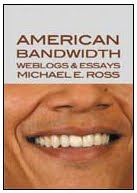
America from 2004 to 2009 –its new ironies and old habits, its capacity for change and transition – is topic A in this collection of essays and blog posts on pop culture, the war in Iraq, Hurricane Katrina, a transformative presidential election and the first 100 days of the Obama administration. | Now available at Authorhouse
One nation subject to change: A collection of topical essays exploring television, hip-hop, patriotism, the use of language under Bush II, and the author's own reckoning with mortality. | Available at Authorhouse
A veteran journalist, producer and blogger, Michael Eric Ross contributes to Medium, and the content channels of Creatd Media. He writes from Los Angeles on the arts, politics, race and ethnicity, and pop culture. A graduate of the University of Colorado, he's worked as a reporter, editor and critic at several newspapers and websites, including The New York Times, the San Francisco Chronicle, the San Jose Mercury News, MSN, Current, msnbc.com, and TheWrap, a major online source of entertainment trade news. He was formerly an adjunct professor at the Columbia University Graduate School of Journalism. His writing has appeared in The New York Times Book Review, Wired, Entertainment Weekly, PopMatters, Salon, The Root, seattlepi.com, NPR.com, theGrio, BuzzFeed, Daily Kos, and other publications. Author of the novel Flagpole Days (2003); and essay collections Interesting Times (2004) and American Bandwidth (2009), he contributed to the anthologies MultiAmerica (edited by Ishmael Reed, 1997) and Soul Food (2000).

.jpg) It’s not supposed to be this easy. The act of demonizing “the other” political party can be a bit of a tic, a reflex, an automatic piling-on often prone to anything but civility. But it all makes sense, the demonizing is justified when “the other party” seems to go out of its way to alienate, obfuscate, distort and flat-out lie — when that party does everything it can to remain “the other.”
It’s not supposed to be this easy. The act of demonizing “the other” political party can be a bit of a tic, a reflex, an automatic piling-on often prone to anything but civility. But it all makes sense, the demonizing is justified when “the other party” seems to go out of its way to alienate, obfuscate, distort and flat-out lie — when that party does everything it can to remain “the other.”

.jpg)
.jpg)
.jpg)
.jpg)
.jpg)


.jpg)

.jpg)