You should be redirected to the new address. If that doesn't happen in a second, visit http://short-sharp-shock.blogspot.com Oh, and update your bookmarks. Thanks.
We get so jaded these days. At every turn we’re disappointed and hardened by opportunists and mountebanks, rat bastards and fools of every shape and kind. It’s gotten easy, too easy, to adopt cynicism as a kind of baseline reaction to everything; people are “suspected murderers” instead of “murder suspects,” guilty until proven innocent. It’s a sour world, and the gray clouds never seem to lift.
But they do lift, more often than maybe we think. They lifted on July 3, when the Ambassadors of Harmony, a 160-member men's barbershop chorus based in St. Charles, Mo., sang at the 71st annual Barbershop Harmony Society's convention in Anaheim, Calif., and blew the roof off the joint in a rousing vocal and musical performance that flirted with nothing less than Perfection. The Ambassadors won the gold in the chorus division.
The award-winning group belongs to SPEBSQSA, the Society for the Preservation and Encouragement of Barbershop Singing in America. But don’t be confused by the quaint, spats-and-corsets label of “barbershop singing.” This isn’t your grandfather’s barbershop sing, with men in straw boaters and striped vests crooning “Sweet Adeline.” This is barbershop on steroids.
The group won the competition almost two months ago, and somehow it escaped our attention all this time (credit Robert J. Eilsberg, a columnist and screenwriter, for writing movingly about the performance on Friday in The Huffington Post). The group’s performance was contrary to the times we live in, all big and gooey and sentimental and Harking Back to an Earlier Time. And guess what? It works, maybe more now than at any other time.
◊ ◊ ◊
First, there’s the performance itself, a physical act that deserves exploration.
Put simply, singing can be hard work. The righteous positional marriage of the diaphragm, the lungs, the palate, the teeth and the mouth is a tricky one, and any partner in that marriage can file for divorce at any moment. And singing is difficult enough when you’re standing still, with a sturdy center of gravity.
Watch the video. You’re witnessing a special kind of singing taking place. Everyone on that stage is in constant motion, from virtually the first moment to the last, and there’s not a note, not a phrase out of place.
Another thing: This isn’t a rock & roll extravaganza. This isn’t a hip-hop battle, with everyone on stage brandishing a live mike, throwing his voice to the cheap seats.
The Ambassadors of Harmony, all of them, share one strategically placed stage microphone, but that’s it. That’s all. That sound you hear ringing against the rafters is amplified mostly by the machinery of the human voice impressively displayed by humans singing, paradoxically, in one voice.
◊ ◊ ◊
Then there's the song that clinched the win. “76 Trombones,” the timeless showstopper from Meredith Willson’s “The Music Man,” is not an easy tune to sing. Its phrasing, its measured but relentless lyric multisyllabic style are nothing for the lazy, complacent vocalist to try. But the wondrous simplicity of its message — witnessing an American parade by the light of a dazzling morning sun — is its own reward with the right people to sing it.
And the Ambassadors of Harmony were the right people to sing it last month. They brought their A game. You can see it. You can hear it. Even through the distancing of a YouTube video … you can feel it.
◊ ◊ ◊
We get so jaded these days, so inured to the world around us. We think we know everything.
But sometimes, we encounter those moments that trump our smug attitudes, breach the walls of our cynicism, demolish snark and irony, and send us into the streets, shivering and in tears of joy unconfined, shouting “you gotta see this!” … marveling at just how good human beings can truly be.
This is one of those moments.
----- Image credit: Ambassadors of Harmony: From their Web site.
A wheel’s worth nothing if there’s no turning, and the wheel of popular momentum lately enjoyed by conservative extremists over health care, domestic public policy and all things Obama is beginning to shift (which is to say continuing the shift that started in November).
The yahoos have had their hours in the sun. More's to come, for sure, but more recently there’s a growing sense that these lower-case Nazis, these thugs and brown shirts of the Internet age, are getting their comeuppance, hoist on the petards of intolerance that’s more obvious every day.
Thank goodness, it’s not the kind of reckoning administered by American soldiers to upper-case Nazis in Quentin Tarantino’s over-the-top WWII splatter epic, “Inglourious Basterds.” But some in the extremist cadres and their supporters are getting the rhetorical Louisville Sluggers upside the head that they and their lies deserve:
Rep. Michele Bachmann, the harebrained mouthbreathing Republican congresswoman from Minnesota, was heckled Thursday night at a town hall in Lake Elmo, Minn., reported Roll Call and Glenn Thrush of The Huffington Post.
"There's a rumor that President Obama was going to have Tiger Woods play a round of golf with him on Martha's Vineyard this week while he was on vacation — "
At this point, HuffPost reported, she was interrupted by shouts of "Health care! Health care!"
She continued: "And I don't know that there's any truth to that rumor -- but there was also a rumor that the president was going to hit him up for a $300 trillion loan, which we might need for our economy."
Crickets. Followed by feedback (electronic and human).
"I would first like to thank you for turning a Reagan voter into a DFL activist," one person said of said one attendee. having joined the state Democratic-Farmer-Labor Party, essentially the apparatus of the state Democratic Party.
Roll Call reported that after Bachmann told a story about women giving birth in hospital hallways (by way of comparing American hospitals to those in the UK), a man in the audience piped up, "That happens here." Bachmann retorted, "I've given birth here probably more times than you, sir."
But it was weak. Bachmann was clearly off her game and out of her element, even if she was in her district. After a bit she retreated into her usual blustery jabbering, especially when she attempted to give her constituents some idea of the scope of the $9 trillion deficit projection, made by the nonpartisan Congressional Budget Office.
“Sometimes we can sometimes get confused when we hear the terms -- millions , billions, trillions,” she said. “What does that mean? Let's just take an example: A million seconds is eleven and a half days. A second is 32 years. A trillion seconds is 32,000 years-- there's a big difference between billions and trillions.”
◊ ◊ ◊
On Aug. 18, at a town hall in Dartmouth, Mass., Rep. Barney Frank masterfully called bullshit on one of the Tea Party crowd, a woman in the audience who compared President Obama to Adolf Hitler on matters tied to the health-care debate.
""Why do you continue to support a Nazi policy, as Obama has expressly supported this policy, why are you supporting it?" she asked.
Frank's response was one for the books. "When you ask me that question, I am gonna revert to my ethnic heritage and answer your question with a question: On what planet do you spend most of your time?
"As you stand there with a picture of the president defaced to look like Hitler, and compare the effort to increase health care to the Nazis, my answer to you is ... it is a tribute to the First Amendment that this kind of vile, contemptible nonsense is so freely propagated ...
"Ma'am, trying to have a conversation with you would be like trying to argue with a dining room table. I have no interest in doing it," Frank said to rounds of applause.
Game, set, match.
◊ ◊ ◊
Fox News commentator and loose cannon Glenn Beck, well into his own twilight of the morons, is finding that even more advertisers are abandoning his Fox “Program,” a desertion that stems from his on-air comments that President Obama is a racist.
From the Color of Change Web site: “Adding to an increasing list of companies distancing themselves from Fox News Channel's Glenn Beck, ten new companies whose ads were recently seen during Beck's program -- Applebee's, Bank of America, Bell & Howell, DirecTv, General Mills, Kraft, Regions Financial Corporation, SAM (Store and Move), Travelers Insurance and Vonage -- have pledged to take steps to ensure that their ads don't run on Beck's show. Forty-six companies have now committed not to support Beck's show since ColorOfChange.org launched its campaign three weeks ago …”
“Over 170,000 people have now signed our petition to Glenn Beck's advertisers, and it's working.”
Still, stupid dies hard. On Wednesday, in a malign tweak on Tim Russert’s classic 2000 election whiteboard moment, Beck used a blackboard to build a laughably tenuous connection between oligarchy and various first letters in several words tied to the governmental excesses Beck has convinced himself Obama is guilty of. He’s pulled a variation of this stunt before, earlier this month.
It’s hard not to see these mad rants for what they are. But shit still floats: The Los Angeles Times reported on Aug. 24 that despite the controversy, Beck’s viewership has hardly collapsed. His “Program” has averaged 2.25 million viewers, almost 100 percent more than tuned in during the same period last year. The comparison may not be a fair one; last year the network aired campaign-related coverage (“America’s Election HQ”) in that time period; such an apples-to-oranges comparison is inherently unequal. Still, The Times reported, the Beckster’s ratings are up from July, when the “Program” averaged a hair over 2 million viewers.
But clearly, for those who really matter, the bloom is off the Glenn Beck rose. It’s one thing for advertisers to vacate en masse a program on a network when the parent company of that network is flush with cash; it’s another matter entirely when that parent company (in this case News Corporation) is deep in debt (about $20 billion as of last October), and necessarily in need of every advertiser in every daypart it can get.
A Fox News spokeswoman said that while some advertisers have "removed their spots from Beck," they’ve moved to "other programs on the network, so there has been no revenue lost." But that’s putting the best face on a deteriorating situation; if an ad’s lost on one show, only an ad to replace it maintains the status quo. Advertisers — risk-averse in good times, much less these times — aren’t likely to pull an ad in a less controversial timeslot just to make an unprincipled flamethrower like Glenn Beck look good.
◊ ◊ ◊
It’s even happening to other more principled members of the Republicans and conservative establishments.
In his own presumably friendly backyard — the city of Phoenix — Arizona Sen. John McCain encountered a pissed-off crowd at a Wednesday town-hall meeting about health care reform. The Associated Press reported that it got so bad, McCain had to tell one a maverick in the audience — a woman who wouldn't stop yelling — that she would had to leave the event.
The AP said McCain hadn’t even officially opened the proceedings before the woman started firing questions and comments, apparently leaving her copy of Roberts’ Rules of Order on the dresser at home.
"You're going to have to stop or you're going to have to leave," McCain told her. When security guards appeared to escort her out, the senator told her "Goodbye, see ya," to hearty applause, The AP reported.
But that malcontent was the least of Big John’s problems.
Straight from AP:
After McCain opened it up to questioning, one man angrily pointed at him and asked the senator why he deserves a better health care plan than him.
"I'm trying to get it for you," McCain told him. "We'll do it for you. We'll make it affordable and available to you."
Other audience members in the crowd of 2,000 told McCain about their medical problems, such as HIV and multiple sclerosis.
McCain said he’d fight for health care reform but repeated his opposition to Obama's plan for a government health-care option that would compete with private insurers in the marketplace. AP reported that one audience member yelled at him that he gets hundreds of thousands of dollars from insurance companies every year.
In a voice of feigned surprise, McCain said "Really? I didn't know that."
“There's more interest and involvement in this issue than I've ever seen in many years on a domestic issue," McCain said afterward. "There's obviously strong feeling and emotions on this issue ...”
Ya think? Really? We didn’t know that.
◊ ◊ ◊
All in all, and as events this week made clear, this isn’t the best time to be an open-minded, principled conservative in America. And in some ways, it’s an even worse time to be a wacko conservative in America. People are beginning to understand that however incomplete or imperfect Obama’s health-care plan might be, it’s still a plan — and as such, it’s the one thing the Republicans on Capitol Hill and in the echo chamber of conservative media haven’t earnestly, meaningfully offered in the health-care debate: a better way forward.
So the blowback the GOP is laying the groundwork for against Obama next year may not be what’s expected. It’s been said that while presidential elections are about change, midterm elections are about anger.
We’ve known this was coming for forever, it seems, but when the news arrived late last night it was still a shock and surprise. He’d come through so many battles in the past, personal and congressional; maybe we hoped for one more comeback from adversity, one more win, one more hurrah.
Massachusetts Sen. Edward Moore Kennedy, father, uncle, brother, sailor, unabashed keeper of the liberal flame in American politics and for forty-seven years the unapologetically liberal voice and conscience of the United States Senate, died Tuesday night of a glioblastoma multiforma of the left parietal lobe of the brain, an aggressive tumor diagnosed in May 2008. He was 77 years old.
The passing of the lion of liberal causes more than closes a chapter in a family’s history. It ends with irrevocable finality an era of American politics in which bipartisanship was not only possible but more commonplace than today, a time when reaching across the aisle wasn’t just a good idea, it was a concession to the notion that, again unlike today, “the loyal opposition” could be defined as much by the modifier in that phrase as by its seemingly defining noun.
Since 1962, Kennedy’s central pursuit has been affordable quality health care for all Americans; the battle for that national health care has again taken center stage, as the Democrats show the possibility of moving that ball down the field for the first time in generations. It’s anyone’s guess how much further along the health-care bill would be toward becoming law had Teddy been in a condition to weigh in on from the Senate chamber floor.
But it’s inescapable that the senator from Massachusetts was a meaningful exception to the usual rule of Washington politicians, and his exceptionalism — as a human being, a leader and a champion of health care reform — could be the unspoken dimension of the health-care debate now raging in Washington.
Cruel irony: Going forward, it’s possible that Sen. Ted Kennedy may have more immediate impact on the advancement of health-care reform now, after his passing, than he could summon from his fellow senators when he strode the halls of power on Capitol Hill.
After then-eldest brother John was assassinated in Dallas in November 1963; after older brother Robert was assassinated in Los Angeles in June 1968, the dynastic title of presidential heir apparent fell to Ted Kennedy. He was already a sitting senator, had been since 1962. For many if not most political observers, it would be only natural, according to the ascensionist tendencies of American politicians, for Teddy to seek the White House. Teddy did not disappoint.
In 1980, he made his one run for the big chair, challenging incumbent Jimmy Carter and losing to Carter in a bitter primary campaign, despite Kennedy’s attempt to get Carter-committed delegates released from their pledges. After that defeat, Kennedy hunkered down in the Senate, making his long-term intentions plain in 1985, when he announced he wouldn’t seek the presidency in 1988:
“I know this decision means I may never be president. But the pursuit of the presidency is not my life. Public service is.”
◊ ◊ ◊
Historian Doris Kearns Goodwin noted last year: “[T]he trouble with so many senators nowadays [is] they’ve got that dream in their minds of the presidency, so they don’t settle down to that institution.”
And Ted Kennedy settled down in that institution; he walked it like he talked it in 1985, and in so doing transforming the United States Senate — and the United States of America — in ways he might never have achieved had he just become president.
Of 2,500 bills he introduced, more than 300 were made into law. Kennedy was a catalyst, if not the catalyst, behind legislation that ultimately led to COBRA (health insurance benefits for the unemployed), Meals of Wheels, AmeriCorps, Title IX (athletic programs for women students), HIPAA (which set new benchmarks for portability of consumers’ insurance and the confidentiality of patient records), SCHIP (childrens’ health insurance) and the Americans With Disabilities Act.
And Kennedy was poised, until illness got in the way, to follow through on that abiding passion in a new Obama administration — an administration he helped come to pass at the Democratic National Convention on Aug. 25, 2008, a year to the day before he died.
“For me this is a season of hope, new hope for justice and a fair prosperity for the many and not just for the few,” Kennedy said at Invesco Field in Denver.
And then, reprising a speech he first made in December 1979: “And that is the cause of my life — new hope that we will break the old gridlock and guarantee that every American — north, south, east, west, young, old, will have decent quaoity health care as a fundamental right and not a privilege.”
The irony is apparent and cruel: Kennedy’s words were as apt in 2008 as they were in 1979; the idea that the ball hasn’t been advanced on making national health-care reform a reality in almost thirty years is one of the nation’s more profound tragedies.
◊ ◊ ◊
The question is, what happens now? The Obama health-care reform bill is set for a vote sometime in September. Some have voiced the possibility, however remote in today’s climate, that Kennedy’s passing (from a form of one of the diseases that’s long been the insurance industry’s pre-existing tripwire for denial of service) might elicit an emotionally galvanizing reaction, maybe even latent support from obstructionist Blue Dog Democrats and No-addicted Republicans. One of those on the hard-headed right, Sen. Orrin Hatch of Utah, said outright that there’s no reason to think Kennedy’s death will change any minds on Capitol Hill.
His death may not change many minds; the open question is whether it changes any hearts. Because at root, that’s what this is all about: something that’s not so much an intellectual or actuarial matter as it is a moral issue, a matter of empathy not for one’s fellow citizens, but for one’s fellow human beings.
Despite Kennedy’s efforts, and to our eternal national shame, the quest for national health care continues. The dream of achieving it may never be closer to realization than it is right now. When it arrives, we can thank that all-too-human champion of everyday people, that irrepressible sailor in the Figawi regatta, that captain who steered hard by the North Star of his principles, for making it happen. ----- Image credits: Kennedy top: Senate photograph (public domain). Kennedy 1962: Public domain. Kennedy 1980: Still from CBS News. Kennedy 2008: Pool.
Inspired by the impact and music of Michael Jackson, and by the symmetries between MJ’s life and his own, Spike Lee announced a few weeks back his sponsorship of a Brooklyn-style street party in Michael’s honor, a throwdown set to happen on Saturday, Aug. 29, what would have been Michael’s 51st birthday.
Never mind that Lee, a resident of Manhattan’s Upper East Side, hasn’t lived in Brooklyn since about 1999: Spike’s heart is in the right place. This is a far better use of Michael Jackson’s birthday than that which had been planned by the family; the Jackson clan had intended to bury MJ that same day.
Also, New York City Councilwoman Letitia James wants a plaque honoring MJ placed at Brooklyn's Hoyt-Schermerhorn station – where the star made the music video for "Bad" in 1987 — or to have "Jackson" added to the name of the subway station on the IND line. She’s planning a petition drive to make that happen.
On the eve of that now-sad, remembering day comes what Michael Jackson fans have quietly dreaded: the report from the Los Angeles coroner. When it was released, it just confirmed our suspicions that in his last hours, Michael Jackson was at the mercy of his own history, and the powers of control and leverage that both helped give his career its loft, and aided in its awful decline.
Recently, Dr. Conrad Murray, the Houston cardiologist who had become Jackson's personal doctor, emerged from the cone of silence he went under after Michael’s death, posting a video on YouTube — a sensible pre-emptive strategy when you’re looking down the barrel of a high-profile criminal investigation. “I told the truth and I have faith that the truth will prevail,” Murray said in part.
According to the report from exhaustive conversations between Murray and the Los Angeles Police Department, these, apparently, are the facts:
On June 25 about 1:30 a.m., Murray administered a10 mg Valium to Jackson, to help the singer deal with the insomnia that had plagued him for weeks, in the wake of rehearsals for a series of major performances.
At around 2 a.m., Murray administered another sedative, lorazepam (trade name Ativan) — this one intravenously.
About an hour later, at 3 a.m., Murray administered the sedative midazolam (trade name Versed), also intravenously.
At 5 a.m., Murray went back to using intravenous Ativan for Jackson, who apparently was still not sleeping.
At 7:30 a.m., apparently still looking for the right combination to help his patient get some rest, Murray injected Jackson with Versed again.
Finally, at about 10:40 that morning, Murray administered 25 mg of propofol, a clinical anesthetic marketed as Diprivan and not generally known about by, much less used by, the general public. Jackson wasn’t breathing when Murray returned to the singer’s room a few minutes later, Between fifteen and twenty minutes after that, amid failed efforts to revive him, the King of Pop was going quickly, or already gone.
◊ ◊ ◊
According to a search warrant affidavit unsealed Aug. 24 in Houston and dated July 23, the L.A. medical examiner-coroner’s office, headed by Dr. Lakshmanan Sathyavagiswaran, “had reviewed the preliminary toxicology results and his preliminary assessment of Jackson’s cause of death was due to lethal levels of [propofol (Diprivan)].”
But you don’t have to be a lawyer to sense something that’s just … wrong about the coroner’s assessment. Out of the pharmacy’s worth of sedatives Jackson ingested over a period of nine hours, why would only 25 mg of a hospital-grade anesthetic be the tipping point? Given the known dangers and risks of drug interaction, what seems more likely (to this untrained observer) is that the relentless cascade of drugs coursing through his system for hours set the stage for one fatal event.
With an already depressed central nervous system, it’s possible that taking even the slightest amount of one more drug — any depressant, and taking it intravenously, bypassing any dilution in the stomach — would be the That Did It moment, the moment of no return.
How can “lethal levels” of Propofol be so certainly implicated as the cause of death when Jackson was reportedly using it for weeks before his death? If his body built up a tolerance to the drug, as often happens, he’d have needed more and more of it to achieve the desired effect — not less and less of it, as Murray claimed he was administering in an attempt to “wean him off” the drug.
◊ ◊ ◊
The coroner’s office has yet to release the final results of its findings; even if forensically justified, it’s somewhat surprising that eight weeks after the death of a transcendent figure in pop culture, the coroner’s report into that death still bears a “preliminary” status.
As lawyers begin circling the wagons, there are more surprises coming in the Michael Jackson story. One thing that’s developing now that’s no surprise is the sense that, little by little, a legal case is being made against Murray certainly for manslaughter, and maybe something more.
Darren T. Kavinoky, a California criminal defense attorney, explained it Monday for MSNBC: “When we’re talking about manslaughter, we’re talking about a departure from acceptable medical standards that’s more than what we call ordinary negligence. It’s criminal negligence.”
The other, no-brainer non-surprise? Claims and counterclaims will obscure the real tragedy, suits and countersuits will lead us to forget what we’ve lost; in part because of doctor feelgoods, enablers, employees and hangers-on would deny him nothing, perhaps the greatest entertainer of our time died as a pharmaceutical pincushion. ----- Image credit: Jackson top: White House (public domain). Valium: Department of Justice (public domain). Ativan tablets: Nsaum75, republished under Creative Commons Attribution ShareAlike 3.0 license. Propofol: Public domain. Jackson bottom: blackcelebkids.com.
The health-care reform debate has been diced, sliced and Limbaughed to the point of becoming something we don’t even recognize any more. With town halls hijacked by strident hysterics jabbering any number of talking points, and gun-totin’ lunkheads in Arizona and New Hampshire just outside the venues of these town halls, there’s been enormous heat surrounding this potentially most important issue, and damn little light.
The issue has been viewed through the medical, actuarial, economic and political prisms of Washington, the blogosphere and the national media. But a conference call made by President Obama on Wednesday to Christian, Jewish and Muslim faith leaders points to a new Team Obama strategy to achieving his health-care reform objective: addressing health care as a moral issue.
Just as all other approaches to achieving this monumental legislation have apparently failed, and there’s every reason to think that they will, Obama may be about to deploy his truly secret weapon: a politically diverse, faith-based community of influentials that will accept nothing less than universal coverage, on the basis of the exercise of Scriptural values — values these faith leaders are apparently prepared to vote on, perhaps as soon as November 2010.
Never let it be said that Barack Obama doesn’t know how to use the bully-pulpit powers of his office.
◊ ◊ ◊
The first part of this was apparently rolled out on Wednesday, when President Obama conducted the conference call attended by those faith leaders, and maybe as many as 10,000 other callers, random citizens with skin in the health-care game (as we all do, sooner or later).
Among those on the call was the Rev. Jim Wallis, the president of Sojourners, a prominent faith-based organization. Wallis appeared on "The Ed Show" on MSNBC on Wednesday, and gave host Ed Schultz his conservative perspective on the roiling health-care debate — and what at least some in the faith-based community are prepared to do about it.
“With the shouting, the anger and the hate we’re seeing in town meetings, we’re losing … the moral core of this debate, which is, a lot of people are hurting in this broken health-care system,” Wallis said.
“This is right at the heart of our vocation. Right now, fear is controlling this debate, and we have to start talking about truth-telling …
“People — our friends, our loved ones, our neighbors— are hurting. This broken system has to be fixed, and the faith community is not going to settle for anything less than full, accessible health-care coverage for all of God’s children.”
◊ ◊ ◊
When a faith leader like Wallis throws down the gauntlet like that, it’s understood that he and others like him do it with the only real power they've got at their disposal (and, rendering unto Caesar, the only one that really matters): the power to vote.
And since those in the nation’s faith communities tend to be older, more politically conservative and more financially secure than other, younger Americans, Wallis’ challenge to Congress to get the health-care job done carries more throw weight than it otherwise might. Conservatives in Congress tend to pay attention to the faith-based constituents in their districts. For good reason.
The president recognizes this, and the power of boiling the health-care reform debate down to its humanistic essence. He recognized this Wednesday when he said, on the conference call, that passage of a meaningful health-care bill is “what I consider to be a core ethical and moral obligation, and that is that we look out for one another.”
◊ ◊ ◊
Obama may be again on the verge of rising to the occasion, as he’s done in the past with other pivotal national issues. His race speech in Philadelphia — perhaps the most masterful exegesis of our third-rail racial fears as any American leader has ever attempted — sticks in the mind as proof that Barack Obama can step up his game like nobody’s business, when the need be.
Today, in another master stroke, Obama brought back the spirit of FDR’s fireside chats, speaking with conservative Philadelphia radio talk show host Michael Smerconish one-on-one at a makeshift studio in the White House, discussing the health-care issue with everyday Americans, and bypassing the GOP spin machine to make his case directly to that audience.
Discussing health care, Obama hinted at what may be a new strategy when he spoke of “ a basic standard of decency” as it relates to health care for the least of us.
Then, right after the Smerconish huddle, Obama joined an online health-care town hall, the Organizing for America National Health Care Forum, at Democratic National Committee headquarters.
◊ ◊ ◊
The upshot of all this is simple: the president is going back on the PR offensive on health care, trying to regain both the momentum and the machinery of public opinion on health care. Thursday’s attempt to reframe the debate on the airwaves shows he’s willing to go straight for the same audience right-wing radio lives by.
And there may be more coming. In a powerful but principled on-air debate with MSNBC's Schultz on Wednesday, Newsweek’s Jonathan Alter predicted flat-out that President Obama would convene a joint session of Congress on the matter.
That would, of course, be a display of the usual big stick of presidential politics. The departure from the script has already happened. From now until the vote, we can expect President Obama to make use of the Golden Rule — to set a more clearly moral tone to the debate — as he pursues health care reform.
That appeal to adherents of the Bible, the Torah or the Koran may not make any difference in the outcome of the bill. It could make a huge difference next year, when conservatives make their own appeal to those faith-based Americans, and millions of others, in the voting booth. ----- Image credits: Obama: Chuck Kennedy, The White House.
Like a doctor looking for the right words with which to communicate a dire diagnosis, President Obama has been trying to tell the American people what others within his party and outside it have been more effectively saying for weeks now: the public option of the proposed Obama health-care reform plan is probably as dead as something can be without a toe tag on a body in the morgue.
Or maybe not, depending.
We should have seen this coming. The president cued us to a shift in position when he spoke Saturday at the town hall in Grand Junction, Colo.:
“The public option, whether we have it or we don’t have it … is not the entirety of health-care reform. This is just one sliver of it, one aspect of it.”
Listen to what Kathleen Sebelius, his secretary of health and human services, said Sunday on CNN’s “State of the Union”: The public option “is not the essential element.”
The italics are entirely mine, and there for a reason. It’s in these feints of the language, these rhetorical dances that the Obama administration seems to be letting people know that the most effective measure ensuring competition for Americans’ health-care services is off the table.
◊ ◊ ◊
Or maybe not. Even Republicans and Blue Dog Democrats can read polls. They can surely appreciate, if not agree with, the overwhelming majority of Americans who want a public option in the health reform bill.
The 12th annual Health Confidence Survey, sponsored by the Employee Benefit Research Institute (EBRI) and released in June, reveals just how out of step conservatives are on the public-option issue:
From the EBRI Web site: “Between 68 percent and 88 percent of Americans either strongly or somewhat support health reform ideas such as national health plans, a public plan option, guaranteed issue, expansion of Medicare and Medicaid, and employer and individual mandates, the survey finds.”
And a NBC News poll, released today, found that when the details of the Obama health-care plan were thoroughly explained to them, 53 percent of Americans agree it was a good idea (once they got past the conservative noise machine that’s tried to characterize the Obama plan as the work of the spawn of Satan).
◊ ◊ ◊
That should be good news for the President: The American people back him, in general, on the public option. What should be more concerning (in light of the weathervane shifts on the public option that recent Team Obama statements suggest) is today’s Rasmussen poll, whose results lock the administration into the public option it said it wanted all along.
From Rasmussen:
“Just 34% of voters nationwide support the health care reform plan proposed by President Obama and congressional Democrats if the so-called “public option” is removed. The latest Rasmussen Reports national telephone survey shows that 57% oppose the plan if it doesn't include a government-run health insurance plan to compete with private insurers. …”
“Without the public option, just 50% of Democrats support the legislation. That’s down from 69% support measured a week ago.”
That in a snapshot nutshell is the dilemma facing the Obama administration: The American people are saying, “in for a penny, in for a pound.” The Obama administration needs to get its arms around that, too.
◊ ◊ ◊
There’s more at stake than a health-care system that’s been in guarded condition for decades. There’s more at stake than the elections in 2010, a vote that could dismantle the plans for achieving the administration’s agenda across the board.
What’s also at stake is the credibility of the president himself, and the public perception of his willingness to stand on the scaffold of principles he erected during the campaign. Back then, and certainly during the heady early months of the administration, the public option was more than a sliver of Obama’s health-care proposal; it was the centerpiece of that proposal.
Even taking into account the prevailing political wisdom — a candidate tacks to the left on the campaign trail, moving rightward as the likelihood of being elected increases — there comes a time to get behind the bedrock of a platform that got you elected, and stay there. There comes a time to dance with who brung you.
The public option is the partner Obama brought to the dance of national health-care reform; together, they’re the couple that much of this country supports. There’s no changing partners now. ----- Image credit: Obama: Samantha Appleton, The White House. Obama bottom: Still from AP video, possible pool origin.
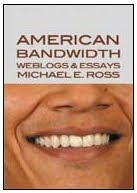
America from 2004 to 2009 –its new ironies and old habits, its capacity for change and transition – is topic A in this collection of essays and blog posts on pop culture, the war in Iraq, Hurricane Katrina, a transformative presidential election and the first 100 days of the Obama administration. | Now available at Authorhouse
One nation subject to change: A collection of topical essays exploring television, hip-hop, patriotism, the use of language under Bush II, and the author's own reckoning with mortality. | Available at Authorhouse
A veteran journalist, producer and blogger, Michael Eric Ross contributes to Medium, and the content channels of Creatd Media. He writes from Los Angeles on the arts, politics, race and ethnicity, and pop culture. A graduate of the University of Colorado, he's worked as a reporter, editor and critic at several newspapers and websites, including The New York Times, the San Francisco Chronicle, the San Jose Mercury News, MSN, Current, msnbc.com, and TheWrap, a major online source of entertainment trade news. He was formerly an adjunct professor at the Columbia University Graduate School of Journalism. His writing has appeared in The New York Times Book Review, Wired, Entertainment Weekly, PopMatters, Salon, The Root, seattlepi.com, NPR.com, theGrio, BuzzFeed, Daily Kos, and other publications. Author of the novel Flagpole Days (2003); and essay collections Interesting Times (2004) and American Bandwidth (2009), he contributed to the anthologies MultiAmerica (edited by Ishmael Reed, 1997) and Soul Food (2000).

 We get so jaded these days. At every turn we’re disappointed and hardened by opportunists and mountebanks, rat bastards and fools of every shape and kind. It’s gotten easy, too easy, to adopt cynicism as a kind of baseline reaction to everything; people are “suspected murderers” instead of “murder suspects,” guilty until proven innocent. It’s a sour world, and the gray clouds never seem to lift.