You should be redirected to the new address. If that doesn't happen in a second, visit http://short-sharp-shock.blogspot.com Oh, and update your bookmarks. Thanks.
Cheer up: A diversion from fretting over the sad ephemera of your 401(k) statement will soon be available to you. Get ready to carve out a movie night sometime this spring or summer ... he’s baaaack, and he’s still the one you’ll love to hate, more now than you did 20 years ago. And with good reason.
Gordon Gekko, the suavely cynical investment buccaneer of Oliver Stone’s “Wall Street,” returns later this year in “Wall Street 2: Money Never Sleeps,” the long-awaited sequel to the 1987 film that typified the freewheeling Reagan era of the financial bazaar — the precursor to the financial temblor we’re climbing out from under today.
Michael Douglas, Oscar-winning producer (“One Flew Over the Cuckoo’s Nest”) and current VOG for the NBC Nightly News, won the Oscar for best actor for his portrayal of Gekko, a ruthless Wall Street trader. The original ended with Gekko on his way to the slammer for an undetermined number of years.
Fast forward to what’s next. In Stone’s sequel, Gekko’s getting out of jail and doing so in high style.
One way or another, this is gonna be a lot of fun. And much of it will center around one player. Taking nothing away from Shia LeBeouf, Carey Mulligan ("An Education"), Frank Langella or Josh Brolin (George Bush in Stone’s “W”), the big draw here, the one who’ll put asses in the theater seats, is Michael Douglas.
He was always nothing less than entertaining in the original, his warped moral principles embodied in a coiffed, gregarious dynamo with a relentlessly cocksure charm. It should be great to see how Gekko the lion has mellowed after X years in the pen. Or if he’s mellowed: some images from the trailer suggest he’s up to his old moneyed tricks. And count on Stone to make a point or twelve about the very real connections between the Reagan-era economy and its hallmark of deregulation, and the fallout we’re enduring right now as a direct consequence of that deregulation.
For one brief white-hot moment, Joseph Andrew Stack — he’s already acquired the American nomenclature for evil, identified with all three of his names, like Lee Harvey Oswald or John Wilkes Booth — became the archetypal American: a doer, an achiever, someone willing to act on an idea and exert the energy to bring it to reality. The fact of that reality, of how he made his simmering passions explode to life, is more of a problem for the rest of us. Those of us who share some of his frustrations. Whether we admit it or not.
A little before 10 a.m. on Thursday, Stack, a 53-year-old software engineer nursing years-long outrage with the Internal Revenue Service, flew a single-engine plane from an airport in Georgetown, Texas, to Austin, about 30 miles away, and then angled the plane into the Echelon Building, a seven-story glass-faced structure where almost 200 IRS employees worked.
Stack died in the crash and/or the subsequent fireball and explosion, as well as at least one person in the building. And Stack didn’t detonate in half measures; he went all the way off, apparently setting fire to his home near the crash site before he flew out of the Georgetown airport.
Not long after the incident, which instantly roused memories of and connections of 9/11, federal officials took note of what appear to be Joe Stack’s last words: a long, rambling but fully articulated (if not reasoned) combination manifesto and suicide note that Stack apparently posted on a Web site earlier in the day.
Stack begins: “If you're reading this, you're no doubt asking yourself, ‘Why did this have to happen?’ The simple truth is that it is complicated and has been coming for a long time. The writing process, started many months ago, was intended to be therapy in the face of the looming realization that there isn't enough therapy in the world that can fix what is really broken.”
What follows is a tale of “the storm raging inside my head,” a bildungsroman animated by life as an independent contractor; frustration with the government; outrage with the recent bailouts on behalf of the “thugs and plunderers” in business and the government; personal false starts and thwarted hopes; retirement savings prematurely exhausted; divorce and bitterness; months of peanut butter and Ritz crackers as a staple diet; and the individual powerlessness driving his belief that “desperate times call for desperate measures.”
Some, uh, highlights:
“We are all taught as children that without laws there would be no society, only anarchy. Sadly, starting at early ages we in this country have been brainwashed to believe that, in return for our dedication and service, our government stands for justice for all. We are further brainwashed to believe that there is freedom in this place, and that we should be ready to lay our lives down for the noble principals represented by its founding fathers. Remember? One of these was “no taxation without representation.” I have spent the total years of my adulthood unlearning that crap from only a few years of my childhood.” ...
“I remember reading about the stock market crash before the “great” depression and how there were wealthy bankers and businessmen jumping out of windows when they realized they screwed up and lost everything. Isn’t it ironic how far we’ve come in 60 years in this country that they now know how to fix that little economic problem; they just steal from the middle class (who doesn’t have any say in it, elections are a joke) to cover their asses and it’s “business-as-usual”. Now when the wealthy fuck up, the poor get to die for the mistakes… isn’t that a clever, tidy solution.” ...
“I know I’m hardly the first one to decide I have had all I can stand. It has always been a myth that people have stopped dying for their freedom in this country, and it isn’t limited to the blacks, and poor immigrants. I know there have been countless before me and there are sure to be as many after. But I also know that by not adding my body to the count, I insure nothing will change. I choose to not keep looking over my shoulder at “big brother” while he strips my carcass, I choose not to ignore what is going on all around me, I choose not to pretend that business as usual won’t continue; I have just had enough.”
◊ ◊ ◊
Cybesq, commenting at The Huffington Post, makes an irrefutable point: “You have to love the thought process of lunatics. He rails against the rich, claims they control the government, and then flies his plane into a building of modestly paid government workers.”
But Jason, commenting on Stack’s manifesto at Business Insider, saw something else: “How can anyone call this man insane? It looks to me that his hostility has been building up for several years. Insane implies you are not in control, this man, it seems, was very deliberate in his actions. Thankfully he didn’t kill a bunch of people. Sounds like he tried to "fudge" his taxes, at least one year, you cannot f#ck with IRS, WARS ARE EXPENSIVE! and ‘somebody’ has to pay for them. Watch out people, it's only going to get worse. ...”
James weighed in, also at Business Insider: “He was extremely eloquent and a long way from a crackpot … perhaps he sees the matrix as it really is, perhaps you need to look at what is really going on. Today Wachovia announced that they have only foreclosed on 1% of the people in default.... the country is hurting because of the big banks and Wall Street, and nobody is protecting the average citizen. In fact, the Supreme Court just ruled that corporations can put as much money as they like behind any candidate that they feel.”
In what may be the most egregious kowtow of a major political party to a political nonentity in at least recent American history, Michael Steele, the chairman of the Republican National Committee, met on Tuesday with members of Tea Party WDC, maybe the most formally established manifestation of the series of ad hoc conservative protesters and extremist malcontents that have rallied under the Tea Party banner for nearly a year.
Steele reportedly huddled with about 50 Tea Party leaders for more than four hours, discussing their angles of attack on the Obama White House, what Republicans and Tea Partiers have in common, and what they don’t have in common, in the runup to the 2010 midterms.
“The chairman believes it is extremely important to listen to this significant grassroots movement and work to find common ground in order to elect officials that will protect these principles,” RNC spokesperson Katie Wright said Tuesday to The Washington Post, offering an olive branch the size of a tree to the cohort of American conservatives that could, maybe, be a force in November.
We may be months away from a political scenario once thought improbable but more and more likely all the time, a variation on the storyline of “King of Hearts,” the 1966 Philipe de Broca film that posits what happens when the inmates run the asylum, and the town it’s located in.
◊ ◊ ◊
The devil and the details are inseparable. Even as the Tea Party makes its mainstream move (a unifying flag-bedecked logo, spokesmen with titles), it’s forced to come to grips with issues that have complicated its existence from the jump.
Credibility has been a problem for the Tea Party set. To this point, the TP’s followers have been characterized by a noisy intolerance that traffics in the symbols of don’t-tread-on-me populism married to silly exercises of self-identification (Tea Party members walked around last April wearing tea bags) and virulent intolerance (others carried signs that equated President Obama with Hitler).
To now, it’s been an orange-pekoe protest whose buffoonery contained just enough extremist rhetoric to make it something to take at least semi-seriously. But it’s hardly enough to suggest it could be a political game-changer for the broad cross-section of Americans who vote.
Another problem for the Tea Party (really, stemming from the first one) has to do with the fraud of its genesis. When the first large-scale Tea Party protests began last April 15, in demonstrations from Oak Harbor, Wash., to Sag Harbor, N.Y., they were heralded as the bellwether of a new grassroots, bottom-up movement in America.
The facts were something else again: A parade of K Street lobbyists and government insiders like former House Majority Leader Dick Armey and former House Speaker Newt Gingrich were instrumental in sparking and bankrolling the protests; and Fox News, the conservatives’ media arm, broadcast the Tea Bag Day rallies from various places around the country.
It’s impossible to believe that the fingerprints of such conservative powers could have disappeared from the movement in less than a year. The populist thrust of this movement was blunted from the start, and still is, by the involvement of the same government and corporate insiders the movement was meant to protest against in the first place.
◊ ◊ ◊
What’s the Tea Party’s reason for being? From the start, most people couldn’t see much difference between the bullet-point credo of the Tea Partiers and that of the Republicans. Even today, Americans still can’t find daylight between their mutual positions. The GOP and the Tea Partiers are in lock step on major issues like tax cuts, smaller government and the disturbingly imprecise notion of “returning to American values."
With no substantive differences in their basic philosophy, then, the TP movement is faced with a question: What can it hope to do in Washington that the GOP can’t do with more resources, more lobbyists, more like-minded partisans already on Capitol Hill? Carving out a distinction when there’s not much distinction is a huge challenge if you define yourself as an independent grassroots political insurgency — like the Tea Partiers do.
That’s what the Tea Partiers have tried to do: articulate distinctions between themselves and the Republicans; they’re doing what they can to make their claim of independence stick. “We're not a function of the Republican party,” one D.C. Tea Party member said last April, and said for a damn good reason. Implicit in that statement is an inescapable fact: If the Tea Party finds common cause with the Republicans, the Tea Party has absolutely no reason to exist.
Former Alaska Gov. Sarah Palin may be either the most daringly self-inventive political figure on the American scene or just the one most desperately in need of a clue. From making the mavericky decision to quit her state post (vacating a power position of some leverage if she really wanted to be president) to writing a roguey book that nonetheless made her a millionaire in as close to overnight as this economy allows, Palin is carving out a reputation as a Rashomon presence in our political culture: adored or reviled, depending on your perspective.
Two recent events bear that out all over again. On Feb. 6 at the Gaylord Opryland Hotel in Nashville, Palin addressed the first Tea Party Convention, a gathering of conservative iconoclasts, ideologues and malcontents for whom the Republican Party is, for now, apparently not conservative enough. Palin, a darling of the Tea Party set, vaulted into another variation of her set speech:
“Very good to be here in Tennessee, the Volunteer State. It’s the home of good country music and good southern barbeque, and…great to be at the Tea Party Convention. I guess down here, that’s some southern sweet tea. And you know, up in Alaska, we have a smaller version of Tea Party up there, and we call it ice tea.
“And I am a big supporter of this movement. I believe in this movement. Got lots of friends and family in the lower forty-eight who attend these events, and across this country, just knowing that this is the movement and that America is ready for another revolution, and you are a part of this. ...
“This is about the people ... and it's a lot bigger than any charismatic guy with a TelePrompter,” Palin said at one point, making a reference to Obama's use of TelePrompters.
But something shows up on the replays of her Nashville speech. At one point, when her left hand is momentarily open, it’s visible: there are talking points clearly written on her left hand in ink:
Independent journalist Stefan Sirucek, writing in The Huffington Post, offers a clarification:
“The notes most likely weren't for her speech, for which she used prepared remarks, but for the Q&A session that followed, during which she glanced at the hand in question.
“But in my opinion that's even worse.
“There were no specifics on there, just general concepts and things she supports.
“The takeaway is that this presidential contender apparently can't remember her supposed core principles and needs a cheat-sheet when simply asked about her beliefs.
To quote Charlie Brown: Good grief.”
◊ ◊ ◊
Jotting crib notes on one’s hand is nothing new for public speakers. It’s usually done to spur a speaker’s recall of salient points to be elaborated on at length and in depth. What’s so problematic for Palin is how this plays into the long-building narrative that she doesn’t think on her feet that well.
And what was written — a clutch of bullet-point words and phrases — only superficially dovetailed with anything approaching a policy statement or an original political philosophy. The handwritten notes and the address they stemmed from had only the scarcest detail and insight. They point to how Palin thinks in bromides and slogans, skimming the surface of the nation’s most important issues.
The Tea Party crowd assembled in Nashville wouldn’t have cared that night; they greeted her with rapturous applause, and the kind of automatic hosannas professing an appeal that continues not in spite of the mainstream’s denigration of Palin, but because of it.
◊ ◊ ◊
A new poll released near the same time as Palin’s hand job indicates that the country as a whole is a lot less charitable. A Washington Post-ABC News poll conducted between Feb. 4 and Feb. 8 found that 52 percent of Republicans say she’s not fit to be president.
Among the general American population, 71 percent of people say she is unqualified for the gig — an 11 percent increase in unfavorables just since November.
A Feb 1-3 Gallup Poll puts it another way. Naming their preferences for the 2012 derby, 14 percent of Republicans or Republican-leaning voters — independents in all but name — support former Massachusetts Gov. Mitt Romney for the presidency. Fourteen percent is hardly a ringing endorsement, but at this early stage and no firm field of contenders, it’s pretty much expected.
But it’s striking that, after her furious media exposure since the 2008 camapign (a best-selling book, a job as a Fox News analyst, numerous magazine covers and mentions) only 11 percent of those voters in the Gallup survey back a Palin campaign in ’12.
That response could be based as much on disbelief in her political acumen; in some ways it could be their way of saying that right now, Palin’s overexposed, a light burning twice as bright for half as long.
Palin’s problem, now and in the ’08 GOP debacle, has been having the ability to build a consensus of like-minded partisans, few of whom have a like mind to begin with. Her initial post-2008 support from regular Republicans smitten with the promise of a new and attractive face has fragmented into backing from the Tea Partiers, whose birther-fueled hate is hardly a platform for a springboard to a national campaign, let alone a shot at a national victory.
And Palin herself speaks in such passive-aggressive, flag-bedecked generalities, she’s created a following built around the flimsiest outlines of a political philosophy. She’s the Great & Powerful Oz from the Yukon.
And since for the most part her talking points dovetail with those of the Republicans — tax cuts, rein in government spending, fidelity to GOP social tripwire issues — the question for the rock-ribbed GOP crowd and independents alike is simple: Why fool around with a Republican Lite when they can have the real thing?
The fact that at this point Romney leads any hypothetical pack of Republican contenders is important. If he’d had a sharper message and been a more inspiring messenger, Romney might well have been the Republican nominee for president in 2008. As it is now, from the standpoint of personal achievement, government service and political credibility, Romney’s electables dwarf Palin’s by orders of magnitude. There’s not enough room on both of her hands to write the reasons why. Image credits: Palin: Reuters/Josh Anderson. Palin left hand: Unknown. 2012 poll snapshot: Gallup Poll.
We interrupt the regularly scheduled joyous hysteria visiting New Orleans on Fat Tuesday with an early bulletin: The New Orleans Saints — a team and a collective metaphor for the city it represents — won Super Bowl XLIV tonight.
That’s not a dispatch from the bizzarro world, as anyone who’s watched this spirited, inspired, talented team win and win and win all season already knows. It was the realest of real deals: 44 days after Christmas, 44 years after the Saints organization was first awarded an NFL franchise, the former whipping boy of the NFL won Super Bowl No. 44, defeating the Indianapolis Colts 31-17.
Fat Tuesday, Feb. 16, was already on the city’s calendar. You can call tonight Fat Sunday. Laissez les bon temps roulez, tout de suite.
◊ ◊ ◊
In a game that had analysts quietly licking their chops at the prospect of coronating Colts quarterback Peyton Manning as Perhaps the Greatest QB of All Time, the Saints spoiled the Colts party with one of their own.
Saints QB Drew Brees mixed it up the hard way, battling back despite an early 10-0 deficit, grinding it out play after play. The Saints combined dogged but spirited offense with opportunistic defense and Garrett Hartley, a field-goal kicker whose points after seemed almost laser-guided.
Saints head coach Sean Payton, who combined undeniable coaching skills with the guts of a burglar and the soul of a riverboat gambler, took risks in different ways throughout the game. Using everything from a smart (and successful) coach’s challenge to a timely reverse to the very act of gambling on Brees (who underwent shoulder surgery after the 2005 season) in the first place, Payton proved he wouldn’t play by the books.
It was most obvious tonight when the Saints, scoring a Hartley field goal in the second quarter to trail 10-6, started the second half with an onside kick.
A pre-fourth quarter onside kick, in the Super Bowl. Find that in the damn playbook. Who pulls shit like that? Payton’s crew does, and the Indianapolis Colts (anticipating the deep kick for a runback) were every bit as surprised as the TV analysts and the crowd at Florida’s SunLife Stadium. The Saints recovered the ball and started the second half of the game with a quick touchdown, and a serious shot to the psyche of the Colts. ESPN said it was the first successfully completed onside kick before the fourth quarter in Super Bowl history.
◊ ◊ ◊
Manning was off his feed much of the night; at times on the sidelines he seemed sullen, rattled and maybe even angry. And the Colts as a team were less than the sum of their well-oiled machine parts. The feared Colts defensive end Dwight Freeney spent much of the fourth quarter sidelined, nursing a still-healing torn ligament in his right ankle, offering himself as a testing aid to the trainers who practiced their taping skills on that ankle the rest of the game.
Little by little the tide turned and stayed turned. Hartley makes another field goal from deep space. Brees hits Jeremy Shockey for a TD that gives them the lead. Payton, bold again, successfully challenges the ruling that Lance Moore had not scored on the 2-point conversion. Saints 24-17.
Meanwhile, Colts kicker Matt Stover misses one from 51 yards out. Colts receiver Pierre Garcon drops a pass; later Garcon was called for offensive pass interference. In the aggregate, the Colts played a decent game, despite some key mistakes that on the whole weren’t more than any other team might post on any given Sunday.
But this was The Super Bowl. The Indianapolis Colts, who had posted stellar numbers all season en route to the best win-loss record in the NFL, had been playing like supermen. They picked the wrong game to turn into mere mortals.
It was all distilled in the last three minutes of the game. Down 24-17, Manning and the Colts mounted a feverish last-minute drive. Manning makes a short pass across the middle, a throw intended for Reggie Wayne. Not today. Looking for the main chance, Saints defensive back Tracy Porter intercepts the pass, and returns it 75 yards for a touchdown.
Game, set, match, title, party.
◊ ◊ ◊
It was hard not to be torn by deep, emotional — and, yeah, racial — affinities either way you placed your bets. You wanted to side with Indianapolis Colts head coach Jim Caldwell, one of only five rookie head coaches to reach the Super Bowl, and one of only three African American coaches (Tony Dungy and Lovie Smith are the others) to get to the big show.
But this year the stakes were bigger than victory for a team, more so than in any other Super Bowl in recent memory. What was at stake for New Orleans was its sense of itself, its idea of the possible four and a half years after the ravages of Hurricane Katrina.
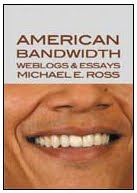
America from 2004 to 2009 –its new ironies and old habits, its capacity for change and transition – is topic A in this collection of essays and blog posts on pop culture, the war in Iraq, Hurricane Katrina, a transformative presidential election and the first 100 days of the Obama administration. | Now available at Authorhouse
One nation subject to change: A collection of topical essays exploring television, hip-hop, patriotism, the use of language under Bush II, and the author's own reckoning with mortality. | Available at Authorhouse
A veteran journalist, producer and blogger, Michael Eric Ross contributes to Medium, and the content channels of Creatd Media. He writes from Los Angeles on the arts, politics, race and ethnicity, and pop culture. A graduate of the University of Colorado, he's worked as a reporter, editor and critic at several newspapers and websites, including The New York Times, the San Francisco Chronicle, the San Jose Mercury News, MSN, Current, msnbc.com, and TheWrap, a major online source of entertainment trade news. He was formerly an adjunct professor at the Columbia University Graduate School of Journalism. His writing has appeared in The New York Times Book Review, Wired, Entertainment Weekly, PopMatters, Salon, The Root, seattlepi.com, NPR.com, theGrio, BuzzFeed, Daily Kos, and other publications. Author of the novel Flagpole Days (2003); and essay collections Interesting Times (2004) and American Bandwidth (2009), he contributed to the anthologies MultiAmerica (edited by Ishmael Reed, 1997) and Soul Food (2000).

.jpg)
.jpg) He was always nothing less than entertaining in the original, his warped moral principles embodied in a coiffed, gregarious dynamo with a relentlessly cocksure charm. It should be great to see how Gekko the lion has mellowed after X years in the pen. Or if he’s mellowed: some images from the trailer suggest he’s up to his old moneyed tricks. And count on Stone to make a point or twelve about the very real connections between the Reagan-era economy and its hallmark of deregulation, and the fallout we’re enduring right now as a direct consequence of that deregulation.
He was always nothing less than entertaining in the original, his warped moral principles embodied in a coiffed, gregarious dynamo with a relentlessly cocksure charm. It should be great to see how Gekko the lion has mellowed after X years in the pen. Or if he’s mellowed: some images from the trailer suggest he’s up to his old moneyed tricks. And count on Stone to make a point or twelve about the very real connections between the Reagan-era economy and its hallmark of deregulation, and the fallout we’re enduring right now as a direct consequence of that deregulation.

.jpg)
.jpg)

.jpg)
.jpg)


.jpg)
.jpg)
.jpg)