With stunning speed after a seemingly endless 22-month investigation, U.S. Attorney Patrick Fitzgerald today finally put someone’s ass in his briefcase in connection with the CIA leak inquiry [see “Waiting for Fitzgerald”]. The first shoe has dropped and it landed squarely on Irving Lewis “Scooter” Libby, the chief of staff for Vice President Cheney, who was indicted by a federal grand jury, on Fitzgerald's recommendation, on five counts of perjury, false statements and obstruction of justice.
Libby, lately glimpsed coming in and out of the White House on crutches, resigned his position in the White House, surrendering his access pass and, presumably, all the perks and privileges connected to his high-profile, maximum security clearance position in the Bush administration. The man known as “Dick Cheney’s Dick Cheney,” the first White House staffer indicted while in office in 130 years, is looking down the barrel of a possible maximum sentence of 30 years in the slammer and $1.25 million in fines. Scooter was last seen scooting his Yale-educated ass out of the White House, probably for the last time without a visitor’s pass.
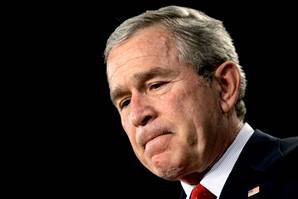
President Bush, the gravity of the situation evident on his face, appeared to offer a terse, six- or seven-sentence statement he might as well have phoned in: We’re sorry to see Scooter go; like everyone in America, he’s entitled to a presumption of innocence until proven guilty; we’ve got a job to do on behalf of the American people and we’re going back to work. He turned and practically fled from the microphones and headed for Marine One for his weekend trip to Camp David, where he’s no doubt hunkering down with aides to try and pull a distracting rabbit out of his hat – most likely the name of a new nominee for the Supreme Court, most likely to be released to great fanfare on Monday.
What followed on the television talk shows and news programs was one of the most immediate and orchestrated exercises in damage control this White House has ever undertaken, and there have been plenty. Right-wing apologists of every stripe emerged to defend the administration, some of them with the nerve to say that, paraphrasing now, “things could have been worse; all in all, this is actually a great day for the administration.” The thinking seemed to be that, with Libby out of the way, things could get back to something approaching normal for the Bushies.
MSNBC analyst and former Republican apparatchik Pat Buchnan called the president’s statement on the White House lawn “brilliant and savvy.” It was neither. In Bush’s brief comments there was nothing more or less than an example of boilerplate butt-covering, hardly anything akin to brilliant, not so much savvy as politically instinctive CYA.
Questions remain. At a 66-minute news conference announcing the indictment, Fitzgerald repeatedly made it clear that the investigation continues and that more indictments were possible. Fitzgerald didn’t mention administration architect Karl Rove by name, but Fitzgerald spoke of a shadowy “Official A” who may be the source of the leak, and possibly the linchpin to the outcome of this sordid mess. Could it be Rove? Could it even be Cheney?
There's much to compel that suspicion. Newsweek reporters Howard Fineman and Richard Wolff, in the magazine's newest issue, offer a plausible connecting of the dots: "Fitzgerald will inevitably have to shine a light on the machinery that sold the Iraq war and that sought to discredit critics of it, particularly Joseph Wilson. And that, in turn, could lead to Cheney and to the Cheney-run effort to make Iraq the central battleground in the war on terror."
Thus are second presidential terms frozen in place. It damn near happened to Reagan; it did happen to Nixon and Clinton -- that slow unraveling of noble intentions and grand agendas, made the victim of hubris in high places.
Some people in Washington must surely know this, or at least sense it. There’s a strong probability, for example, that junior White House staffers are working this weekend at 1600 Pennsylvania Avenue, though not so much working as pursuing their own form of damage control: updating their resumes to remove all mention of employment there.
Next week should be entertaining, if not instructive. The wheels of Fitzgerald’s investigation are grinding forward, with no telling where all this will end up. This bit of political theater is revealing the seams and patches of the Bush administration mindset more tellingly than any of the Bushies’ official policy statements. The Libby indictment, along with the Harriet Miers debacle and the long-running agony of the Iraq war, show the Bush White House in the position of reacting to events, rather than directing them. The flight to Camp David will lead, mark our words, to a transparent attempt to regain the high ground of public attention next week.
Regardless of those attempts, the historical parallels between this administration and another presidency are inescapable and have been for some time. A new parallel is lately emerging.
It’s been obvious for some time that Iraq is George Bush’s Vietnam; what remains to be seen is whether or not the president and his associates can prevent this current domestic meltdown from becoming George Bush's Watergate.
The betting window is open.
Friday, October 28, 2005


Thursday, October 27, 2005
The 'pit bull' in the kennel
George Bush’s annus horribilis just keeps rolling along. An announcement today reveals just how high the burn rate really is on that “political capital” he claimed to have inherited two days after the 2004 election. With White House counsel Harriet Miers’ voluntary withdrawal from consideration to fill the pending vacancy of Associate Justice Sandra Day O’Connor, President Bush has experienced the latest in a series of body blows to whatever vestige of Leadership & Prestige he has left. In the world of bad-luck presidential poker, George Bush keeps doubling down – by accident.
 It’s anyone’s guess if the president’s nomination of Miers was meant as a real, honest validation of his estimation of her as a litigator and a champion of the law, or as a flattering but calculated maneuver meant to buy him time to build momentum for naming Attorney General Alberto Gonzales to the high court, which is what he’s thought to have wanted all along. Whatever the real reason, it has backfired in a way that underscores the image of an administration in a free fall – a government waiting on what may or may not be the next blow to the head from some guy named Fitzgerald.
You’re tempting to blame his handlers and advisers, but something about the nomination of Miers from the beginning seemed to be so stunningly off the wall, it was quite clear in this instance that the president was taking no one’s bad advice but his own. It was always hard to imagine Harriet Miers as an especially brilliant mind, with anything close to withering erudition, anything faintly resembling the rapier insights of Holmes, Brandeis, Frankfurter and Warren.
There were, in the early going, some people (me included) who were willing to give her the benefit of the doubt on the grounds of bringing to the high judiciary a lived-in life, with experiences and viewpoints off the beaten track; we knew she was a lawyer, one who worked capably and efficiently in the pressure cooker of the post-Sept. 11 White House, and she was in some personal respects refreshingly out of the mold [in both spatial and fungal contexts] of those who ascend to the closest thing we have to a throne in America.
Then the Senate Judiciary Committee began the process of drilling down into the nominee’s substance – as much for her positions on topics of the day as for a sense of her grasp of constitutional law. Sen. Charles Schumer of New York, a mensch on the Hill if there’s ever been one, gave her more than one benefit of the doubt, saying at first that she could be the consensus candidate they were dreaming of. Schumer later met with her, made nice … and kept digging, and not digging so terribly far before he found himself coming up on dry wells of constitutional scholarship where there should have been gushers.
Others in the Senate said much the same. A groundswell of bipartisan opposition emerged, rude and smug, strident and talk-radio mean. You half expected a crowd with torches and pitchforks to roll the tumbrels up onto the White House lawn in a hunt for her office, her staff and herself.
Harriet Miers had the inescapable bad luck to be the juggling act to follow a performance by the judicial equivalent of Lord Olivier. The nimble, polished presentation of John G. Roberts Jr. at his confirmation hearings set an incredibly high bar, and anyone following his act in front of the senators would have paled by comparison.
But there were shortcomings. The senators on the committee knew it. Harriet Miers probably knew it. The press knew it (or they said they knew it, but of course they say they know everything). Maybe even the president knew it (he wouldn’t say he knew it, but frankly sometimes we wonder if he knows anything).
The “pit bull in size 6 shoes” who stormed out of the gate with such promise– what, two weeks ago? – is back at her desk in the White House kennel again, one of many people lately dispatched to the doghouse, and not likely to be the last.
 It’s anyone’s guess if the president’s nomination of Miers was meant as a real, honest validation of his estimation of her as a litigator and a champion of the law, or as a flattering but calculated maneuver meant to buy him time to build momentum for naming Attorney General Alberto Gonzales to the high court, which is what he’s thought to have wanted all along. Whatever the real reason, it has backfired in a way that underscores the image of an administration in a free fall – a government waiting on what may or may not be the next blow to the head from some guy named Fitzgerald.
You’re tempting to blame his handlers and advisers, but something about the nomination of Miers from the beginning seemed to be so stunningly off the wall, it was quite clear in this instance that the president was taking no one’s bad advice but his own. It was always hard to imagine Harriet Miers as an especially brilliant mind, with anything close to withering erudition, anything faintly resembling the rapier insights of Holmes, Brandeis, Frankfurter and Warren.
There were, in the early going, some people (me included) who were willing to give her the benefit of the doubt on the grounds of bringing to the high judiciary a lived-in life, with experiences and viewpoints off the beaten track; we knew she was a lawyer, one who worked capably and efficiently in the pressure cooker of the post-Sept. 11 White House, and she was in some personal respects refreshingly out of the mold [in both spatial and fungal contexts] of those who ascend to the closest thing we have to a throne in America.
Then the Senate Judiciary Committee began the process of drilling down into the nominee’s substance – as much for her positions on topics of the day as for a sense of her grasp of constitutional law. Sen. Charles Schumer of New York, a mensch on the Hill if there’s ever been one, gave her more than one benefit of the doubt, saying at first that she could be the consensus candidate they were dreaming of. Schumer later met with her, made nice … and kept digging, and not digging so terribly far before he found himself coming up on dry wells of constitutional scholarship where there should have been gushers.
Others in the Senate said much the same. A groundswell of bipartisan opposition emerged, rude and smug, strident and talk-radio mean. You half expected a crowd with torches and pitchforks to roll the tumbrels up onto the White House lawn in a hunt for her office, her staff and herself.
Harriet Miers had the inescapable bad luck to be the juggling act to follow a performance by the judicial equivalent of Lord Olivier. The nimble, polished presentation of John G. Roberts Jr. at his confirmation hearings set an incredibly high bar, and anyone following his act in front of the senators would have paled by comparison.
But there were shortcomings. The senators on the committee knew it. Harriet Miers probably knew it. The press knew it (or they said they knew it, but of course they say they know everything). Maybe even the president knew it (he wouldn’t say he knew it, but frankly sometimes we wonder if he knows anything).
The “pit bull in size 6 shoes” who stormed out of the gate with such promise– what, two weeks ago? – is back at her desk in the White House kennel again, one of many people lately dispatched to the doghouse, and not likely to be the last.
Wednesday, October 26, 2005
Waiting for Fitzgerald
 All apologies to the late great Samuel Beckett, but one can't resist appropriating the title of his most famous play and tweaking it a little, in honor of the most intense, excruciating waiting game Washington has seen in at least five years -- one that's likely to have a big impact on the Bush administration's domestic agenda for the next three years.
The nation's capital waits -- in what MSNBC's Chris Matthews turgidly called "a tangy meringue of the maudlin and the giddy" -- on the indict/no-indict decision by U.S. Attorney Patrick J. Fitzgerald, the special counsel appointed more than two years ago to investigate the possible complicity of certain figures in the Bush White House in the outing of CIA agent Valerie Plame's identity, as an act of political retribution against her husband, former ambassador Joseph Wilson, for his failure to toe the mark on the White House party-line policy of Iraq as nuclear-capable boogeyman.
The administration is in the unlikely position of being at the mercy of an outside force; long used to being the catalyst of events, the Bushies are compelled to wait and see what transpires. In the balance: possible indictments for perjury and obstruction of justice for Karl Rove, White House deputy chief of staff and by all estimations one of two powers behind the throne; and I. Lewis "Scooter" Libby, chief of staff for Vice President Cheney, the shadow president of the United States, who walks the corridors of power with the smirk of a man giddy with the realization of being the one who runs the country without getting the heat of the man elected to run the country.
The prospect of losing the architect of the Bush presidency and another high-ranking official a heartbeat away from the man an irregular heartbeat away from the presidency has Foggy Bottom Republicans in a quiet panic. Some have already retreated into defensive postures that owe more to instinct than to intellect. Sen. Kay Bailey Hutchison, the Texas senator herself under a past ethical cloud, has already gone on the record saying that the possible perjury charges amounted to a "technicality." Bow-tied right-wing apologist Tucker Carlson said as much to Matthews on the same show last night.
These reflexive political crouches beg the question of why perjury was an impeachable offense for President Bill Clinton, during the Monica Lewinsky scandal, but is now no more than a minor flaw in the judicial process and one to be overlooked this time. What can you say? It's automatic, about as automatic and scripted as the probable response from the White House if indictments do come down (possibly tomorrow). The Los Angeles Times Web site has a story up by the excellent Doyle McManus reporting the likely strategy if the shithammer comes down: try to do the backstroke in the toilet bowl, work to serenely rise above the situation and come up with a suitable distraction.
As if they haven't adopted that approach in the past. Like yesterday, when the 2,000th known U.S. military fatality was reported. President Bush, in as close to a pre-emptive strategy as he's ever ventured, spoke before an audience of military spouses at Bolling Air Force Base in Washington, and admitted the agony of the nation's mounting losses affected him as well -- all the while insisting that America stay the course in Iraq.
These strategies may fail to work if Fitzgerald finds a true bill in this case. If he brings indictments against Rove, Libby or possibly even Cheney for being the source of the leak of Valerie Plame's identity, the mendacity of this administration will be laid bare on a global scale. The very underpinnings of the rationale for pre-emptive war will be questioned again, but with an urgency and a foundational skepticism from the national judiciary not seen before. And indictments will sure as hell embolden the already growing number of Americans against the war in Iraq, giving weight to their longstanding belief that the war on terrorism as prosecuted in Iraq was a fiction from start to finish.
Even if Fitzgerald doesn't indict them, or anyone else, there's a sentiment out there that suggests Fitzgerald -- by all indications something of a Boy Scout, a single, single-minded Irish-immigrant's son from Brooklyn utterly dedicated to the case at hand, whatever the case is -- may feel compelled to release some kind of statement of progress, a disclosure of what he did and didn't find, if for no other reason than to justify his expenditure of the taxpayers' money for two years.
Unlike the situation in Beckett's play, in which the two characters wait for someone who never comes, at least two of the protagonists in this little drama will realize a very real finalilty, one way or the other. Will Vladimir Libby and Estragon Rove be the subject of target letters? Let's wait and see.
Tuesday, October 25, 2005
2,000 points of light
The news came across the wires at 12:07 p.m. West Coast time: The U.S. armed forces fatality count reached 2,000 today. Army Staff Sgt. George T. Alexander Jr., 34, of Killeen, Texas, died over the weekend in San Antonio, Texas. Alexander, assigned to the 1st Batallion, 15th Infantry Regiment, 3rd Brigade, 3rd Infantry Division at Fort Benning, Ga., was wounded by a roadside bomb on Oct. 17 in Samarra, 60 miles north of Baghdad.
The 2,000th-death event was expected for some time; newspapers and Web sites were for weeks preparing special sections to make note of that grim, presumably inevitable numerical signpost. Editors and reporters probably had the phrase "grim milestone" coded into macro keys on their computers; so many of them used those words for previous somber war-related anniversaries -- like when 100 troops died, and when 500 died, and when 1,000 died.

Today the chief spokesman for the American-led coalition, Army Lt. Col. Steve Boylan, asked reporters covering the conflict not to read too much into a single number, actually having the nerve to describe the number as an “artificial mark.”
“The 2,000 service members killed in Iraq supporting Operation Iraqi Freedom is not a milestone," Boylan said presumably with a straight face, given the gravity of the circumstances. "It is an artificial mark on the wall set by individuals or groups with specific agendas and ulterior motives."
Boylan's half-right. It's an artificial mark not unlike the convenient numerical benchmarks the press relishes as a way to make their lives easier. Another one the press is fond of has happened with every administration of the past thirty years: the 100-day "report card" that's such a bane of our existence it begs the question of why we even bother to do it any more.
But in another way Boylan, like so many others seeking to legitimize an illegitimate conflict, misses the point. To call it artificial is to minimize the impact, individually and collectively, on the people involved. In our society we use numbers as an index to our joy and our pain, our triumphs and our sadness. That's how we keep score ... of everything that matters. There's nothing artificial about reaching the level of two thousand Americans killed in the prosecution of an unnecessary war.
“The 2,000th Soldier, Sailor, Airman, or Marine that is killed in action is just as important as the first that died and will be just as important as the last to die in this war against terrorism and to ensure freedom for a people who have not known freedom in over two generations,” Boylan e-wrote to reporters with an eloquence that would be profound if it weren't so self-serving.
The statement overlooks the fact that if the first soldier to die wasn't sent to die -- wasn't dispatched to perform a politician's errand -- the 1,999 to follow wouldn't have had to die either. Those deaths, either the first or the most recent, would be somewhat easier to take if the mission that Boylan parrots -- "to ensure freedom for a people who have not known freedom in over two generations" -- was the real reason those soldiers, sailors, airmen and Marines are over there in the first place.
And it's not. And the continuing deception practiced by the Bush administration -- its very own "specific agenda," pursued for the administration's own "ulterior motive" -- only makes our great national agony that much worse.
-----
Photo credit: Department of Defense
Monday, October 24, 2005
Rosa Parks (1913-2005)
 It was on a day in December 1955 when a black seamstress in Alabama got uppity in the Deep South, boarded a city bus and, by taking a seat in the wrong place, took a stand for the right thing.
Rosa Louise McCauley Parks died today at her home in Detroit, at the age of 92. In the rapidly passing parade of events -- a relentless cascade of tragedy and folly that makes it hard to keep track of what happened fifty hours ago, let alone fifty years -- Rosa Parks' statement endures, resonates in ways that many Americans, and just as certainly many black Americans, may have forgotten.
They never lived a life in which they had no choice about where to sit on a city bus or a commuter train; they've never had to contend with ridiculous distinctions made between one water fountain and another, or one bathroom on another, or one lunch counter seat or another.
Those distinctions began to be erased with Parks' stand on principle in December 1955. From that action, and her arrest afterward, the black residents of Montgomery, Ala., began a boycott that underscored the economic power of African Americans living under siege. For 381 days, blacks boycotted Montgomery buses, in an action spurred on by a relatively unknown minister named Martin Luther King.
With the landmark Brown vs. Board of Education ruling of the year before her sitdown statement, and the bus boycott that lasted more than a year after, the groundwork was laid for what became the modern civil rights movement, a concatenation of events, legislation and acts of personal courage that rings in the nation's ears today, regardless of whether or not the nation really wants to hear.
What more to say? Thank you, Sister Rosa; go to your rest, your job well done.
-----
Image credit: Montgomery (Ala.) Sheriff's Department
Wednesday, October 19, 2005
Doc Rice & the contractors
Sometimes the fallacy in an argument, a policy, a world-view is revealed in the smallest, slightest way. Walls of rationale and well-thought-out positions fall apart with a single word, one word that points to how weak the whole structure is.
Dr. Condoleezza Rice, the secretary of state, was testifying on Capitol Hill today, offering senators a blueprint for the foreseeable future of Iraq, flush with the apparent success of the Oct. 15 referendum on a draft constitution, despite vote certification irregularities that at this writing are yet to be fully identified -- is this the Middle Eastern equivalent of the hanging chad controversy?
In the course of her appearance -- customarily categorical, abrasive and dismissive, sometimes in the same sentence -- Doc Rice responded to a question from Massachusetts senator John Kerry. Madame Secretary spoke of the future of Iraq and how Iraqis' assumption of their own affairs, in the embrace of a Western-style democracy, would constitute "victory in this war."
Victory. The word summons every outmoded, antediluvian image you can think of. There's a 17th- or 18th- or 19th-century feel to its usage in this context, a subscribing to a polar, binary, us-vs.-them view of the world that properly ended with the dissolution of the Soviet Union. Doc Rice's use of the word, maybe more than any other, illustrates the anachronistic thinking behind much of the planning and execution of the war in Iraq.
The present conflict is fundamentally at odds with traditional conceptions of warfare, the comfortable framing devices of past conflicts that defined success in terms of geography, loot, empire in the most martially atavistic terms. Doc Rice's embrace of the word as a level of achievement suggests she's overlooked the ways that ideology, religion and faith have become the new yardsticks of success and failure. The war in Iraq is not a turf battle; this is hearts and minds writ large, and the danger is in this country's failure to see that indelible message, and to see how we ignored or overlooked that message before.
Doc Rice's simplification is one that the architects of the current conflict continue to embrace. On PBS' "News Hour With Jim Lehrer," one of the prevailing thinkers on the right gave a glimpse into the way the conservatives have distilled the contours of this conflict into something innocuous, and not a little elitist.
Walter Russell Mead, senior fellow at the Council on Foreign Relations, defended Doc Rice against the barrage of questions on the timetable of the war, and explained, or tried to, the futility of coming up with a timetable for getting out. "Fighting a war is a little like having a contractor come in and redo your kitchen," Mead said. "You want to know the deadline and you want to know the cost and you want everything to be done on time, and if things go over budget, you're very irate."
In Mead's "contractor mentality" cosmology, war is a willfully improvisational exercise in which armies are "testing their srength and trying strategies and looking for weak points in the opposition." (Much like you look for weak spots when you're trying to shore up your home's foundation.)
Mead's is a perfectly plausible, articulately expressed, readily accessible argument. It is also complete and unmitigated bullshit.
The basic wrong-headedness of his position stems from making an assumption based on his apparent past experiences with unscrupulous contractors. Despite what Mead believes, there's not a contractor worth his Better Business Bureau recommendation that doesn't really know what it takes to complete a job. It's not that the contractor doesn't know what the job will cost or how long it'll take -- it's just that he won't share that knowledge with you.
This begins to explain the dancing Doc Rice got into when asked, point-blank by Maryland Sen. Paul Sarbanes, for something resembling a timetable for extraction from the land of George's miseries. Will we start to be out in five years? In ten?
"We are moving on a course in which Iraqi security forces are rather rapidly able to take care of their own security concerns," she said. "...And as they are able to do certain tasks, as they are able to hold their own territory, they will not need us to do that."
The sharp reader will of course notice Doc Rice's use of the word -- that single undermining word again -- rapidly. That word, by its very nature, implies an action in some chronological framework, one in apposition to another, longer chronological framework. You don't think of things happening rapidly in a theoretical vacuum. It's always "rapidly" in relation to "slowly." The adverb preceding "rapidly," "rather," makes the sense of a prospective timetable even more obvious.
But clearly, this is a timetable that head contractor Doc Rice would prefer to keep to herself. It takes as long as it takes; it costs what it costs.
For Mead, the idea of a defined timetable for exit from Iraq isn't possible because of the precarious, unpredictable nature of warfare. "It's not one of those simple controllable processes," he said on "News Hour." Mead overlooks just how controllable a situation can be when you create it in the first place. His insistence that a timetable for gradual withdrawal is neither prudent nor possible runs up against the way the United States got into the war: by slow degrees, through incremental deceptions that happened so slowly but methodically it was hard to discern them as a building wave, until the wave was upon us.
Over more than a year the United States accrued the intelligence, materiel and popular support for beginning a war, then slowly developed plans for attack and invasion, then slowly executed those plans. The documentable metrics for starting military action were arrived at over a period of time; how can developing a documentable plan for ending that military action be unsound or difficult?
Like we said, it's not that the contractor doesn't know what the job will cost or how long it'll take -- it's just that he won't share that knowledge with you.
Zbigniew Brzezinski, the national security adviser under President Carter, understands what's at stake. On the same "News Hour" segment, Brzezinski made the case for full disclosure. "We have to take a critical look at the overall costs of the war, for America's legitimacy in the world, for our moral standing and, indeed, even for our resources, both military and economic."
Doc Rice and the contractors have the high ground right now, and they can charge whatever they want. But for the American people, the bill comes due too frequently. It shows up somewhere in America every day, a bill that doesn't come in the mail, a bill that shows up on the front porch, in uniform and somber expressions that say, without a word being said, that we regret to inform you ...
It's a bill the nation won't be willing to pay forever.
Subscribe to:
Posts (Atom)