We’re not where we used to be

You should be redirected to the new address. If that doesn't happen in a second, visit
http://short-sharp-shock.blogspot.com
Oh, and update your bookmarks. Thanks.

Wednesday, July 9, 2008

The McCain scrutiny IX

Sen. John McCain’s toughest opponent between now and November is likely to be a surprisingly nimble politician with an Islamic name, and it’s not who you think it is.

It’s true that Sen. Barack Obama has been an able challenger, but for McCain, the bigger concern in the short term may be dealing with Nuri Kamal al-Maliki, the elected prime minister of Iraq, whose inconvenient call on Monday for the United States to either leave Iraq or to set a timetable to do so has, in an instant, reset the dynamic of the Iraq war as a foreign-policy issue for the White House and a political issue for the McCain campaign.

This is McCain’s dilemma now: waging a political campaign whose stay-the-course militaristic underpinnings vis-à-vis Iraq have been suddenly undermined by the Iraqi government. It is only the latest of challenges before him.

◊ ◊ ◊

Maliki on Monday confirmed that his government was considering a short-term agreement with the United States that would extend the presence of American troops and include a timetable for withdrawal, The New York Times reported.
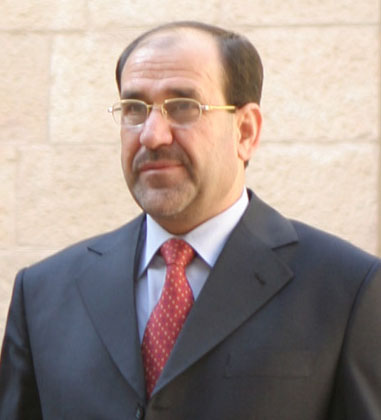
On Tuesday, through Mowaffak al-Rubaie, the Iraqi national security adviser, Maliki made it clearer still. “We will not accept a memorandum of understanding without having timeline horizons for the cessation of combat operations as well as the departure of all the combat brigades,” he said in a phone interview with Campbell Robertson of The Times.

Team McCain — along with the State Department of the same Bush administration that McCain says he thinks independently of — have said that something was lost in translation, that Maliki was speaking more in the context of a domestic politician, appealing to his constituency with a proposal rather than a plan; that any withdrawal plans will be determined “by the situation on the ground” — a position more or less identical to what Obama has maintained for months.


But McCain has already been on the record about where he stands on such a scenario. He laid it out at a speech before the Council of Foreign Relations on April 22, 2007:

“Well, if that scenario evolves, then I think it's obvious that we would have to leave … if it was an elected government of Iraq … I don't see how we could stay when our whole emphasis and policy has been based on turning the Iraqi government over to the Iraqi people.”

The McCain campaign will almost certainly refine its policies on this matter. As it is, the McCain shibboleth of opposition to a withdrawal timetable — one of his foreign-policy campaign weapons and the same “tantamount to surrender” club he’s tried to beat Obama upside the head with for months — has been neutralized as a campaign issue.


◊ ◊ ◊

McCain is vulnerable on another war-related front. His campaign’s obsession with Iraq as the front line on the war on terrorism largely overlooks evolving events in Afghanistan and Pakistan. Obama’s months-ago pivot toward national-security issues linked to those two countries puts him in a position of forward thinking — the Democrat considering the next theater in the war on terrorism, rather than the last one.

By continuing to focus on Iraq, and especially in the wake of Maliki’s demands, McCain has effectively positioned his own campaign behind the curve on this aspect of national security.

Under new management, Team McCain has retrenched somewhat, with a new round of campaign ads in the battleground states, ads intended to reintroduce McCain to the nation. One of the ads is instructive as much for what it doesn’t say as for what it communicates, at times movingly:


For all its documentary power and its assumption of the national symbols and verities, this ad preaches mightily to the choir. It doesn’t take us anywhere we haven’t been with McCain already; it fails to suggest how McCain would embrace not only force but also the strength of diplomacy in his foreign policy; and it offers no outreach to the millions of younger, disaffected voters he’ll need to prevail in the fall. It’s an eloquent line in the sand, but it’s the same line in the sand McCain has drawn in the past to distinguish himself from Barack Obama.

◊ ◊ ◊

More concerning for voters may be the baseline of terrorist fear McCain has sought to evoke in the nation as a reason for making him president. This came clear in June, when McCain chief strategist Charlie Black said, in a Fortune magazine interview, that another 9/11-style terrorist attack would play to the Republicans’ advantage.

This followed McCain’s own statement to CNN in December, after the assassination of former Pakistani prime minister Benazir Bhutto, that her killing would burnish his credentials on foreign policy. Team McCain’s play of the fear card didn’t go unnoticed.


“If this were just one comment by John McCain or one comment by his chief strategist, that might be forgivable or an apology might be credible,” said Democratic Rep. Robert Wexler of Florida, an Obama supporter, on MSNBC June 25. “But this is now the second, possibly the third instance in which the mindset of John McCain is becoming quite evident … he appears to be calculating the value of a terrorist attack or an assassination to his campaign. And that’s quite eerie.”

All of which is why McCain is hobbled, at least briefly, by Maliki’s call for withdrawal from Iraq. With his CFR speech last year, with Maliki’s demand for a pullout, and with the loss of the boogeyman of unbridled chaos in Iraq he’s waved in front of the American people, McCain is forced into having to actually articulate a policy on the war on terrorism that doesn’t feature Iraq as the main attraction, a policy that entertains (for him) the unthinkable: a timetable for bringing American forces home.

◊ ◊ ◊

Warm-fuzzy patriotic ads won’t change voters’ perceptions of McCain as an ardent and eager hawk; all the campaign retooling and staff-shifting in the world can’t alter the public’s foundational perception of McCain as first and foremost a cold-war champion of military force at the utter expense of diplomacy.

But then, subtlety and nuance aren’t strong suits for the Republicans. For the last seven-plus years, they haven’t had to be. John McCain has been and is now as much a victim of that fact as a beneficiary of it.

And sadly for McCain, that lack of subtlety and nuance in foreign affairs makes perfect sense: When you have crafted your political persona, generated so much of your political capital on defining yourself as a hammer, it’s no surprise that the world at large looks like nothing but a nail.
-----
Image credits: McCain: T toes, republished under Creative Commons Attribution 2.0 license. Maliki: Public domain. Framing hammer: Luigi Zanasi, republished under Creative Commons Attribution ShareAlike license 2.0 Canada. Nail: Marcos André, republished under Creative Commons Attribution 2.0 license.

Tuesday, July 8, 2008

The Webb browser is down

It all seemed so right for the Democratic ticket: Barack Obama, the junior senator from Illinois, change agent of the 2008 presidential race, paired with James Webb, the passionate Virginia senator whose bona fides on war and national security seemingly dovetailed with Obama’s domestic focus.

That combination — one the ‘Vox thought enough of to predict would be a lock for the general election — is apparently not to be. Webb took himself formally out of consideration Monday, in language direct and emphatic enough to suggest his rejection is more than the ritual dance of presidential politics.

“Last week I communicated to Senator Obama and his presidential campaign my firm intention to remain in the United States Senate, where I believe I am best equipped to serve the people of Virginia and this country. Under no circumstances will I be a candidate for Vice President,” Webb said in a statement released Monday.

◊ ◊ ◊

There could be any number of reasons. The first, of course, was included in the statement: “A year and a half ago, the people of Virginia honored me with election to the U.S. Senate. I entered elective politics because of my commitment to strengthen America's national security posture, to promote economic fairness, and to increase government accountability. I have worked hard to deliver upon that commitment, and I am convinced that my efforts and talents toward those ends are best served in the Senate.”

The generalities of that explanation aren’t especially singular to Webb; every politician commits to strong defense, economic prosperity and good government. Drilling down, Marc Ambinder at The Atlantic reported, from a Democratic source, that “… Webb did not want to relive the vigors of a campaign so soon after his election to the Senate.”

Or was it the little matter of offshore drilling? The Hill reported June 19 that Webb was split from Obama over the issue, with Webb supporting natural-gas exploration off the coast of Virginia, and attaching his name to a bill by Republican Sen. John Warner.

“Webb’s proposal, unveiled Wednesday with John Warner, would allow Virginia to request a federal waiver to drill for natural gas at least 50 miles from the coastline on an exploration-only basis. A second waiver would be needed if gas is found, and any revenues would be split between state and federal coffers,” The Hill reported.

◊ ◊ ◊

For Obama, Webb’s opt-out has negatives and dividends. Obama loses the undeniable gravitas his campaign needs on the national security front, as well as a published historical intellect that matches his own. But he gains freedom from the distractions of Webb’s sometimes abrasive, exuberant temperament and shoot-from-the-hip style — a sharp contrast with the more methodical Obama campaign ethos.

Obama may yet benefit from Webb on the stump. From the Webb statement:

“I am also renewing my commitment to work hard to make sure that Senator Obama wins both Virginia and the presidency this November. He is a man who speaks eloquently about our national goals and calls for the practical solutions that must be put into place to obtain them. I will proudly campaign for him."

That should give heart to Democrats who eye Virginia as winnable in November. The Appalachian region, and its fiercely proud Scots-Irish residents of which Webb is a descendant, is key to any Obama shift in the electoral map. The state, trending blue in recent years (Gov. Tim Kaine, another name bruited in the Veepstakes handicap, is a Democrat), is still considered susceptible to a return to its Republican voting history. Webb can help Obama here.

◊ ◊ ◊

Who’s still in play? Who isn’t? The list of remaining possibles for the Obama ticket — and that just means the list we know about — is still impressive. Sen. Joe Biden of Delaware, another prospect with foreign policy cred and long standing on Capitol Hill, may be at or near the top now. Sam Nunn of Georgia, a former chairman of the Senate Armed Services Committee, would lend the ticket the weight of past Washington experience (even though something about Nunn feels mysteriously Cheneyesque).

Former Sen. Chuck Hagel of Nebraska could put the Rocky Mountain West in play; his consistent anti-war stance would play well with Democratic party activists, and Hagel's being a Republican gives strength to Obama's reach-across-the-aisle style of politics.

Wesley Clark, former NATO supreme allied commander and aspirant for the presidency in 2004, gives Obama definite national security credentials, although he may have damaged his prospects with his recent comments dismissing McCain's military experience — comments that Obama, in a mastery of understatement, called "inartful." And former North Carolina senator John Edwards can't be overlooked as both a geographical balance for the ticket and a bid to break up the GOP's ostensibly solid South.

Obama-Webb is still a worldbeater, but we won't propose another Democratic ticket for 2008. We've seen just about everything happen this election year already, and there's still three-odd months before the fall classic. For now, though, despite the myriad advantages of that pairing, the Webb browser is off.

For now.
-----
Image credits: Webb: Public domain. Virginia sign: Public domain. Edwards: Mike Murphy, republished under GNU Free Documentation license.
-----
'Vox update: The Politico's David Paul Kuhn reported Saturday that Wesley Clark was taking a break from presidential politics. An aide told Kuhn that Clark is “moving on,” and can now “devote his time to the business affairs which pay the bills.”

Sunday, July 6, 2008

The farrago over Fargo

Like lemmings making a sprint for the ocean, the American press more or less collectively insinuated over the July 4th weekend that Sen. Barack Obama has changed his fundamental position on ending the Iraq war — a cornerstone of his presidential campaign. The fact that nothing could be further from the truth (as even a cursory look at the record would reveal) points to a disturbing rush to judgment on the flimsiest of pretexts.

It all started Thursday in Fargo, N.D., when Obama, responding to reporters’ questions on the airport tarmac, explained his stance on the war. “I continue to believe that it is a strategic error for us to maintain a long-term occupation in Iraq at a time when the conditions in Afghanistan are worsening, Al Qaeda has been able to establish bases in the areas of northwest Pakistan, resources there are severely ... strained. And we're spending $10 to $12 billion a month in Iraq that we desperately need here at home, not to mention the strains on our military.

“So my position has not changed, but keep in mind what that original position was. I've always said that I would listen to commanders on the ground. I've always said the pace of withdrawal would be dictated by the safety and security of our troops and the need to maintain stability. That assessment has not changed. And when I go to Iraq and have a chance to talk to some of the commanders on the ground, I'm sure I'll have more information and will continue to refine my policies.”

◊ ◊ ◊

No sooner had he said that then the campaign of challenger Sen. John McCain went into full-throated attack mode. Team McCain was in the first throes of a reinvention. Installing as campaign director the veteran GOP op Steve Schmidt (a man whose physical countenance suggests the prison camp guard from Central Casting), the McCain campaign issued a statement calling Obama’s statement proof of a reversal of his previous stand on bringing American forces home from Iraq.

Team McCain said Obama “has now adopted John McCain's position that we cannot risk the progress we have made in Iraq by beginning to withdraw our troops immediately without concern for conditions on the ground. There is nothing wrong with changing your mind when the facts on the ground dictate it. … Now that Barack Obama has changed course and proven his past positions to be just empty words, we would like to congratulate him for accepting John McCain's principled stand on this critical national security issue.”


A rush of stories followed from online and cable reporters, fixating on the phrase “refine my policies” and adopting the McCain line that Obama had flip-flopped on the war. It got so bad that Obama had to go back to the microphones later in the day. “Apparently, I wasn’t clear enough this morning,” he said, clearly upset by the need to restate his position. “The McCain campaign primed the pump with the press to suggest that somehow we were changing our policy, which we haven’t … that just hasn’t been the case.”

"Let me be as clear as I can be. I intend to end this war," he said. “On my first day in office, I will bring the Joint Chiefs of Staff in and I will give them a new mission, and that is to end this war responsibly, deliberately but decisively. And I have seen no information that contradicts the notion that we can bring our troops out safely at a pace of one to two brigades a month. And again, that pace translates into having our combat troops out in 16 months' time," he said, reiterating a timeline first mentioned last December.

◊ ◊ ◊

Obama’s nuanced second-draft statement wasn’t really necessary to anyone who compared what he said Thursday to what he said in the presidential debate on Sept. 26 in Dartmouth, N.H.:

“What I can promise is that if there are still troops in Iraq when I take office … I will drastically reduce our presence there to the mission of protecting our embassy, protecting our civilians and making sure that we’re carrying out counter-terrorism activities … “I believe we should have all our troops out by 2013, but I don’t want to make promises not knowing what the situation is going to be three or four years out.”

Some in the press, and Team McCain in general, have criticized Obama for tacking to the political center in the run to the general election. What are they failing to understand about the nature of American presidential politics? Only a political neophyte or an outright fool adopts a position that fails to respond to the shifting exigencies of reality. Obama’s 16-month pledge was never made in a vacuum, but in the context of contemporaneous events. The media’s rush to pile on in Fargo, without a wider grasp of what he said before, is baffling to say the least.


And lost in the sauce of talk about ending the war was Obama’s statement about what to do for the troops who went to fight it. Speaking Thursday at Fargo's Children's Museum at Yunker Farm, Obama called for the nation to improve its services to veterans with better medical and financial assistance for veterans, more funding to help vets buy homes, and ways to enhance the GI Bill — the same GI Bill that Vietnam War veteran McCain was against … until he was for it.

◊ ◊ ◊

The bigger challenge on politically handling the Iraq-war issue now falls to McCain. A recent report from the nonpartisan General Accountability Office finds that, by many benchmarks, the U.S. troop escalation referred to as “the surge” has largely succeeded.

From the report: “Overall violence, as measured by enemy-initiated attacks, fell about 70 percent in Iraq, from about 180 attacks per day in June 2007 to about 50 attacks per day in February 2008. Security gains have largely resulted from (1) the increase in U.S. combat forces, (2) the creation of nongovernmental security forces such as Sons of Iraq, and (3) the Mahdi Army’s declaration of a cease fire. Average daily attacks were at higher levels in March and April before declining in May 2008. … The number of trained Iraqi forces has increased from 323,000 in January 2007 to 478,000 in May 2008; many units are leading counterinsurgency operations.”


All of which, ironically enough, is a big political problem for John McCain, an early supporter of the strategy. The apparent success of the “surge” removes one of the main reasons for indefinitely maintaining U.S. troop strength at current levels. McCain, a champion of keeping troops in Iraq whether the “surge” worked or not, is faced with an obvious and inevitable question: If 150,000 American troops can’t come home when things are doing well, when will they be able to return? 100 years, perhaps?

McCain can’t have it both ways forever. In the face of a growing domestic discontent with the war and its cost in blood, treasure and global stature, McCain will be forced to take one side or the other — to adopt a position as clear and relatively unambiguous as the one Barack Obama has had, and repeated, for more than five years.

And for the American press, which on this story apparently left its skepticism in another pair of pants back at the hotel, the question is why so many reporters and columnists ran with the McCain view of events as the unassailable leads of their stories.

It’s been a foundational issue for Obama on the war: “What I do believe is we've got to be as careful getting out as we were careless getting in.” That kind of circumspection and investigation have largely eluded the McCain campaign on matters about the Iraq war. They shouldn’t elude the press.
-----
Image credit: Lemming: Public domain.

Wednesday, July 2, 2008

Another inconvenient movie

Seems a robot can’t even look for love 800 years in the future without drawing the scorn of the right wing right now. That’s the early message being sent by some protesting the new Walt Disney/Pixar movie “Wall-E,” which opened Friday. Many of the criticisms put a political spin on what is clearly an environmental message, but in an election year when phrases like “cap and trade” and “carbon credit” are working their way into the popular lexicon, complaints like that ring hollow when the truth is reflected in the mirror of fiction.

◊ ◊ ◊

The film’s background: It’s around the year 2100. The Buy N’Large corporation has essentially remade Earth in its image, so much so that our blue-green planet is not a place to come to, but a place to get away from, a vast and ecumenical holding company* that's more a factory than a planet.

In a frantic bid to keep its customer base of humanity alive, Buy 'n Large offers the earthbound residency in space, aboard several spaceships (dubbed “starliners”). Back on earth, millions of waste-disposal units (acronymed WALL-E) perform the role of trash compactors for earth, sweeping up after the human parade has moved on.

Fast forward 700 years. It’s 2805, and there’s only one WALL-E still working.

EVE (Extraterrestrial Vegetation Evaluator), a robot from one of the earth-escape ships, arrives on Earth, where she meets that last Wall-E in the world. A love story is born.


◊ ◊ ◊

Conservatives weren’t having any.

“Godforsaken dreck,” said Shannen Coffin in the National Review. “From the first moment of the film, my kids were bombarded with leftist propaganda about the evils of mankind.”

Kyle Smith, author and columnist for the New York Post, mouthpiece of media Cyclops Rupert Murdoch, condemned the film for depicting humans in the future as “a flabby mass of peabrained idiots who are literally too fat to walk. Instead they zip around in flying wheelchairs surfing the Web, chatting on phone lines and stuffing their faces with food meant to be sucked down like milkshakes while unquestioningly taking orders from the master corporation that controls all aspects of their existence. … I'm also not sure I've ever seen a major corporation spend so much money to issue an insult to its customers.”

Frederica Mathews-Green, an NPR contributor writing in the National Review Online (in a counter to its conservative bent), said “the film succeeds in making an ecological statement without being annoying […]”

In the “beautiful-but-thin” production, she says, “Wall-E” has achieved a visual power at the expense of a plot [“(are his eyes maybe a little too pathetic — like a kitten in an alley in the rain?”) she asks], but finds passages of the film “surprisingly, delicately, effectively, poignant […]”.

◊ ◊ ◊

Leave it to Lars Larson, Oregon radio talk-show host and cable-TV’s special pleader on the matter, to boil down the objection of those on the right:

“We’re talking about a movie that foists off on little kids the idea that human beings are bad for planet Earth, and that’s not true,” Larson said Tuesday on MSNBC’s “Verdict With Dan Abrams.” “I think people should understand, if you take your kids to see this … they’re going to come away with the idea that mommy and daddy are bad for the planet. …”


While it may not be true for “mommy and daddy” specifically, someone should tell Larson: Human beings are bad for planet Earth!

Human beings are even bad for human beings. Speculating on our species in the year 2805, the director, Andrew Stanton, outlined the world view that animated his creation of “Wall-E” at Comic-Con 2007. For human beings, it ain’t pretty.

“…[H]umanity is in a sorry state. You see, the star-liners were basically futuristic cruise ships with technology so advanced that all of their basic needs were met by service robots that could self repair themselves and work around the clock 24/7. Their long-term residency in space have caused their bones to sort of atrophy. So bone loss and instant gratification has caused us to turn into couch-potato blobs.”

From global warming to chaotic weather disruptions to an ice cap seemingly shrinking by the day, the assaults on the planet by Humanity Inc. are a matter of common knowledge, and (slowly, almost glacially) common populist action. The earth’s condition is our fault. Or maybe Larson thinks we should look into the carbon footprint of that elephant on the African savannah. Perhaps he’s personally seen animals driving SUVs on freeways in the Amazon.

◊ ◊ ◊

Setting aside the intrinsic silliness of his statement, Larson’s apparent astonishment suggests he needs to see more movies. If he did, he’d know that “Wall-E” is hardly the first major feature film to posit a world in ecological disarray. “Quintet” (1979) the coldly-reviewed Robert Altman science-fiction film starring Paul Newman and Bibi Andersson, takes place in a frozen future world, an environmental nightmare where city dwellers amuse themselves with a board game played in deadly earnest.

In “Blade Runner,” Ridley Scott’s 1982 masterpiece, residents of Los Angeles in the year 2019 are bombarded by airship ads offering homes off the planet: “A new life awaits you in the Off-World colonies. The chance to begin again in a golden land of opportunity and adventure.”

And “Soylent Green” (1973), Richard Fleischer's dystopic vision that has held up remarkably well over the years, an overpopulated world faces food shortages, famine-related violence and, ultimately, the discovery that the one reliable food source consists of … some of the people inhabiting that overpopulated world.

◊ ◊ ◊

Irony of ironies: An animated movie may do as much to affect people deeply about the environment as an Oscar-winning environmental documentary did. For all its authority and high-profile launch into the culture, “An Inconvenient Truth” (2006), the controversial Al Gore-presented film, has the didactic, lecture-hall underpinnings of a classic documentary.

For all its plotline paucity and gigabyte gimmickry, “Wall-E” has resonated with moviegoers because it’s a Story. Sampling from the pop-cultural buffet, building a plate with everything from “Star Wars” to the Book of Genesis, “Wall-E” succeeds because it connects emotionally, with a narrative we recognize, with characters whose “mechanical” aspects don’t obscure the flesh-and-blood experience of longing and love.

For some, the fact that some of that emotionalism is hard-wired to the planet we live on — a love story of literally global proportions — makes “Wall-E” a political issue, an inconvenient movie arriving at the wrong time.

For the rest of us, there’s a movie with a message with a heart and a sense of what we are, what we may be becoming and what we want to be. Movies like that may be inconvenient, even uncomfortable, but they are hardly unnecessary.
--
Image credits: Wall-E poster: ©2008 Walt Disney/Pixar. Soylent Green poster: ©1973, 2008 Metro-Goldwyn-Mayer. An Inconvenient Truth poster ©2006 Paramount Classics. * Paddy Chayefsky, “Network.”

Saturday, June 28, 2008

Unified field theory

Union, N.J., wasn’t quite right. Nor, apparently, were Harmony, R.I. or Accord, N.Y. But for the long-awaited Kum Ba Yah convention of Barack Obama and Hillary Clinton, Unity, New Hampshire (pop. 1,715, according to 2006 Census figures) was the proper setting — the right name on the right place for the former combatants for the Democratic presidential nomination to jointly appear Friday for the first time since Obama clinched that nomination.


There have been no news reports of any handholding and swaying among the 6,000 people attending the “Unite for Change” rally in that sunlit open field in Unity. In fact, some Clinton supporters have announced their intention to resist the building tide of good feeling, despite Clinton’s outreach.

The immediate sense was that such sour grapes are best distilled and sweetened into table wine at the Democrats’ new welcome table. But there may be something under that table. Something with teeth.

◊ ◊ ◊

It all sure sounded warm and fuzzy.

“To anyone who voted for me and is now considering not voting or voting for Senator (John) McCain, I strongly urge you to reconsider," said Clinton, calling on her supporters to hook up with Team Obama "to create an unstoppable force for change we can all believe in.”

"We need them. We need them badly," Obama said of the two-for-one deal of Hillary and Bill Clinton. "Not just my campaign, but the American people need their service and their vision and their wisdom in the months and years to come because that's how we're going to bring about unity in the Democratic Party. And that's how we're going to bring about unity in America."

“We are one party; we are one America, and we are not going to rest until we take back our country and put it once again on the path to peace, prosperity and progress in the 21st century," Clinton said.

“For 16 months, Sen. Clinton and I have shared the stage as rivals for the nomination, but today I could not be happier and more honored and more moved that we're sharing this stage as allies to bring about the fundamental changes that this country so desperately needs," Obama said.

And in other, more substantial ways, the unity was real. They’ve apparently beaten their swords into donations: Both Clintons, Hillary and Bill, each made the maximum $2,300 donation to Obama's campaign Friday in an online transaction, aides said. The Obamas reciprocated with the same.

◊ ◊ ◊


All of which screams the question, the obvious one, about what one blogger called “Hillary’s delegate condition”: If all this goodwill, this unity is the real thing, why hasn’t Hillary Clinton released her remaining delegates?

One blog, Clinton Democrats, reported that “In a conference call with delegates June 9, Hillary reiterated she has ‘suspended’ her campaign, which means she is holding on to her delegates. In addition, she said she is seeking 300 more delegates to take to the convention.”

“Someone asked specifically if this meant Hillary would hold on to her delegates until the convention. [Clinton campaign manager Harold] Ickes said yes, so she can fight to make sure the platform includes issues central to her campaign, particularly universal health care. Ickes added that of course pledged delegates were free to work for Obama if they did not want to stay with Hillary until the convention in Denver."

But Hillary’s gambit calls on Clinton delegates to willingly embark on an existential dilemma — pledged to one candidate while working actively for another. You have to assume that if they’ve decided to work for Obama, they realize the value of his policies, compared to John McCain. Since those same delegates can vote their consciences at the convention in August, and having already committed thousands of hours of effort for Team Obama, there’s as much of a chance for Hillary Clinton to be embarrassed at the convention as Obama, and maybe more.

◊ ◊ ◊


What’s left is to get the disgruntled Clinton supporters on the peace train bound for Denver. Some won’t get on board no matter what.

“I will not vote for BO — it was a STOLEN election,” posts Rita on Marc Ambinder’s blog at TheAtlantic.com.

“Many of us Hillary Clinton supporters are now John McCain supporters. Hillary and Obama campaigning together will not sway us to vote for Obama,” – says S.A., posting on the Los Angeles Times blog.

Others would disagree.

“There is a stark difference between the Democratic and Republican platforms. I advise S.A. to read both before making a choice. If she supported Senator Clinton because of her policies than the choice is obvious. If she supported Senator Clinton because she is a white woman, well that's another choice.” – says P.C. Chapman, on the LATimes blog.

“I know many Hillary supporters who are behind Obama.
 Hey, I know it hurts, but the pain of losing the Supreme Court to the Conservative Right, the loss of a woman's right to choose, continuing to have our democracy morph into the fascist state that the Republicans have been creating, the pain of knowing that Mobil, Chevron and other oil companies have been awarded NO-BID contracts for Iraq's Oil, and that's why so many people had to die in Iraq... how can you possibly vote for McCain? …” writes Barbara Brockelman, at LATimes.

◊ ◊ ◊

The idea — the theory, if you will — of Obama and Clinton achieving unity in New Hampshire is a fine one, like theories often are on paper. But the torrent of angry pro-Hillary posts and fledgling Web sites launched after Obama secured the nomination suggest that bringing that idea to reality is still an uphill thing. Clinton’s backers still harbor grim suspicions.

In politics as in physics, a unified field theory attempts to bring fundamental forces together under a single framework. But the political version may be harder to achieve:

Gluons and photons don’t write Weblogs.

Tuesday, June 24, 2008

Don Imus' 14-month 'lifetime' warranty

Just when you thought it was safe to turn on the radio again — he’s baaaack. Don Imus, celebrated and reviled radio talk-show host, returned Monday to his old form, invoking the racist inferences and innuendo that got him fired from his previous radio job — and appearing, at least, to go back on the lofty promise he made to some of his targets of opportunity last year.


On Monday, Imus made comments about suspended Dallas Cowboys cornerback Adam Jones in a segment with his sports announcer, Warner Wolf:

Wolf: Here’s a guy suspended all of 2007 following a shooting in a Vegas nightclub —

Imus: Well, stuff happens. You’re in a nightclub, for God’s sake. What do you think’s gonna happen in a nightclub? People are drinking and doing drugs … There are women there and people have guns …

Wolf: He’s been arrested six times since being drafted by Tennessee in 2005 —

Imus: What color is he?

Wolf: He’s African American.

Imus: Well, there you go. Now we know.


At first blush, it looked like the same kind of blithe but malicious racial character assassination that Imus engaged in in April 2007, when Imus, then working for WFAN radio and simulcasting his radio show on MSNBC cable, called the Rutgers University women’s basketball team “nappy-headed ho’s” on the air. Imus, whose previous exploits in a 40+ year radio career have reportedly been fueled as much by vodka and cocaine as by vitriol and populist outrage, was fired by both his employers within a week.

Since then, Imus has rebounded, returning to radio on the ABC Radio Networks and to cable television on Rural Media Networks' RFD satellite network, in December 2007. In full contrition mode, Imus hired two black comedians, Karith Foster and Tony Powell, to act as foils and counters to some of his expected racialist barbs. And in his first program post-Rutgers, Imus seemed to fully recognize the gravity of events around him. Imus pledged to “never say anything in my lifetime that will make any of these young women at Rutgers regret or feel foolish that they accepted my apology and forgave me."

◊ ◊ ◊

Imus sent an e-mail to The New York Times on Monday, and today went on his ABC Radio program to embellish on his earlier explanations, saying he was trying to “make a sarcastic point” about the presence of black people in the U.S. criminal justice system.

“What people should be outraged about is that they arrest blacks for no reason,” he said today. “I mean, there's no reason to arrest this kid six times. Maybe he did something once, but everyone does something once.”

He dismissed the criticism. “How insane would I have to be? What would I be thinking?” Imus said.

Foster, one of three black staffers on the Imus program, came to his defense. "People who interpret what you said as racist clearly didn't hear the whole thing, and they don't know who you are and what the program is about — and they obviously haven't been listening.'' Foster said, calling for context.

Jones himself, reacting today on the Web site of the Dallas Morning News, said “Obviously Mr. Imus has problems with African-Americans. I'm upset, and I hope the station he works for handles it accordingly. I will pray for him.''

“What would I be thinking?” Imus said today, asking the question asked by black Americans and just about anyone else. The Monday episode, of course, wouldn’t be the first time Imus’ subconscious mind decided to go for one of the little walks it takes from time to time, leaving reason and argument, and strolling over to the bigotry side of the street. He’s been there before.

In 1998, when he told CBS’ "60 Minutes" that he hired an African-American producer to "tell nigger jokes."

In 2000, when he described the New York Knicks as “chest-thumping pimps.”

In 2007, when he described Washington Post columnist Howard Kurtz as “a boner-nosed... beanie-wearing Jewboy."

◊ ◊ ◊

It’s sad, more than anything else, that a man whose medium is in the center of everything can himself seem to be so out of touch with everything. After last year, and with all that happened since, Imus’ flashes of madcap fire really just don’t matter that much anymore. The viewers he gets on RFD-TV nowadays are one-third of those who watched him on MSNBC. Statements like those he made Monday are a scream for attention, a willful act of malicious rebellion — a bit like a child who pulls the wings off of a fly just to see what happens.

The Rev. Al Sharpton, head of the National Action Network, said he and his organization are still deciding on a course of action. “[I]t plays into stereotypes,” Sharpton said Tuesday of Imus’ comments, on his National Action Network Web site. “Any use of stereotypes is always counterproductive. We will determine in the next day or so whether or not his remark warrants direct action on our part …”

But frankly, no matter what Sharpton decides … we’ve moved on. There’s nothing to see here now, and wasn’t that much to see before. The stakes are higher today. We’re electing a president this year, and we’ve caught Imus’s act before, when he had a way higher profile.

The 2008 Don Imus model may not work any better than the previous models did. There’s supposed to be a Kum Ba Yah upgrade in place, with contrition and apology in the new hard drive. Apparently, though, the old repeat-offender chip still controls the operating system.

Just drag that “lifetime” warranty into the Trash.
-----
Image credit: Imus magazine cover: ©2007, 2008 Time Inc.