You should be redirected to the new address. If that doesn't happen in a second, visit http://short-sharp-shock.blogspot.com Oh, and update your bookmarks. Thanks.
The iPad revolution is held to have officially begun on Saturday at 9 a.m., when Apple began sales of the multimedia tablets nationwide. According to Piper Jaffray analyst Gene Munster's estimates for iPad's first day of sales, somewhere between 600,000 and 700,000 iPads were sold on that frabjous opening day.
While the jury is very much out about who those 600K to 700K customers were, Ken Gibbs Jr. of BlackWeb 2.0 weighed in on March 30 with a lament (also published Saturday, in TheGrio) over who’s apparently opted out of the first wave of media organizations and publications to embrace redesigned Web presences built around the device.
“[W]hat about the African-American market?” Gibbs asks. “Has anyone seen or heard of an iPad demo of Ebony or Jet? Or how about Black Enterprise, Essence, Uptown or Vibe? African-American brands are the ones who could benefit most from the new revenue streams offered by the iPad.”
BW2.0 has a valid point. We’ve known the generalities of what Apple was planning for some time; The New York Times published a U.S. Patent and Trademark Office drawing of an Apple prototype months ago. We’ve known the specifics of what was coming since January, when Apple chieftain Steve Jobs showed it to the world in a dog-and-gigabyte show in San Francisco.
So it is curious that Johnson Publishing Company, publishers of Ebony and Jet, apparently didn’t come up with an early promotable working prototype of their Web sites in the iPad environment, in light of Johnson’s recent (and stunningly attractive) makeovers of both print magazines — and their Web counterparts.
Same would seem to be true for Essence — and for Black Enterprise! Given BE’s high-profile place in minority business journalism, some from-the-jump tie-in with a device likely to be a new and powerful form of personal technology would seem to be a no-brainer.
◊ ◊ ◊
It’s entirely possible, though, that all those print pubs BlackWeb mentioned may have such iPad-configured prototypes in the works right now. It’s not necessarily an advantage to be the first one out of the chute on tweaking a major technological advancement.
With the way technology changes in general, and the way Apple technology can be relied on to change in particular, there’s a lot to be said for laying in the cut for a minute and surveying the terrain before you jump in. Maybe they’re all taking a page or two from Sun Tzu.
We can assume (and sure as hell hope) that when the dust settles, the Webmasters at those black pubs will have iPad-ready versions of their sites, and soon. Like all the early adopters who waited in lines outside Apple Stores for days, the top-shelf, deep-pocketed publishers got in first, which means they’re hostage to any glitches or malfunctions that might arise in the first-generation devices themselves. First-to-market isn’t always the one that people remember.
As it was with the vote, major league baseball and the presidency of the United States, African Americans may not get to something early in the game, but the impact made when we finally arrive is inescapable.
Stay tuned. Better still, stay wired. Image credit: Steve Jobs, January 2010: Apple tablet patent illustration: U.S. Patent and Trademark Office, via The New York Times. Apple Inc. Brother iPad: Via The Huffington Post.
With Pampers worn in their proper place, the early adopters are already in line at an Apple Store near you, caffeine IV drips positioned next to the lawn chairs that will be their homes for the next forty-three hours or so. Saturday begins the season of the itch to be scratched by techies and fanboys/girls, artifact-collecting dilettantes with disposable income, and by the loyalists who’ve over 30 years made Apple Inc. as much a religion as a corporation.
The iPad arrives at 9 a.m. on Saturday and, to go by the early reactions of those who’ve played with it and tested it, the latest tablet-shaped device thrown down from Mount Cupertino by Steven the Lawgiver will then start the process of revolutionizing online access, publishing, music retrieval and things we haven’t thought of yet.
Walt Mossberg, dean of the tech journalists who also navigate the mainstream media, weighed in yesterday in The Wall Street Journal: “After spending hours and hours with it, I believe this beautiful new touch-screen device from Apple has the potential to change portable computing profoundly, and to challenge the primacy of the laptop. It could even help, eventually, to propel the finger-driven, multitouch user interface ahead of the mouse-driven interface that has prevailed for decades.”
At the Chicago Sun-Times, Andy Ihnatko also made with the hosannas: “[A]fter a
week with the iPad, I’m suddenly wondering if any other company is as committed to invention as Apple. Has any other company ever demonstrated a restlessness to stray from the safe and proven, and actually invent things?”
The New York Times’ David Pogue: “The iPad is so fast and light, the multitouch screen so bright and responsive, the software so easy to navigate, that it really does qualify as a new category of gadget.”
USA Today’s Jefferson Graham gave his endorsement — ringing but with a little less tintinnabulation than the others — in a video:
The choruses of early praise come amid a galaxy of new applications already designed for the iPad, with more following every day. And the ebook market is has been set for a major liftoff for awhile. The International Digital Publishing Forum reported on March 26 that U.S. wholesale ebook sales for the month of January increased more than 260 percent from the same period a year ago.
January, of course, was the month that Steve Jobs, Apple’s CEO and Zen visionary in chief, formally debuted the iPad to the world from the stage of the Moscone Center in San Francisco. Just a coincidence, for sure.
◊ ◊ ◊
If history is any judge, what’s coming on Saturday will certainly be the first act of the iPad’s existence. All computer technology goes through upgrades and improvements, but it’s Apple’s peculiar genius to have reinforced the organic aspect of that evolution. More than with any other computing devices alive, Apple devices have mastered the mirroring of the plasticity of our lives. The semiotics of Apple technology fully dovetail with our idea of what computers, phones and music players should look like. Feel like. They’re becoming more and more extensions of ourselves.
The iPad will be subject to the same evolutionary process that took us from being quadrapeds to creatures that get around on two legs. And in the future like the past, that evolution will test our adaptability as much as that of the device itself. Starting with its features and its price.
We already know the iPad doesn't support Adobe's Flash technology, one of the thing’s biggest drawbacks. The Flash embargo locks iPad users out of some of the best visually-driven features of major Web sites like Disney, Hulu and ESPN. No onboard camera.
And, as the ‘Vox noted in January:
[I]ronically (very ironically for Apple), the iPad doesn’t allow for running multiple applications at once — a truly concerning omission given the insanely great multitasking capability of the other, most successful Apple products available today. In real-world terms, the iPad’s portability is almost neutralized by its lack of multitasking power. In marketing terms, it’s a challenging, counter-intuitive reach to expect consumers to step back from expectations based on what Apple’s already proven it’s capable of doing.
There’s issues with accurate translation of Microsoft formats to the iPad environment; Mossberg discovered this the hard way: “In one case, [an] exported Word file had misaligned text. When I then tried exporting the document as a PDF file, it was unreadable.”
Some other matters, minor on their own, take on greater importance in the aggregate. GPS won’t be available on all versions. The iPad’s lack of widescreen capability means getting a letterbox effect without the corresponding increase in image size (like you get when you watching a movie in letterbox format on TV). And, Mossberg also notes, familiar iPhone apps including Clocks, Stocks and Weather aren’t included.
◊ ◊ ◊
But no worries: Some of the features not in the inaugural iPads purchased by the truest believers — the people mainlining French roast outside the Apple stores right now — will show up in iPad 2.0. The long-term early adopters know this little drill, know it well. The X dollars you paid for an iMac with a 17-inch display in January will get you a 20-inch display and other goodies — in September of the same year.
It’s the price you pay for being in the church: accepting the fact that the pews will be bigger, the hymnals will be thicker, and the stained glass will reveal another 2 million colors the next time you come to worship. Count this writer (working at this moment on a second-generation iMac) as one of the longtime parishioners.
This just in: The iPad is about to change everything.
Including, eventually, itself. Image credits: iPad images: Apple Inc.
The Wall Street Journal got it exactly right recently: “The last time there was this much excitement about a tablet, it had some commandments written on it.”
That distills the months-long tongue-wagging and online fervor over Apple’s plans to introduce an electronic tablet for access to the Internet, music and (especially) the quickly exploding e-book market. What would it look like? Would it work seamlessly with the other iProducts that we didn’t know we needed until they arrived? How deep would we have to dig in our slim wallets to buy it?
Steve Jobs, the sorcerer-in-chief at Apple, laid it all Wednesday at a news conference in San Francisco to announce ... the iPad, billed by Jobs as “our most advanced technology in a magical and revolutionary device at an unbelievable price.”
There’s a lot to recommend it. The iPad offers a mobile repository for photos, a moving link to e-mail and the Internet via WiFi, a portable studio for artwork, a panoramic platform for video games, a notepad for text entry (complete with touch-screen keyboard, an e-book reader whose 9.7-inch screen presents text and images from books and magazines in crisp color, and a device that will make use of the 140,000 applications available through the Apple App Store.
Visually, it extends the iPod/iPhone design paradigm: sleek, elegant, easily as seductive in look & feel as any of Apple’s products in recent years (someone at the Moscone Center wolf-whistled when Jobs showed off the iPad). And if Apple’s past practices are any guide, the iPad that drooling early adopters will swoop down on when it goes on sale in March will be tweaked and upgraded between then and Christmas.
◊ ◊ ◊
That would be a good thing. Technology analysts are already up in arms about certain features that should be in the iPad right now, but aren’t. Since the Safari browser is the only one available, iPad buyers will of course be locked into Apple's ecosystem right from the jump. But there's more:
The iPad doesn’t support Flash, which means any number of videocentric sites like Hulu and Disney, and hugely popular sites like ESPN, are pretty much off limits. "[The] iPad offers the best web browsing experience there is — way better than laptops," Jobs said on Wednesday, apparently unfazed by the fact that, during his presentation of the front page of the New York Times home page, those devilish blue boxes with white question marks showed up in places where Flash-driven ads should have been.
The iPad doesn’t have a native USB port, which will make filesharing and file transfers more of a challenge than you’d expect from Apple; you need an adapter (optional) for that.
It doesn’t have an onboard camera, a deficiency that’s philosophically at odds with the device’s portability. While still photos would be a problem, who wouldn’t want to have the option of video chat when they move around? All the attention Jobs paid in his hands-on presentation to the ability to manipulate archived photos would seem to make having a digital video camera a no-brainer. Not in this first generation.
"Video chat fits right in with the hardware profile," said Aaron Vronko, CEO of an iPod and iPhone repair shop and author of a guide to iPhone technology. "Not having that really limits the benefit of that device. The iPad is no more capable than the iPod Touch as a communicator."
Since Jobs didn’t highlight it on Wednesday, we're left to assume there’s no way to personally adjust the iPad for brightness or contrast, which could be a problem given its LED-backlit screen; screens using the emerging OLED (organic light-emitting diode) technology are said to be clearer for reading text.
And ironically (very ironically for Apple), the iPad doesn’t allow for running multiple applications at once — a truly concerning omission given the insanely great multitasking capability of the other, most successful Apple products available today. In real-world terms, the iPad’s portability is almost neutralized by its lack of multitasking power. In marketing terms, it’s a challenging, counter-intuitive reach to expect consumers to step back from expectations based on what Apple’s already proven it’s capable of doing.
JayMonster, commenting in Information Week, was decidedly underwhelmed: "I know there are going to be Apple apologists, but this is sad. The iPad as it stands now, will go down in history with the Newton, Pippen, and AppleTV."
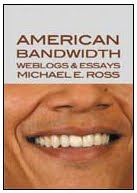
America from 2004 to 2009 –its new ironies and old habits, its capacity for change and transition – is topic A in this collection of essays and blog posts on pop culture, the war in Iraq, Hurricane Katrina, a transformative presidential election and the first 100 days of the Obama administration. | Now available at Authorhouse
One nation subject to change: A collection of topical essays exploring television, hip-hop, patriotism, the use of language under Bush II, and the author's own reckoning with mortality. | Available at Authorhouse
A veteran journalist, producer and blogger, Michael Eric Ross contributes to Medium, and the content channels of Creatd Media. He writes from Los Angeles on the arts, politics, race and ethnicity, and pop culture. A graduate of the University of Colorado, he's worked as a reporter, editor and critic at several newspapers and websites, including The New York Times, the San Francisco Chronicle, the San Jose Mercury News, MSN, Current, msnbc.com, and TheWrap, a major online source of entertainment trade news. He was formerly an adjunct professor at the Columbia University Graduate School of Journalism. His writing has appeared in The New York Times Book Review, Wired, Entertainment Weekly, PopMatters, Salon, The Root, seattlepi.com, NPR.com, theGrio, BuzzFeed, Daily Kos, and other publications. Author of the novel Flagpole Days (2003); and essay collections Interesting Times (2004) and American Bandwidth (2009), he contributed to the anthologies MultiAmerica (edited by Ishmael Reed, 1997) and Soul Food (2000).

.jpg)
.jpg)
.jpg)


.jpg)
.jpg)
.jpg)
.jpg)